
Social Silos: Why Diversity Actually Makes Us Move Communication into Private Groups
The Effects of Network Diversity and Social Norms on Social Structuring: Empirical Evidence from Online Social Networks
This study investigates "social structuring behavior"—the use of groups and lists in Online Social Networks (OSNs)—as a strategic response to the restrictive social norms caused by network diversity. Using a matched Facebook dataset (N=34 focal networks), the researchers demonstrate that increased social embeddedness diversity significantly drives users to create semi-private sub-networks to maintain behavioral fit.
TL;DR
Is your Facebook feed feeling too "crowded" to post anything personal? A study from the University of Mannheim reveals that as our online social circles become more diverse—specifically in how "embedded" our friends are—we instinctively turn to grouping and lists. This "social structuring behavior" is a defense mechanism against an overwhelming wall of social norms that grow more restrictive as different worlds collide.
Background Positioning
While most OSN research focuses on why we connect (affiliation), this study looks at how we manage the resulting mess. It positions itself at the intersection of Social Norm Theory and Diversity Typology, shifting the focus from the quantity of friends to the diversity of their social expectations.
The Problem: The "Additivity of Norms"
In the offline world, you don't talk to your grandmother the same way you talk to your college roommates. In OSNs, these audiences often collapse into one. The authors argue that social norms are additive. Adding a coworker doesn't remove the norms of your family; it adds a new layer of "what is acceptable."
This leads to a dilemma:
- Self-Expression: You want to share information or "like" pages.
- Norm Breaching: You fear social sanctions if a certain part of your network finds your post inappropriate.
The result? Informational Impoverishment. Users stop sharing because the "safe" middle ground is too narrow.
Methodology: Mapping Diversity
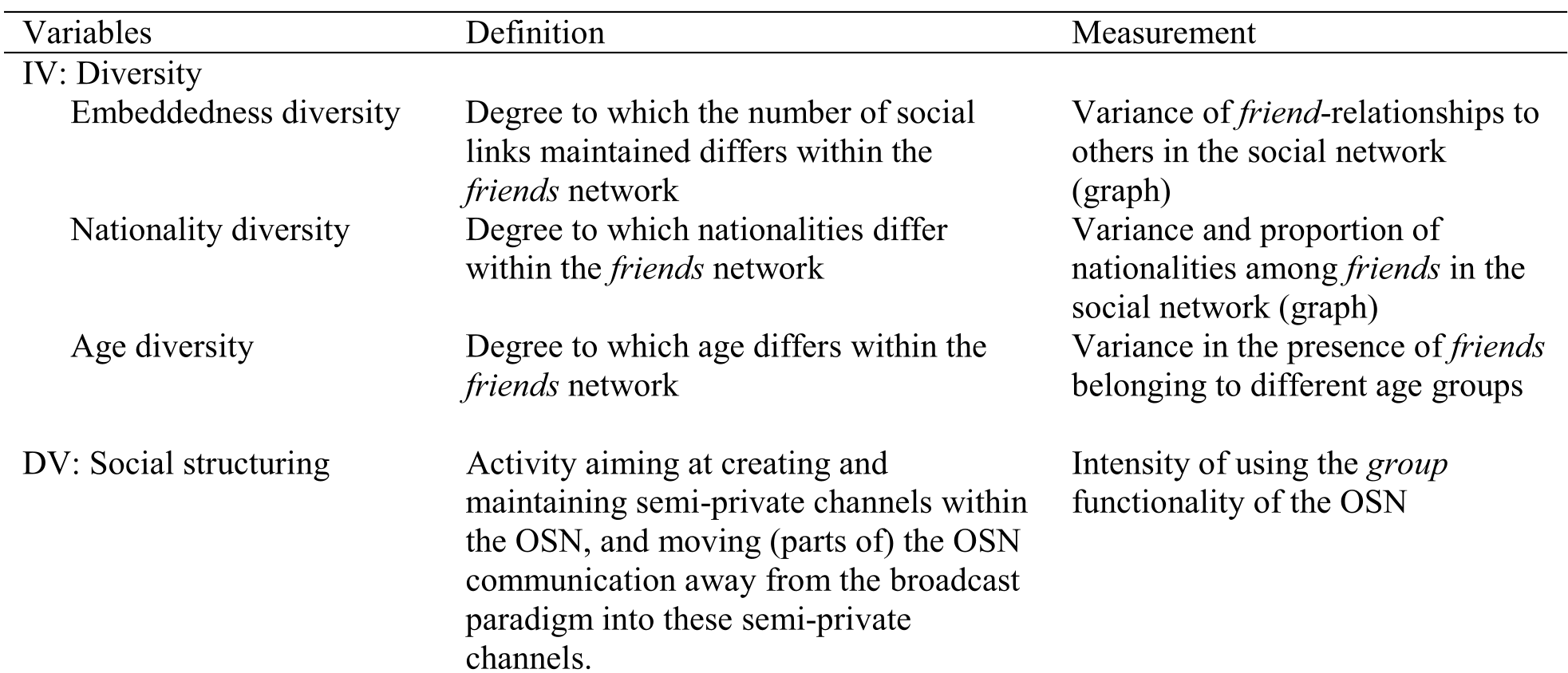
The researchers used a unique method: linking survey-based personality data with actual Facebook data from participants. They categorized diversity into three buckets based on Harrison and Klein’s typology:
- Age Diversity (Separation): Do your friends span multiple generations?
- Social Embeddedness Diversity (Separation): Is there a mix of "super-connectors" and "isolated nodes" in your circle?
- Nationality Diversity (Variety): Do your friends come from different cultural backgrounds?
Measuring Social Structuring
The Dependent Variable (DV) was the frequency of group membership—both joining and founding groups—as these represent "semi-private channels" that bypass the general broadcast paradigm.
Deep Insight: Why Embeddedness Matters Most
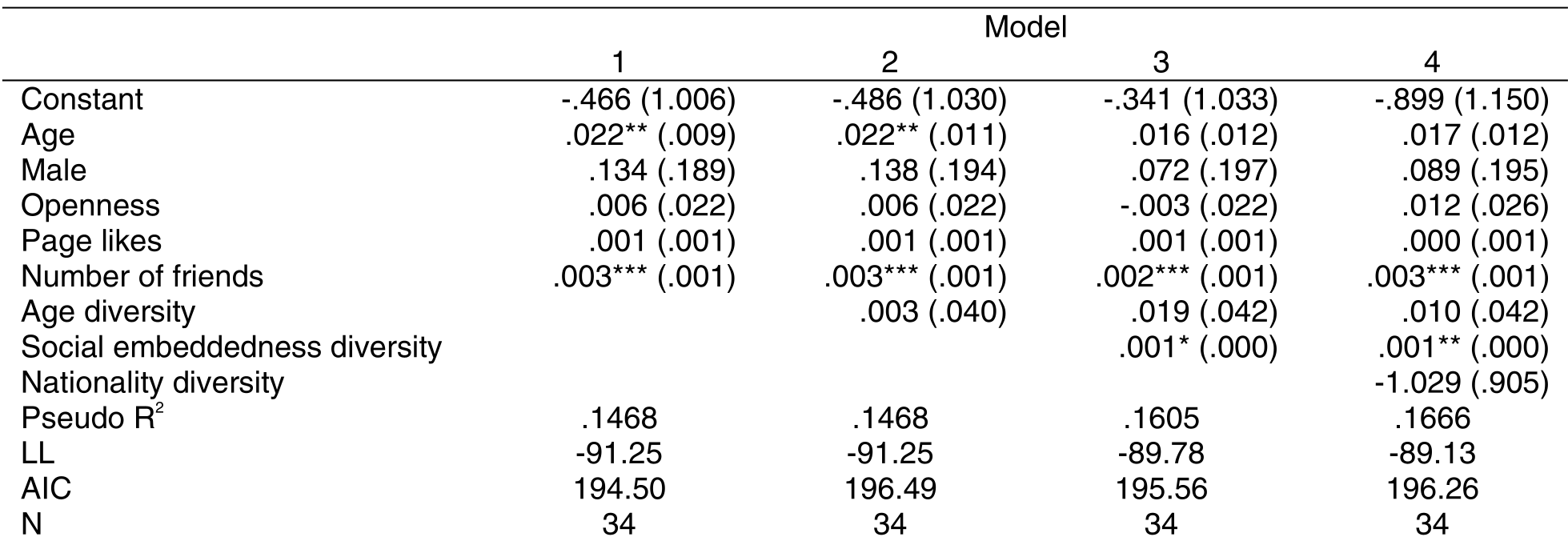
The results (shown in the table below) were selective. While age and nationality didn't trigger grouping behavior as strongly as expected, Social Embeddedness Diversity was a significant driver.
Why the result?
- Social Embeddedness reflects how "deeply" someone is woven into the network. If your network has high embeddedness diversity, you are dealing with people who have vastly different amounts of social capital and information access.
- This creates a highly unpredictable "rule system." To navigate this, users create groups to "play it safe," ensuring their message only reaches a contextually relevant audience.
- The Age Surprise: The study suggests that in OSNs, "technology affinity" might bridge the gap between ages, making generational norms less distinct than they are in the physical world.
Critical Analysis & Conclusion
Takeaway
The core contribution here is the realization that diversity creates friction. While diversity is often hailed as a benefit for information reach, the social cost of that diversity (sanctions for breaking norms) actually forces users into silos.
Limitations
The study focused on a US-centric Facebook population. In the modern era of 2026, where platforms like TikTok (algorithmic) and Discord (group-first) dominate, the "broadcast" norm of the mid-2010s Facebook has already shifted. Furthermore, the "Nationality" variable was a simple US/Non-US binary, likely missing the nuances of internal cultural diversity.
Future Outlook
For marketers, this is a wake-up call: "Viral" content is becoming harder because users are retreating into private groups. The future of digital engagement isn't in the "Public Square" but in the "Private Room," where social norms are predictable and the risk of a "faux pas" is low.