
When Reality Knocks: How Your Virtual Identity Reshapes Your Real Life
When your Second Life comes knocking: Effects of personality on changes to real life from virtual world experiences q
This study investigates how Big Five personality traits influence real-life behavioral and psychological changes resulting from participation in the "Second Life" virtual world. Utilizing Structural Equation Modeling (SEM) on a survey sample (N=223), it identifies how emotional involvement, avatar identification, and user-avatar similarity act as critical mediators between innate personality and offline impact.
TL;DR
Is your digital double changing who you are? A deep-dive study into Second Life users reveals that our personality traits—like Extraversion and Conscientiousness—determine whether virtual experiences "leak" into our real lives. The secret isn't how long you spend online, but how emotionally involved you become with the environment and how much you behave like your avatar.
The Boundary Problem: Why Do Virtual Worlds Matter?
For decades, we’ve treated "online" and "offline" as distinct silos. However, as virtual social media grows more sophisticated, the distinction is blurring. Why do some people experience profound personal growth or social shifts after a session in a virtual world, while others remain completely unaffected?
The authors of this study argue that the missing link is Personality. Using Trait Activation Theory, they suggest that virtual worlds act as specialized "cues" that bring certain traits to the surface, which then dictates how deeply the virtual world integrates into one's psyche.
Methodology: Mapping the Psychological Bridge
The researchers surveyed 223 Second Life veterans, measuring their Big Five traits and their "Virtual World Experience" across three dimensions:
- Relationship to the Environment: Feelings of presence, absorption, and emotional attachment.
- Identification with the Avatar: The "closeness" and bond felt toward their digital self.
- User-Avatar Similarity: How much the avatar’s physical and behavioral traits mirror the user.
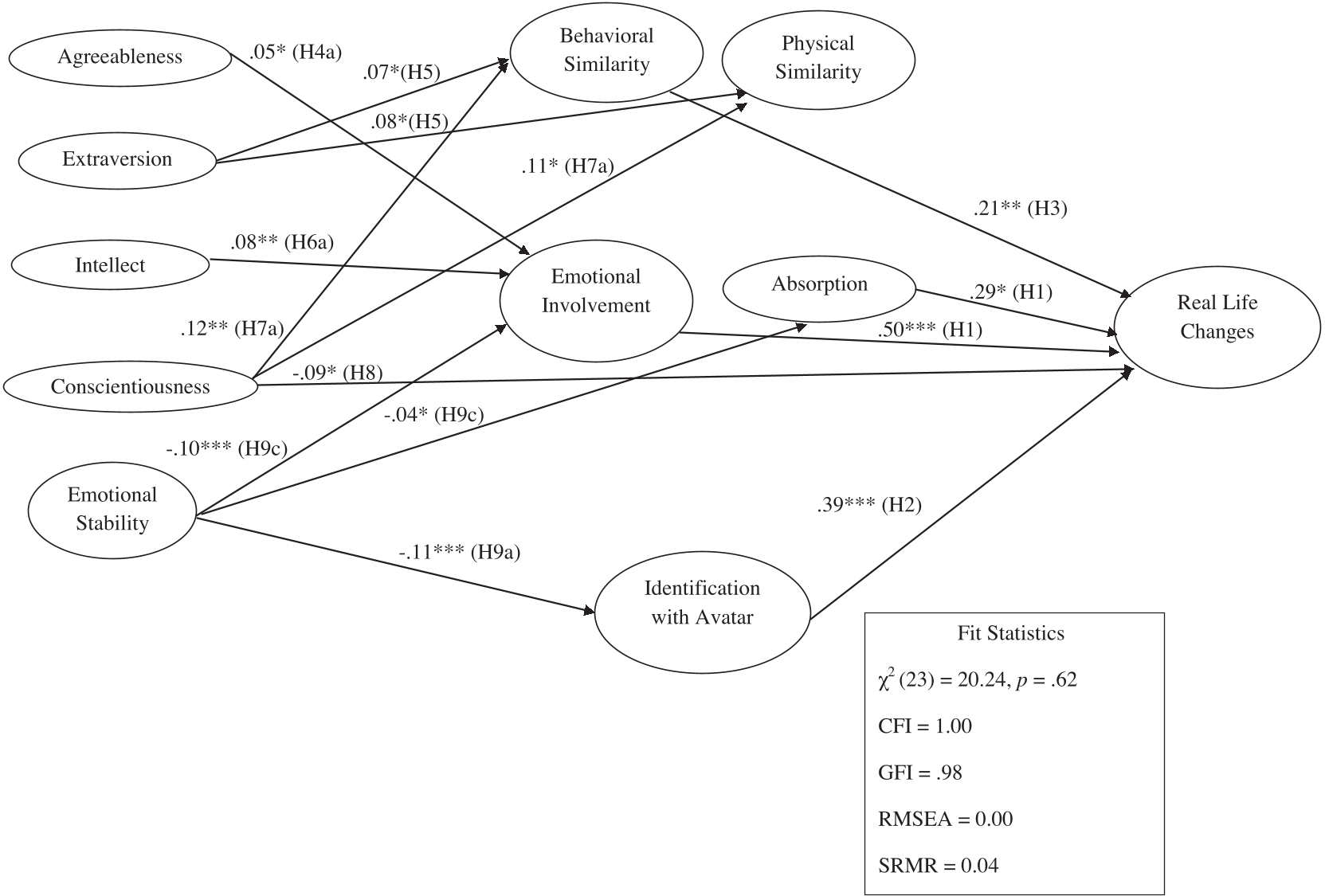
Key Findings: The Mediators of Change
The study’s Structural Equation Model (SEM) revealed several fascinating pathways:
1. The Power of Emotional Involvement
Contrary to popular belief, Absorption (losing track of time) does not significantly change your real life. Instead, Emotional Involvement—the traces of anger, joy, or attachment that linger after you log off—is the single strongest driver of offline change.
2. Conscientiousness as a Shield
One of the most striking findings is that Conscientiousness has a direct negative effect on real-life changes. Highly organized, reliable individuals tend to maintain a "psychological distance." They use their avatars to build trust through similarity, but they actively prevent virtual drama from disrupting their real-world responsibilities.
3. Extraversion and "The Social Mirror"
Extraverts tend to create avatars that are behaviorally similar to themselves. Because virtual worlds are inherently social, they "activate" an extravert’s sociability, making the avatar an authentic extension of their existing personality.
(Note: Refer to Table 1 in the study for the specific behavioral indicators used to measure these shifts.)
Critical Analysis: Why This Matters for the Future
The merit of this research lies in its departure from simple "time-spent" metrics. It proves that the quality of the psychological experience—the "internal signaling"—is what facilitates behavioral spillover.
Limitations to Consider:
- Self-Selection: The study used voluntary Second Life users who likely have a higher-than-average predisposition for virtual immersion.
- Linearity: The model assumes personality flows to real-life change, but long-term virtual engagement might eventually alter the fundamental personality traits themselves (a feedback loop).
Conclusion: A Second Life, A Shared Reality
This research confirms that virtual worlds are more than mere games; they are cognitive laboratories. Your "Second Life" is not a separate existence but a filtered version of your first, mediated by your personality. Whether it enriches your "real" self or remains a distant fantasy depends entirely on your psychological makeup.
As we move toward a more "Metaverse"-centric society, understanding these trait activations will be crucial for designing environments that promote positive therapeutic or educational outcomes while respecting the boundaries of the Material Self.