
Beyond Centrality: Why "Social Characters" Are the Secret Sauce of Viral Propagation
Effects of Social Characters in Viral Propagation Seeding Strategies in Online Social Networks
This paper proposes a social-character-enhanced seeding strategy for viral propagation in Online Social Networks (OSNs), moving beyond traditional graph-based metrics. It introduces a multi-layered trust model—integrating network topology, interaction frequency, and node similarity (homophily)—to identify influential seeds, achieving superior propagation speed and reach compared to standard centrality measures.
TL;DR
Is being "well-connected" enough to start a viral trend? This paper argues no. While traditional network science obsesses over high-degree nodes (the "popular kids"), this research introduces a multi-layered trust model that integrates user behavior and personal similarity. By selecting seeds based on Social Characters rather than just Graph Position, the authors achieved significantly higher reach and faster propagation in real-world social traces.
Background: The Human Factor in OSN Security
Online Social Networks (OSNs) have transformed from simple aggregation points into targets for sophisticated attacks—from identity theft to "mutated worms" like Ramnit. Unlike classic network attacks, OSN exploits rely on consent: a user must choose to click, share, or trust.
The authors argue that existing security and marketing models fail because they ignore the physical intuition of human interaction. They propose that propagation is a function of Trust, which is a composite of how often we talk (Interaction) and how much we have in common (Homophily).
Methodology: The Four-Layer Trust Framework
The paper deconstructs a social network into four distinct layers to calculate the true "Activation Probability" between users:
- The Network Graph: The raw topology (Who is friends with whom).
- The Interaction Graph: Weighted by the frequency of communication.
- The Character Graph: Focused on Homophily. Using Shannon Entropy, the authors weight profile attributes (age, language, interests) to see how "similar" two nodes are.
- The Trust Graph: The culmination of the above, providing a mathematical probability () that a source will successfully infect a destination.
 Figure: The formulaic approach to integrating PageRank with interaction frequency to refine node importance.
Experiments: Social vs. Topological Seeds
Using the Infocom06 dataset (Bluetooth encounter traces supplemented with user surveys), the researchers compared "Top Social Nodes" against "Network Centrality" heavyweights like Betweenness and Closeness Centrality.
Key Findings:
- The "Short Run" Advantage: Social-character-based seeds showed explosive growth in the 2nd and 3rd hops. This is critical for viral campaigns that need to gain momentum before "saturation" or "intervention" occurs.
- Quantitative Dominance: The "Trust" nodes consistently infected more users. In a 6-step simulation, the social strategy reached 38 nodes, whereas the best PageRank-based strategy capped at 30 nodes.
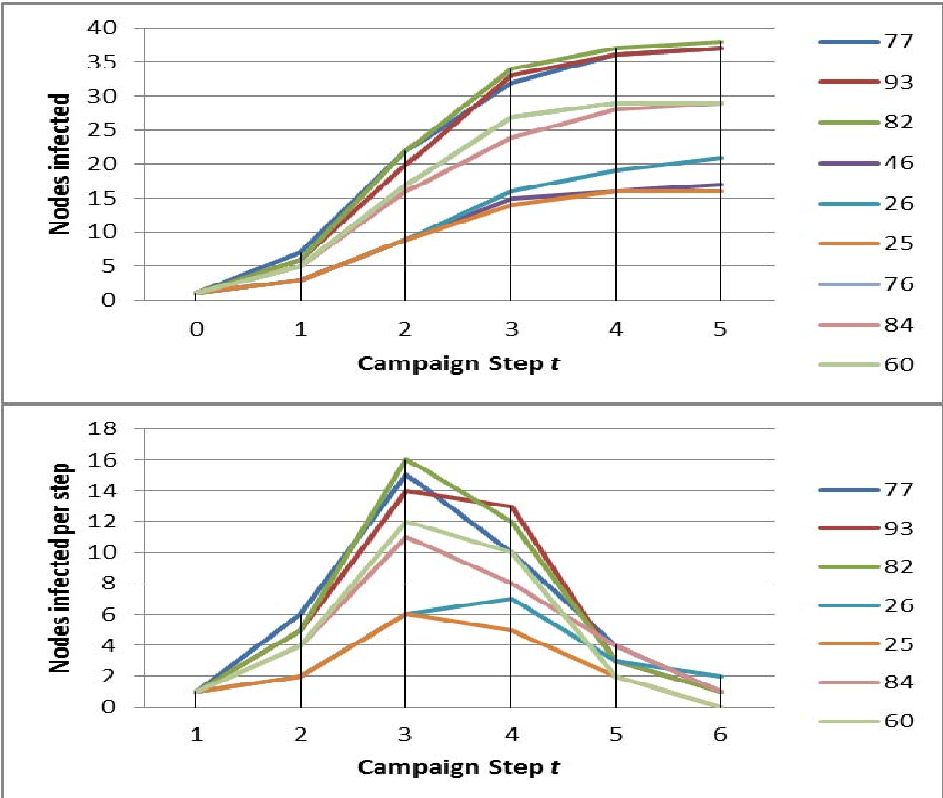 Figure: Comparison of propagation speed—social-character strategies (Nodes 77, 93, 82) clearly outpace traditional centrality measures.
Critical Insight: Why Does This Work?
The physical intuition here is Homophily ("Birds of a feather flock together"). You are more likely to click a link shared by a friend who shares your passion for soccer than a "popular" acquaintance with whom you have nothing in common. By quantifying this "affinity" through entropy-weighted similarity, the authors move from potential influence to actual influence.
Conclusion & Perspectives
The paper successfully demonstrates that "Trust" is the engine of viral growth. For researchers, this means that future IM (Influence Maximization) algorithms must be context-aware.
Limitations: The study uses the Infocom06 dataset (98 nodes), which is relatively small by modern standards. How these social character weights scale to billion-node graphs remains an open question. However, the move toward Character Profiling serves as a vital blueprint for both better marketing and more robust defense against social engineering.
Future Work: The authors suggest creating "Character Stamps"—a form of behavioral signature—to detect malicious activity and improve online security.