
SkylineTF: Optimizing Social Crowdsourcing through Structural Intelligence
An efficient algorithm for crowdsourcing workflow tasks to social networks
The paper introduces SkylineTF, an efficient algorithm for crowdsourcing complex workflow tasks to social networks by identifying an optimal group of experts. It utilizes a novel "Connector-Betweenness" centrality to select team leaders and a reference-point-based Skyline query to find collaborative partners, achieving SOTA performance in balancing personnel costs and interaction efficiency.
TL;DR
Building an expert team is more than just matching skills; it's about minimizing the "tax" of human interaction and labor costs. This paper presents SkylineTF, a framework that uses graph theory and Skyline queries to efficiently assemble collaborative teams from social networks, significantly outperforming existing bi-objective optimization methods in both speed and cost-effectiveness.
Problem & Motivation: The Collaborative Overhead
In cross-organizational business processes, tasks are often outsourced to social networks. However, two major hurdles persist:
- The Interaction Tax: Even the best experts fail if they cannot communicate effectively. High communication costs lead to project delays.
- The Search Explosion: In a network with thousands of candidates, finding the perfect balance between a leader's influence and the team's total salary (labor cost) is a combinatorial nightmare (NP-hard).
Prior works like BioTF attempted to solve this using weighted summations, but they often struggle with normalization and scale. The authors of this paper noticed a key structural intuition: effective collaboration usually flows through specific "connector" nodes that bridge different functional expertise areas.
Methodology: Pruning the Search Space
1. Identifying the "Right" Leader (ConnBC)
Instead of calculating the importance (Betweenness Centrality) of every single node in the social graph, the authors focus on Connector Nodes. These are nodes that sit on the boundaries of functional subgraphs (e.g., the person who links the "Machine Learning" group to the "Database" group).
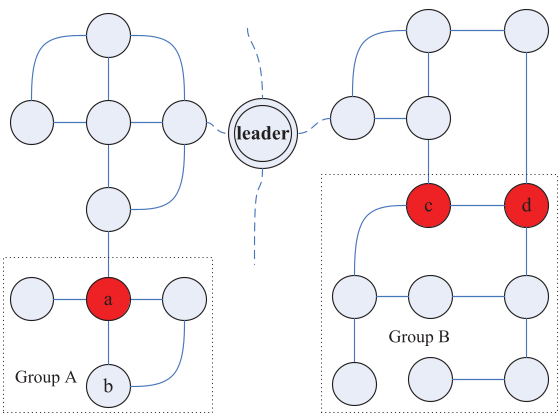 Fig 1. Identifying functional subgraphs and the connectors that link them.
By focusing on these connectors, the ConnBC algorithm identifies leader candidates who are structurally positioned to coordinate cross-functional tasks with minimal distance to all necessary skills.
2. The Skyline Filter
To handle the labor-vs-distance trade-off, the paper employs Skyline Queries. An expert is in the "Skyline" if no other expert is both cheaper and closer to the leader. By pruning "dominated" candidates (those who are both more expensive and further away), the search space for team members shrinks from hundreds to just a handful of optimal contenders.
Experiments & Results: Efficiency at Scale
The researchers validated their model using the DBLP dataset, a massive co-authorship network.
Communication vs. Budget
The experiments proved a clear Pareto frontier: as you increase the budget, you can "buy" better communication (shorter distances). SkylineTF proved more sensitive and efficient at navigating this trade-off than the BioTF baseline.
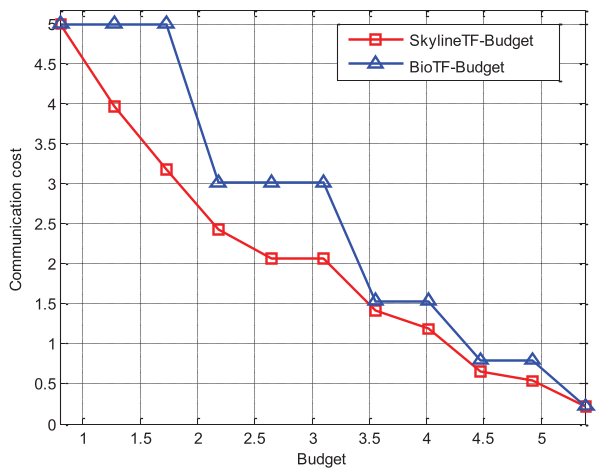 Fig 2. How total team communication cost decreases as the personnel budget increases.
Computational Speedup
The most striking result was the runtime performance. As the number of expert candidates increases, traditional algorithms like Brute-Force see exponential growth in latency. SkylineTF remains nearly linear, making it suitable for real-time workflow engines.
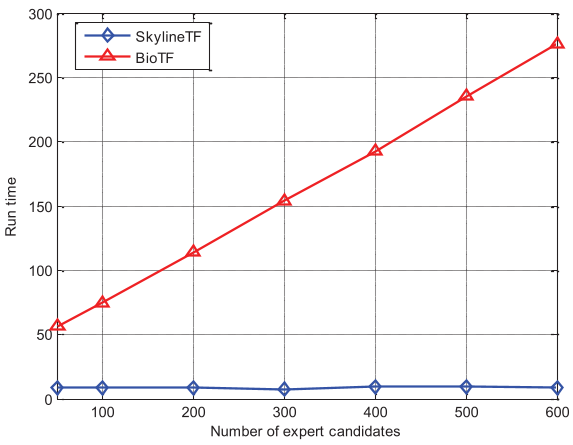 Fig 3. Runtime comparison showing SkylineTF's scalability compared to BioTF.
Critical Analysis & Conclusion
The Takeaway: SkylineTF effectively shifts the heavy lifting of team discovery from "search" to "pruning." By using structural connectors as reference points, it achieves a 1+1>2 effect in team formation.
Limitations:
- The model assumes interaction costs are static based on past co-authorship. In reality, human fatigue or current workload might change these costs dynamically.
- It relies heavily on a well-defined social graph, which might be sparse in newer industries.
Future Outlook: Integrating this approach with Generative AI could allow for automated task breakdown where the AI not only identifies what needs to be done but who should do it based on real-time social dynamics.