
Scaling Influence: Efficient Heuristics for Partial Dominating Sets in Social Networks
Efficient approximation algorithms to determine minimum partial dominating sets in social networks
This paper investigates efficient approximation algorithms for finding Minimum Partial Dominating Sets (MPDS) in large-scale social networks. It adapts five existing greedy and degree-based algorithms to handle partial coverage constraints (p%) and conducts extensive benchmarking across 10 real-world SNAP datasets, as well as synthetic Power-law and Erdos-Renyi networks.
TL;DR
In the world of social network analysis, finding the smallest group of people to "cover" a network is a classic NP-complete challenge. This paper argues that 100% coverage is often unnecessary. By shifting the goal to Partial Dominating Sets (PDS)—reaching only a fraction p% of the network—and employing optimized hybrid heuristics (Algs 4 & 5), we can achieve high-quality results at a fraction of the computational cost compared to traditional greedy methods.
Context: Why "Partial" is Better
In marketing or information dissemination, the cost of reaching the last 5-10% of a population often outweighs the benefit. This is the motivation behind the Minimum Partial Dominating Set (MPDS) problem. While the Minimum Dominating Set (MDS) focuses on total coverage, MPDS introduces a coverage parameter p, allowing for more flexible and realistic resource allocation.
The Problem: The Greedy Bottleneck
The standard approach to dominance is the "Greedy Algorithm" (Alg 1 in the paper), which repeatedly picks the node that covers the most currently uncovered nodes.
- The Pain Point: Updating the "span" (the count of uncovered neighbors) for every node after each selection is computationally expensive ( in worst-case scenarios).
- The Reality: In networks with millions of nodes, this becomes a bottleneck that prevents real-time analysis.
Methodology: Five Flavors of Dominance
The authors adapt and compare five algorithms, ranging from high-precision greedy updates to fast, static degree-based sorting.
The Core Algorithms
- Alg 1 (Standard Greedy): High quality, slow speed.
- Alg 3 (Fast Reduction): Removes nodes and their neighbors immediately from the graph to shrink the problem space rapidly.
- Alg 4 (The Hybrid): Combines the logic of degree-1 node neighbors with the fast reduction of Alg 3.
- Alg 5 (Static Degree Ranking): Simply sorts nodes by degree and picks the top until coverage is met.
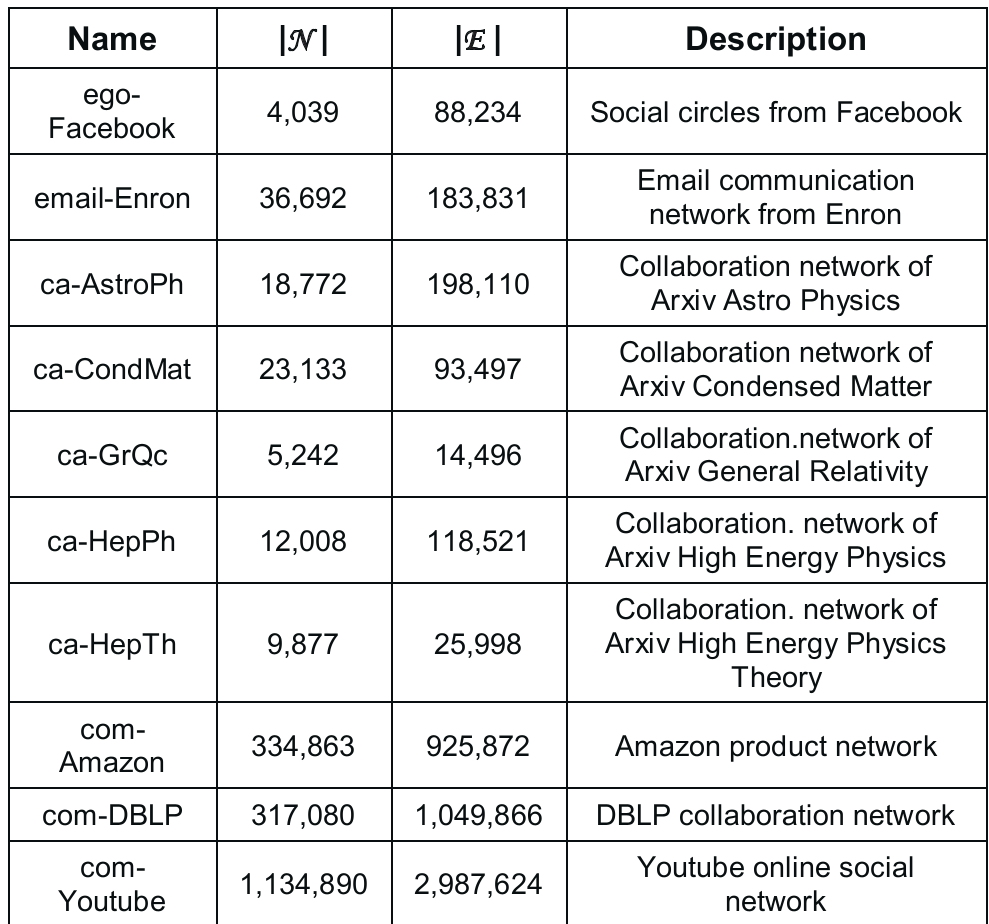 The study utilized a diverse array of SNAP datasets, ranging from small collaboration networks to the massive YouTube social network with over 1M nodes.
Experimental Insights: Quality vs. Speed
The study reveals a crucial trade-off. For small percentages of coverage (e.g., p = 10%), almost all algorithms perform similarly because they all pick the obvious "hubs" (high-degree nodes).
Key Findings
- Complexity Matters: For large datasets like YouTube, Alg 1 and Alg 2 fail the efficiency test, especially as the coverage requirement p increases.
- The "p" Pivot: When p < 90%, Alg 1 provides the smallest sets, but for p = 100% (Complete Dominance), Alg 4 and 5 actually produce smaller sets on many large-scale topologies. This suggests that the standard greedy approach can get trapped in local optima in specific graph structures.
- Topological Sensitivity: In Power-law networks (ConfNetworks), the choice of algorithm is less critical for quality but vital for speed.
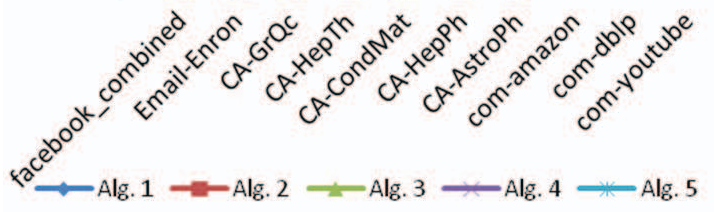 Performance of algorithms on various real-world datasets at p = 100% coverage.
Critical Analysis & Conclusion
This work provides a pragmatic roadmap for network scientists. It debunked the myth that the most expensive greedy algorithm is always the best for dominance.
Takeaways:
- Use Alg 4 or 5 if you are dealing with massive graphs where time is a constraint. They offer a "sweet spot" of near-optimal set size and high throughput.
- Use Alg 1 only if the network is small and you absolutely require the smallest possible set size for low-coverage tasks.
Limitations: The study focuses on static graphs. In the real world, social networks are dynamic. Future work should explore how these partial dominating sets evolve as edges are added or deleted in real-time.
Summary Table of Recommendations
| Requirement | Best Algorithm | Reason |
|---|---|---|
| Maximum Speed | Alg 5 | No graph updates needed, purely degree-based. |
| Quality (Smallest Set) | Alg 1 / Alg 2 | Best for p < 90% on small datasets. |
| Robustness (Large Scale) | Alg 4 | Balanced reduction and handling of degree-1 nodes. |
Editor's Note: This paper is a significant benchmark for practitioners who need to implement influence strategies on a budget. It bridges the gap between theoretical graph theory and large-scale social network engineering.