
Efficient Bi-objective Team Formation: Balancing Dollars and Dialogue in Social Networks
Efficient Bi-objective Team Formation in Social Networks
The paper introduces a bi-objective optimization framework for forming expert teams in social networks, balancing personnel costs with communication efficiency. It proposes a linear combined cost function and provides a 2-approximation algorithm along with three heuristics (Replace, MCC, MCC-Rare) to achieve SOTA performance in scalability and cost-efficiency.
TL;DR
Forming a dream team isn't just about who knows what; it's about how much they cost and how well they talk to each other. This paper presents a mathematically rigorous yet practical framework to solve the NP-hard problem of picking experts from a social network by minimizing both Personnel Cost and Communication Cost. The authors introduce a 2-approximation algorithm and a highly effective heuristic called MCC that mirrors human intuition in recruitment.
Background & Positioning
In the era of LinkedIn and GitHub, the "Social Network" is the primary database for talent. While previous SOTA methods (like those by Lappas et al.) focused heavily on the Communication Cost (the shortest path between experts), they ignored the reality of budgets. This paper acts as a bridge between Operational Research (Personnel Costs) and Graph Theory (Network Dynamics), positioning itself as a comprehensive solution for real-world project management.
The Core Challenge: Why is this hard?
The problem is a constrained bi-criteria optimization. You need to cover a set of skills . If you only minimize personnel cost, you get a "cheap" team that can't communicate. If you only minimize communication, you get a "cohesive" team that breaks the bank. Combining these into a single objective () makes the problem NP-hard, as it is a variation of the Steiner Tree problem but with added node weights and skill constraints.
Methodology: The "Node-to-Edge" Transformation
The most elegant contribution of this paper is how it handles the 2-approximation.
1. The Approximation Trick
The authors transform the original graph into where node weights are absorbed into edge weights . The transformation formula is: By proving that satisfies the triangle inequality, they unlock the ability to use distance-based approximation algorithms that provide a guaranteed performance bound within 2x of the optimal.
2. The MCC (Minimal Cost Contribution) Heuristic
The MCC algorithm treats team formation like an incremental draft. It starts with a seed expert and adds the next member based on: This ensures that each new expert added doesn't just look good individually but fits well with everyone already in the room.
 The combined cost function balancing P.C. and S.D. with the trade-off parameter λ.
Experiments and Results
The authors tested their methods on DBLP (Computer Science co-authorship) and IMDb (Actor collaborations) datasets.
- Near-Optimal Performance: The MCC algorithm achieved a cost within 0.3% of the exhaustive Exact search.
- Scalability: While the Exact algorithm failed to terminate for projects requiring more than 6 skills, MCC and Approx processed 10-skill projects in milliseconds.
- The Rareness Insight: The "MCC-Rare" variant, which starts the team from the expert with the rarest required skill, proved to be an excellent balance of speed and quality.
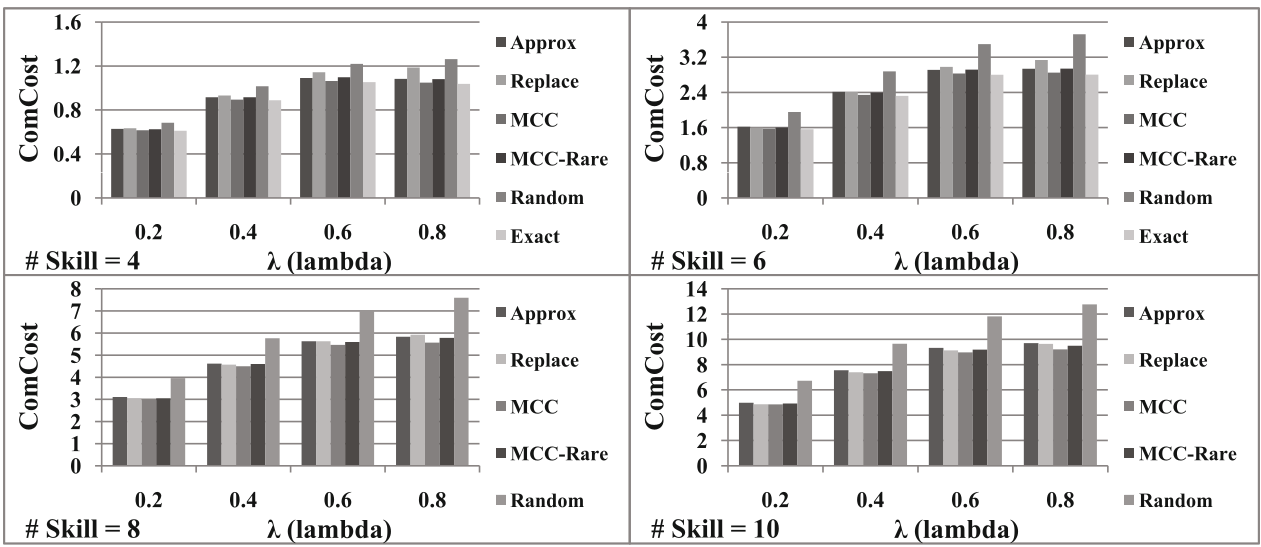 Comparative performance across different skill counts. Note how MCC (Red) consistently hugs the bottom (lower cost).
Critical Insight & Future Outlook
The beauty of this work lies in the parameter analysis. It allows project managers to "tune" the team:
- High : Prioritizes team synergy (low communication overhead).
- Low : Prioritizes budget (cheap experts).
Limitations: The model assumes that communication cost is static. In reality, experts learn to work together over time. A future expansion could involve "Temporal Social Networks" where communication costs decrease as the project progresses.
Conclusion: This paper provides the mathematical "glue" needed to build automated team-building tools. Whether you're assembling a software dev team or casting a movie, the MCC-Rare algorithm offers a robust, scalable, and theoretically sound starting point.