
CrowdBudget: Optimizing the ROI of Human Intelligence in Crowdsourcing
Efficient budget allocation with accuracy guarantees for crowdsourcing classification tasks
The paper introduces CrowdBudget, an agent-based budget allocation algorithm for crowdsourcing binary classification tasks. It optimizes the distribution of a finite budget across tasks with heterogeneous costs to minimize total estimation error, achieving a theoretical error bound of which outperforms previous asymptotic states.
TL;DR
Crowdsourcing is often a game of redundancy—asking multiple people the same question to find the truth. But when tasks have different costs and your budget is finite, how many people should you ask for each? CrowdBudget provides a mathematically rigorous answer, moving beyond simple heuristics to offer an algorithm that reduces error by up to 40% while providing the first practical theoretical guarantees for finite task sets.
The "Cost of Truth" Problem
In systems like Amazon Mechanical Turk or Galaxy Zoo, not all tasks are created equal. Identifying a rare species in a blurry photo is harder and often more expensive than identifying a cat in a clear one.
Current state-of-the-art methods typically ignore this heterogeneity, either:
- Uniformly distributing the budget, which wastes money on easy tasks and under-invests in hard ones.
- Relying on asymptotic bounds, which only work if you have an "infinite" number of tasks—a luxury real-world project leads rarely have.
The core challenge is the Cost-Accuracy Trade-off: How do we minimize the expected total estimation error subject to ?
Methodology: The Square-Root Intuition
The authors propose CrowdBudget, which operates on a simple but powerful insight derived from concentration inequalities. By applying the Hoeffding-Azuma inequality, the authors show that the error for a single task decreases exponentially with the number of workers .
The optimal allocation strategy derived in the paper suggests that the number of workers assigned to task should be proportional to:
The Two-Phase Algorithm:
- Initial Phase: Pre-set assignments based on the derived optimal fractional solution, adjusted for integer constraints.
- Residual Phase: Use any remaining "spare change" in the budget to incrementally boost assignments, ensuring no penny is wasted.
- Fusion Phase: Collect labels and use an MV-Efficient method (like Majority Voting or IBCC) to determine the final answer.
 Figure 1: Conceptual overview of redundant task allocation under budget constraints.
Proving Efficiency: Beyond Asymptotics
One of the paper's strongest contributions is Theorem 2, which provides a PAC (Probably Approximately Correct) bound. Unlike previous work by Karger et al., which requires the number of tasks to approach infinity, CrowdBudget’s bounds hold for any finite .
The authors demonstrate that with high probability, the error is bounded by:
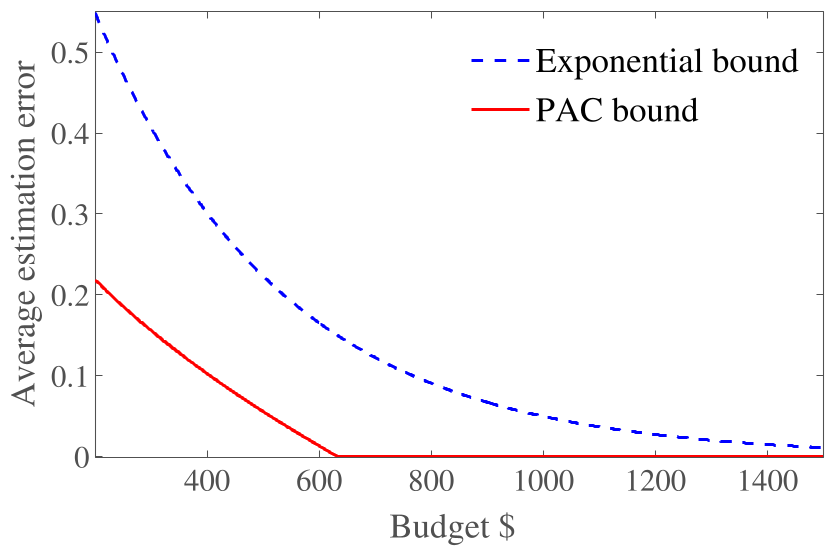 Figure 2: The PAC bound (blue) compared to the Exponential bound (red), showing that CrowdBudget reaches zero error at much lower budget levels than previously thought.
Experimental Validation: Galaxy Zoo
The authors tested CrowdBudget using real-world data from Galaxy Zoo, where volunteers classify galaxy shapes. Even though these volunteers aren't paid, the authors modeled "costs" based on task difficulty.
Key Results:
- 40% Improvement: CrowdBudget significantly outperformed "Uniform" allocation when budgets were tight.
- Robustness: As the budget increases, the gap closes—but in the most critical "limited resource" scenarios, CrowdBudget is the clear winner.
- Synthetic Stress Test: In cases of extreme difficulty (highly noisy labels), CrowdBudget maintains a lower error floor compared to random strategies.
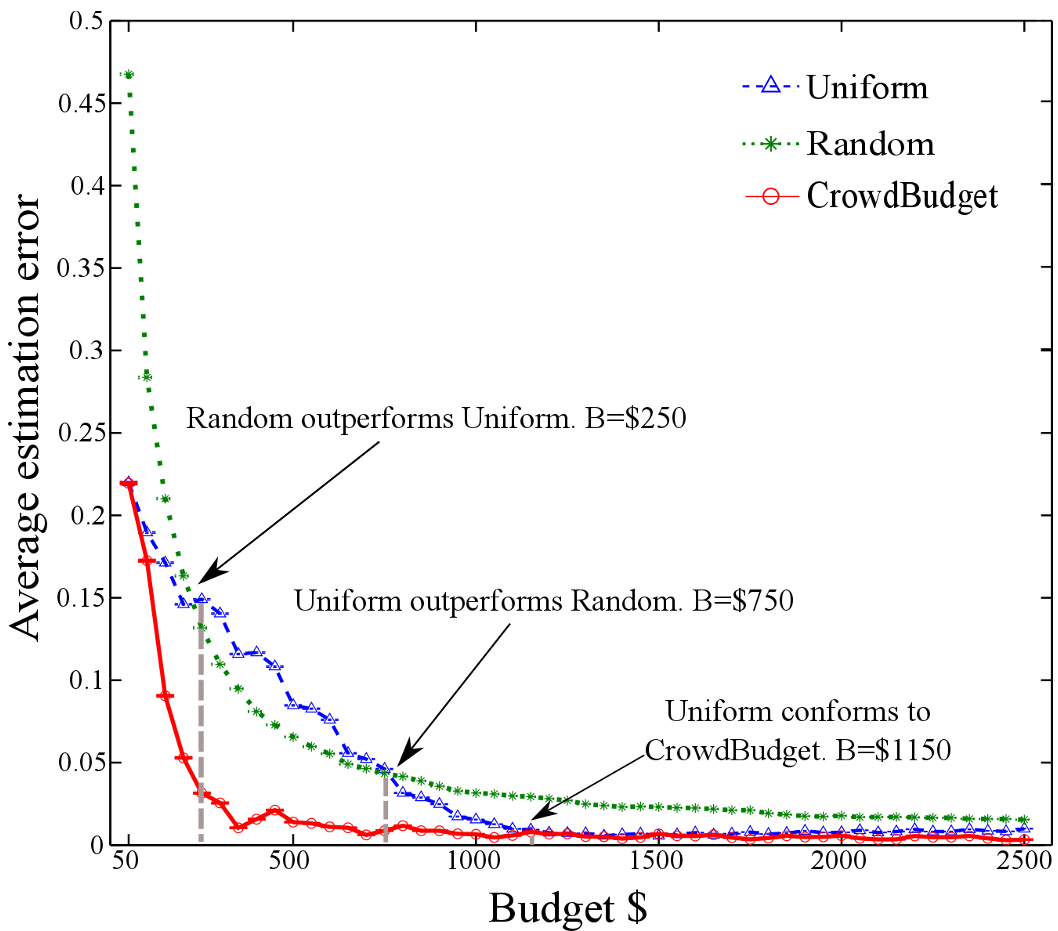 Figure 3: Performance comparison on the Galaxy Zoo dataset. CrowdBudget (solid line) maintains the lowest error across a wide range of budgets.
Critical Insight & Conclusion
The brilliance of CrowdBudget lies in its simplicity. It doesn't require complex online learning or real-time adjustment; it uses the physics of probability (concentration bounds) to determine the best allocation in advance.
Limitations: The current model assumes tasks are binary (Yes/No). In the real world, many tasks are multi-class or require structured output (like translation). Furthermore, the algorithm assumes the "cost" of a task is known beforehand.
Future Outlook: This work sets a gold standard for budget-aware crowdsourcing. Future iterations that incorporate Active Learning—where the agent learns the task difficulty on the fly—could potentially push the efficiency even further.