
PM(p) Algorithms: Maximizing Crowdsourcing Efficiency with Dynamic Worker Pools
Efficient Budget Allocation and Task Assignment in Crowdsourcing
The paper proposes a Markov Decision Process (MDP) framework and a class of "Power Mean" algorithms (PM(p)) to solve the budget allocation and task assignment problem in crowdsourcing. It specifically addresses binary labeling tasks under a dynamic worker pool, achieving performance near sequential allocation while significantly reducing completion time.
TL;DR
Requesters in crowdsourcing platforms (like AMT) face a constant trade-off: how to spend a limited budget to get the highest accuracy in the shortest time. This paper introduces the PM(p) algorithm, a Reinforcement Learning-based approach that manages a dynamic pool of workers. By framing budget allocation as a Markov Decision Process (MDP), the authors achieve the accuracy of careful sequential selection with the 10x speedup of parallel execution.
The Problem: The High Cost of "Slow and Steady"
Most academic models for crowdsourcing assume Sequential Allocation: you give one task to one worker, see the result, and then decide what to do next. While mathematically optimal for accuracy, it is a disaster for real-world latency. In a real marketplace, dozens of workers might be available simultaneously. If you only assign one task at a time, you waste worker availability and increase total completion time.
Conversely, naive parallel strategies like Equal Allocation (giving every task the same number of redundant labels) waste money on "easy" tasks that are already certain, leaving no budget for "hard" tasks that require more consensus.
Methodology: From Sequential Luck to Weighted Power Means
The authors treat the state of each task (instance ) as a Beta distribution . Every time a worker provides a label, the distribution updates. The goal is to maximize the overall accuracy across tasks given a total budget .
The Challenge of Parallelism
When multiple workers () are available, the "Action Space" becomes a combinatorial explosion—you have to choose a subset of tasks. To solve this, the authors propose the PM(p) Algorithm.
Instead of searching every possible combination, they calculate a "reward potential" for each individual task using the Weighted Power Mean of the rewards associated with different labels:
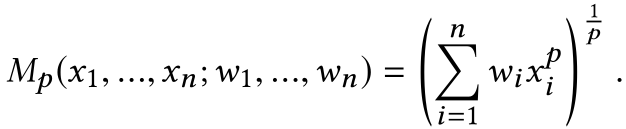
By ranking tasks according to this metric and picking the top tasks, the system can assign work to everyone currently available without losing the strategic focus on the most "difficult" or "uncertain" instances.
Experimental Battleground
The researchers tested their approach against common baselines:
- RAND: Random task assignment.
- EQ: Equal budget for every task.
- PM(p): Their proposed class of algorithms (Harmonic Mean, Geometric Mean, etc.).
Accuracy vs. Budget
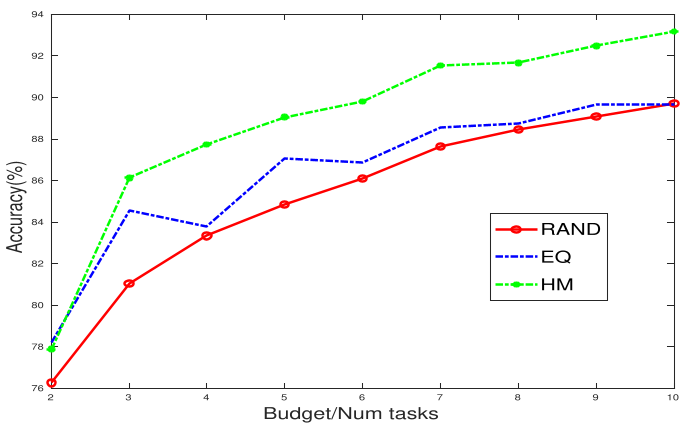
As shown in the results, PM(-1) (the Harmonic Mean version) consistently stays at the top of the accuracy curve, especially when the budget is tight (2I to 5I labels).
The Impact of "p"
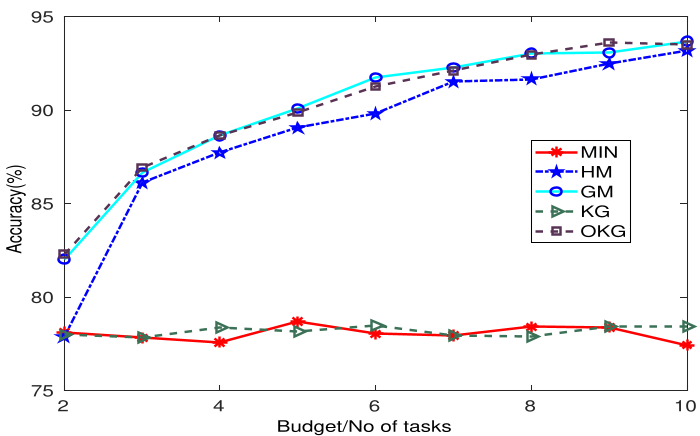
The choice of in the Power Mean matters. While (standard Knowledge Gradient) performed poorly in this parallel setting, the Harmonic Mean () and Geometric Mean () proved robust.
Handling Worker Diversity
The model doesn't just assume workers are "black boxes." It incorporates a reliability parameter for each worker. When a highly skilled worker arrives, the algorithm automatically adjusts the reward expectations, potentially assigning them the hardest tasks where their expertise provides the most "information gain."
Critical Analysis & Conclusion
Takeaway
The PM(p) framework successfully bridges the gap between theoretical MDP optimality and practical crowdsourcing constraints. It proves that you don't have to sacrifice speed for accuracy if you use a mathematically grounded ranking system for task assignment.
Limitations
- Prior Knowledge: The model assumes we have a way to estimate worker reliability () beforehand, which isn't always possible for new workers.
- Task Complexity: This study focuses on binary labeling. Complex tasks like translation or image segmentation would require a much more sophisticated reward definition than simple Beta-Bernoulli conjugacy.
Future Outlook
The next frontier is extending this to multi-class classification and finding the "theoretical why" behind why certain values (like the Harmonic Mean) outperform others in parallel settings.