
ScAN: Breaking the "Uniform Influence" Myth in Social Recommendation through Co-Attention
An efficient co-Aention Neural Network for Social Recommendation
This paper introduces ScAN, a Social co-Attention Neural network for recommendation tasks. It leverages a dual-attention mechanism and node2vec pre-training to dynamically model how a user's preference is influenced by their social circle relative to specific items, achieving SOTA performance on Ciao, Epinions, and Douban datasets.
TL;DR
The recommendation landscape has long relied on the "social homogeneity" assumption—that we like what our friends like. However, ScAN (co-Attention Neural Network for Social Recommendation) argues that friend influence is not a fixed constant. By combining deep neural networks with a dynamic co-attention mechanism, ScAN learns which friends to "listen to" based on the item in question, while using graph embeddings to capture the deep structural signals of social networks.
Problem & Motivation: The Heterogeneity Gap
Most prior works in social recommendation (like SocialMF or TrustSVD) treat social influence as a static variable. If you follow someone, their influence on your ranking is weighted the same whether you are buying a basketball or a philosophy book.
The authors identify two fatal limitations in current SOTA:
- Context-Insensitive Influence: Real-world trust is domain-specific. A friend who is a cinephile should have a higher weight for movie recommendations but zero weight for sports gear.
- Linear Interaction Models: Traditional Matrix Factorization (MF) only captures linear relationships. In reality, the interplay between a user's latent preference and their social circle is highly non-linear.
Methodology: The ScAN Architecture
ScAN bridges these gaps using a four-layer architecture: Input, Embedding, Pooling, and Prediction.
1. The Co-Attention Interactive Module
This is the "brain" of ScAN. Instead of a single embedding, the model generates:
- Latent Preference Vector (): The user's own historical tastes.
- Social Influence Vector (): A dynamic aggregation of friends' preferences.
The "Co-Attention" happens by calculating a correlation matrix between the user and their friends, then passing this through a Softmax layer conditioned on the Item Vector (). This ensures that the weights are context-aware.
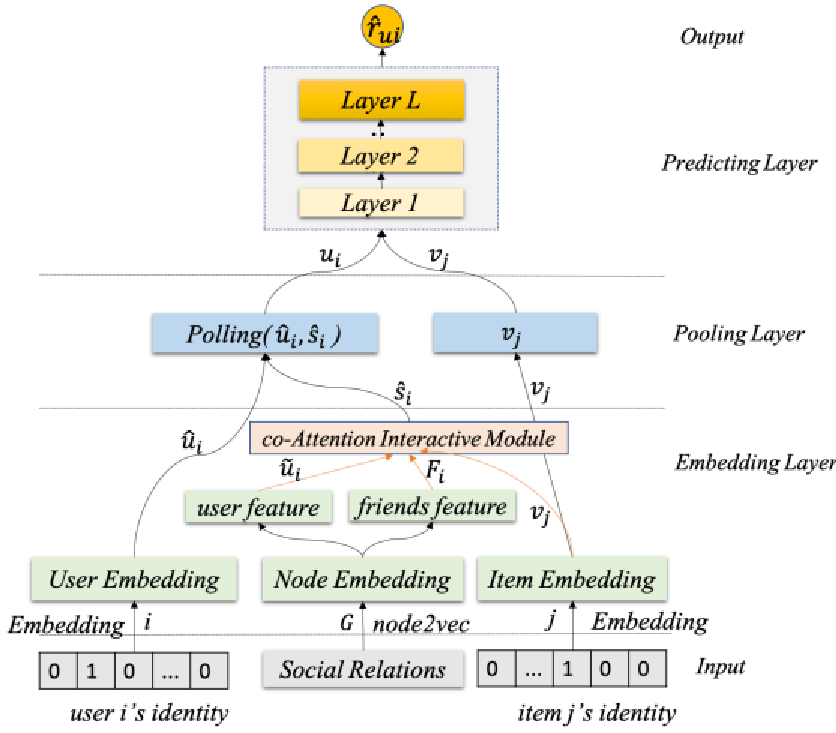 In Figure 1, notice how the social influence vector is not a simple average but a weighted sum determined by the co-attention module.
2. Graph Embedding Pre-training
Social networks are graphs, not just lists. To capture community structures (the "friends of friends" effect), ScAN uses node2vec to initialize user embeddings. This allows the model to start with a rich understanding of the social topology before even looking at item interactions.
Experiments & Results: Quantifying the "Expert" Effect
The authors tested ScAN against heavyweights like PMF, BPR, and NCF on three datasets: Ciao, Epinions, and Douban.
Key Findings:
- Superiority over NCF: ScAN consistently outperformed Neural Collaborative Filtering (NCF), showing that social signals, when modeled correctly, provide a massive boost over implicit interaction data alone.
- Ablation Success: By replacing the co-attention module with a "uniform weight" strategy (SN-uniform), performance dropped significantly. In Epinions, the NDCG@10 surged by over 10% simply by enabling the dynamic item-aware attention.
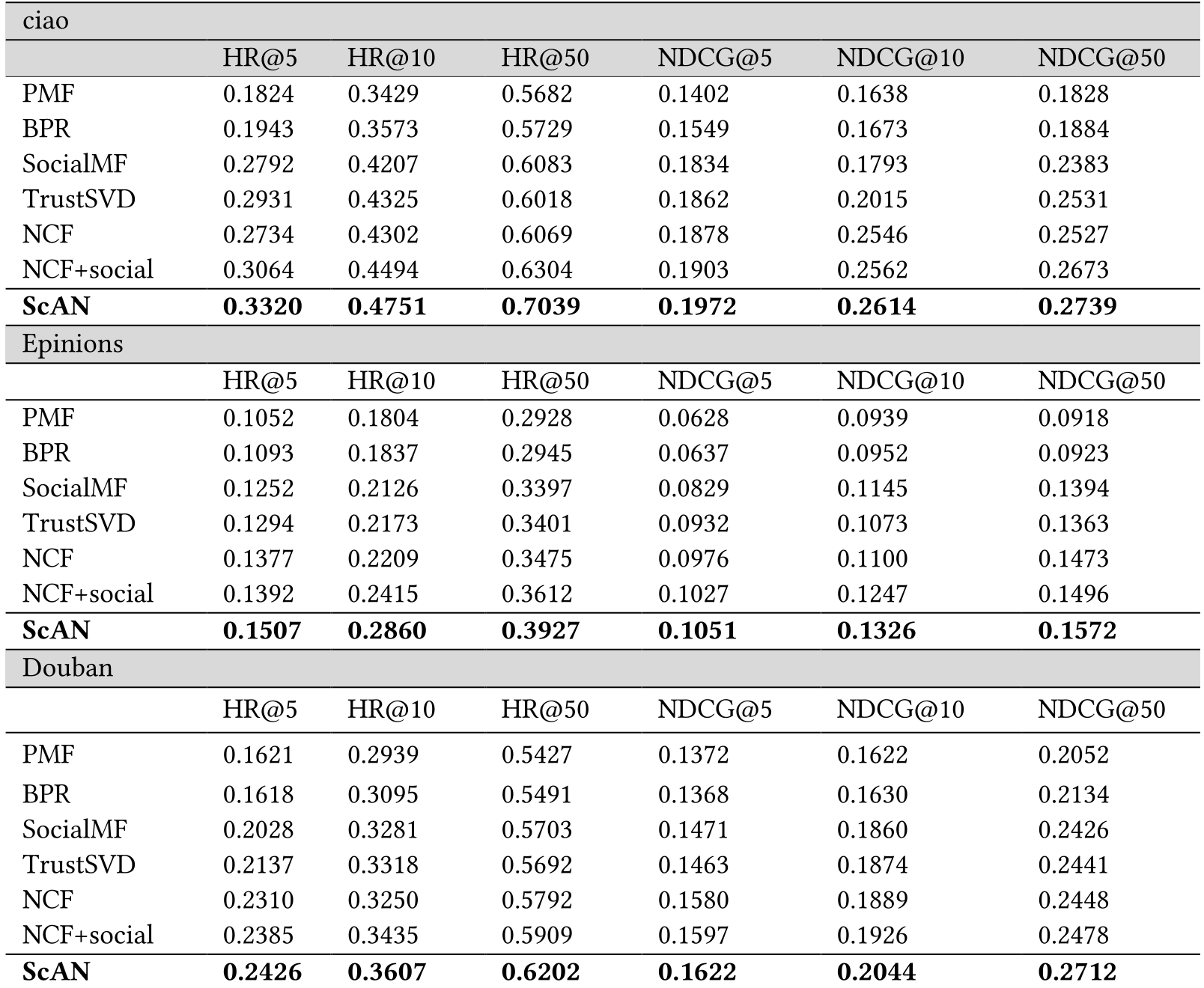 Table 2 shows ScAN achieving the highest HR and NDCG scores across all top-K variations.
The Embedding Sweet Spot
Interestingly, the researchers found that performance peaks at an embedding size of 32. Moving to 64 dimensions led to overfitting, a critical insight for practitioners deploying deep recommendation models on sparse social data.
Critical Analysis & Conclusion
Summary (Takeaways)
ScAN proves that who influences you is just as important as what you are looking at. By moving away from static trust weights and incorporating graph-based pre-training, the model effectively addresses both data sparsity and the "heterogeneous influence" problem.
Limitations & Future Work
While ScAN is robust, it still relies on a static social graph. Modern social networks are highly dynamic—friendships form and dissolve. A future extension integrating Temporal Graph Networks (TGNs) with this co-attention mechanism could further refine the accuracy for real-time recommendation engines. Furthermore, solving the "cold start" for users with zero social ties remains a secondary challenge for this specific architecture.