
Socially-Aware CDNs: Predicting Virality to Revolutionize Content Delivery
Efficient content delivery through popularity forecasting on social media
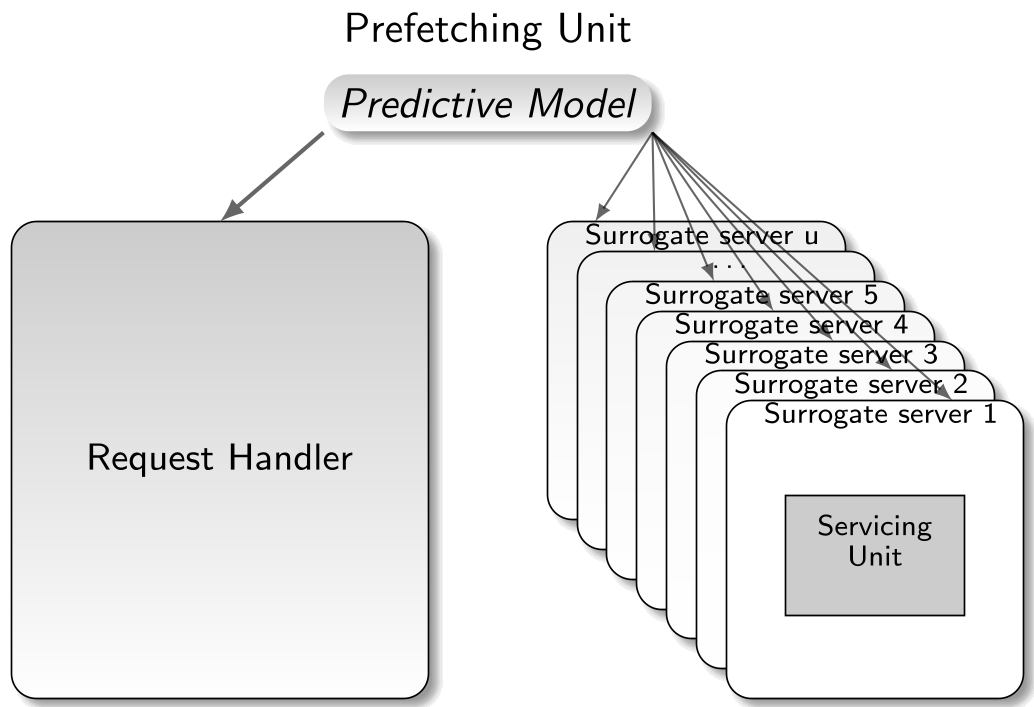
This paper introduces a predictive model for video popularity on social media by fusing Twitter user-centric data with YouTube video-centric data. By leveraging a lightweight feature set—User Score, its temporal derivative, and Content Distance—it optimizes Content Delivery Networks (CDNs) through social-aware proactive replication.
TL;DR
The explosion of video sharing on platforms like Twitter and YouTube creates massive pressure on internet infrastructure. This paper proposes a lightweight linear regression model that predicts video virality using only three core features: user influence, influence trends, and interest similarity. By integrating this prediction into Content Delivery Networks (CDNs), the authors achieved a significant reduction in Mean Response Time (MRT), effectively "pre-warming" the cache for viral content before the traffic spike hits.
Problem & Motivation: The Infrastructure Gap
When a video goes viral, it often causes a "Social Cascade" where requests exponentially increase in a very short window. Standard CDNs are reactive—they cache content after it has been requested. This leads to:
- High Latency: Initial users experience slow load times as the content is fetched from the origin server.
- Bandwidth Inefficiency: Redundant data transfers across backbone networks during peak times.
The authors argue that if we can predict which "followers" will watch a video based on their relationship with the "sharer," we can proactively replicate that video to the geographically relevant surrogate servers.
Methodology - The "Three Pillars" of Prediction
The core innovation lies in a simple yet effective feature set that avoids the computational "curse of dimensionality" found in large-scale graph mining.
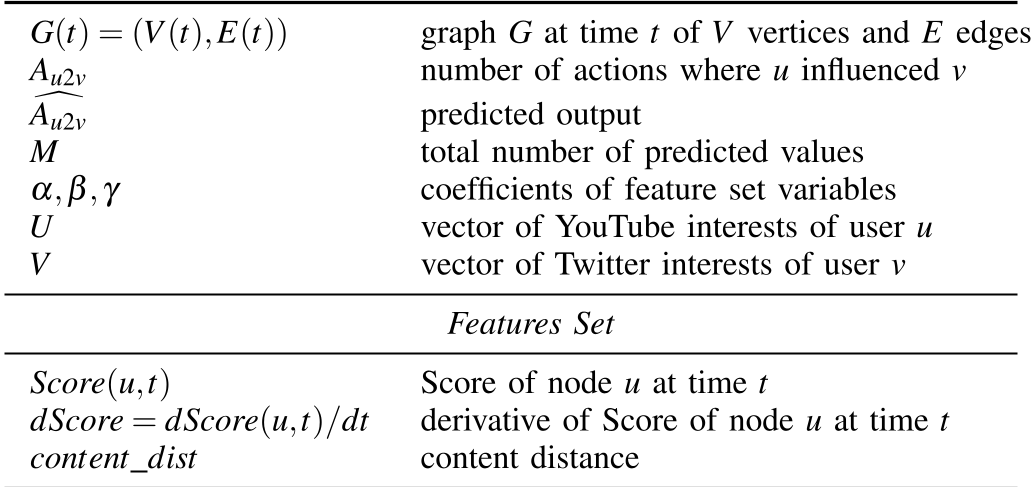
1. The Influence Score
The model calculates a user's potential impact using a logarithmic formula: Where is the number of followers, is a reciprocity factor, and is the "effect" (average retweets).
2. Temporal Dynamics (dScore/dt)
Predicting popularity isn't just about how big a user is, but how fast their influence is growing. This derivative component captures "rising stars" and trending conversations.
3. Content Distance
This is the semantic bridge. It uses Cosine Similarity between a user’s YouTube interests and their followers' Twitter interests. If the content matches the niche of the social circle, the probability of a cascade increases.
Experiments & Results: Efficiency in Action
The authors compared their Linear Regression (LR) model against high-complexity classifiers including SVM, Random Forest, Naive Bayes, and SGD.
Prediction Performance
Surprisingly, the simpler Linear Regression model achieved the highest Area Under the Curve (AUC) of 0.699, beating more complex models like Random Forest (0.608). This suggests that for social cascades, the linear relationship between influence and retweets is robust.
CDN Impact (The Real-World Test)
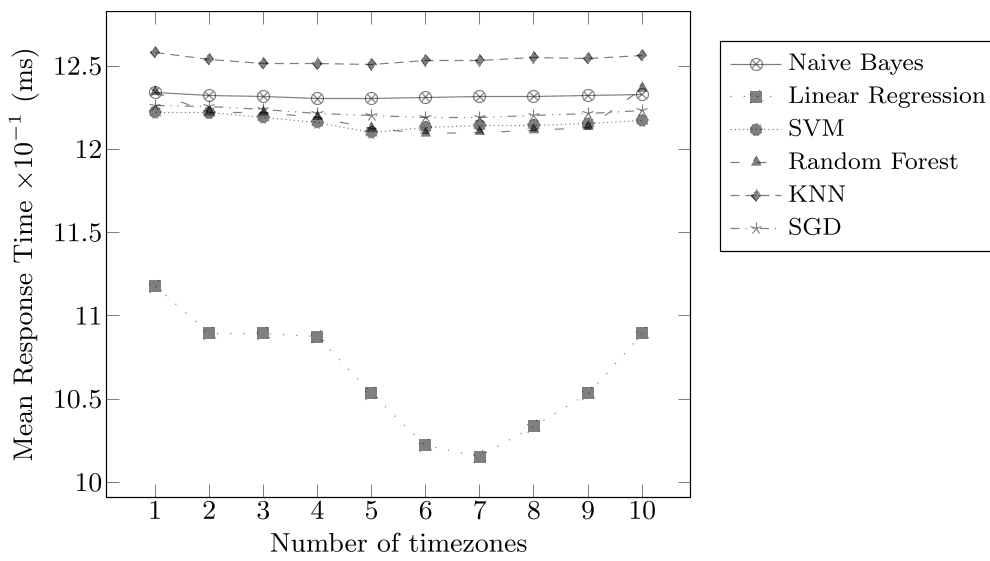
The most impressive result is the "Subpolicy" simulation. By using the LR model to decide where to pre-fetch data:
- Mean Response Time (MRT) was lowered to approximately 1.06ms.
- The model identified an optimal threshold (around 7 timezones) for proactive copying; beyond this, the "cost of copying" starts to diminish the speed benefits.
Critical Analysis & Conclusion
Takeaway
The paper proves that Social Awareness is a viable metric for infrastructure optimization. By merging datasets (Twitter + YouTube), we get a clearer picture of user intent than either platform could provide alone.
Limitations
- Platform Specificity: The model is tuned for Twitter/YouTube. The dynamics of TikTok or Instagram (which rely more on algorithmic feeds than follower graphs) might require different feature weights.
- Outlier Sensitivity: The paper noted that removing outliers was necessary for linear regression to perform well, suggesting the model might struggle with "black swan" viral events that don't follow standard influence patterns.
Future Outlook
As edge computing becomes more prevalent, these "Social-Aware" policies will be crucial. Future work could transform this into a Reinforcement Learning (RL) task where the CDN "learns" to balance prediction confidence with delivery costs in real-time.