
SPNC Model: Mastering the Tug-of-War Between Truth and Rumors in social networks
7798_Efficient Coupling Diffusion of Positive and Negative Information in Online Social Networks.
The paper introduces a novel Susceptible-Positive-Negative-Chaotic (SPNC) model to characterize the coupled diffusion of antagonistic information in Online Social Networks (OSNs). It proposes collaborative control strategies (Persuasion and Guidance) to minimize system losses and costs via optimal control theory, achieving state-of-the-art performance in rumor suppression.
TL;DR
Online Social Networks (OSNs) are digital battlegrounds where positive news and negative rumors engage in a constant "coupling diffusion." This paper proposes the SPNC model, which identifies a critical "Chaotic" user state and utilizes Optimal Control Theory to deploy collaborative strategies—Persuasion and Guidance—minimizing social panic and system costs by over 60%.
The "Chaotic" Reality of Digital Information
Most classical models treat information spreading like a simple biological virus: you are either infected or you aren't. However, human sociology is messier. When faced with contradictory reports, users often enter a state of uncertainty (Chaos). Prior research typically focuses on single-cascade suppression, failing to account for how positive information can actively "recapture" users from negative influence.
The authors argue that ignoring the interaction between truth and lies leads to inefficient control measures. They seek to answer: How can we mathematically model this interplay and intervene at the minimum cost?
Methodology: The SPNC Framework
The core of the paper is the Susceptible-Positive-Negative-Chaotic (SPNC) model. Users move between four states based on specific transition probabilities:
- S (Susceptible): Uninformed users.
- P (Positive): Active spreaders of authentic news.
- N (Negative): Active spreaders of rumors/gossips.
- C (Chaotic): Users holding both pieces of information but remaining undecided.
The Mathematical Engine
By using a system of nonlinear ordinary differential equations (ODEs), the researchers define the flow of users. A pivotal contribution is the derivation of (Basic Reproduction Number).
- If : The rumor naturally dies out.
- If : The rumor persists in a steady state (Non-zero Equilibrium).
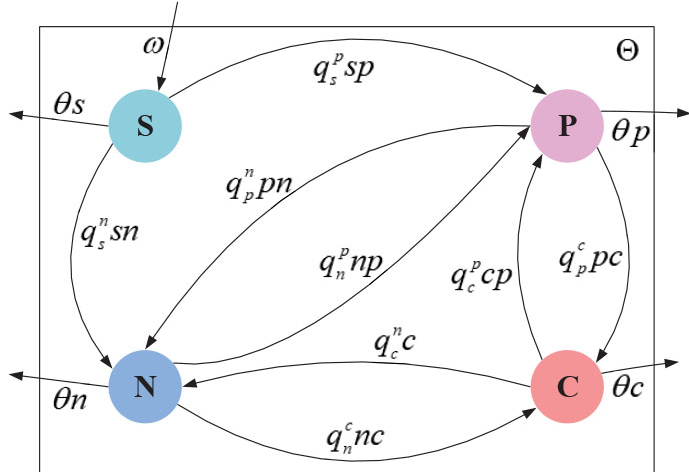 Figure 1: State transition diagram showing the complex flow between Susceptible, Positive, Negative, and Chaotic states.
Collaborative Control: Persuasion & Guidance
To flip the script on rumors, the paper introduces two specific interventions:
- Persuasion (): Releasing authoritative data to convince 'Negative' users to adopt the 'Positive' state.
- Guidance (): Communicating with 'Chaotic' users to resolve their uncertainty in favor of the truth.
Using the Pontryagin Maximum Principle, the authors solve for the optimal time-varying intensity of these strategies. This ensures that resources are not wasted—intervention is strongest when it yields the highest impact on cost reduction.
Experimental Results & Insights
The model was validated using two massive real-world datasets: Slashdot (technology news) and Epinions (consumer reviews).
Key Findings:
- Cost Efficiency: Collaborative strategies (Case 2: ) outperformed single-pronged approaches significantly. In Slashdot, costs dropped by 63.25%, whereas using only one strategy yielded much lower gains.
- Speed of Recovery: The time required to reach a "rumor-free" equilibrium was halved under collaborative control.
- State Transformation: The peak ratio of positive users increased by 55.6%, proving that "fighting fire with water" (positive info) works better than just "blocking the fire."
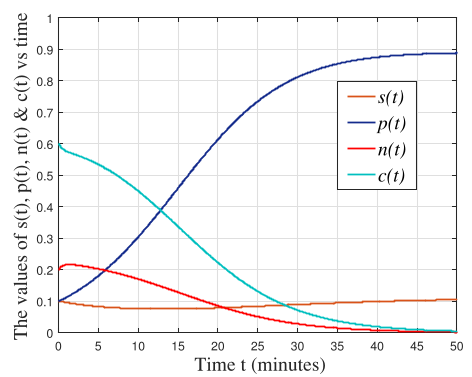 Figure 2: Performance comparison across different control cases, highlighting the superiority of collaborative intervention.
Critical Analysis & Future Outlook
Contribution: The primary value of this work is the mathematical formalization of "indecision" (State C). By treating information control as an optimization problem rather than a binary "on/off" switch, it provides a realistic blueprint for platform moderators.
Limitations: The model assumes a relatively homogeneous network mixing. In reality, OSNs are highly clustered (echo chambers), which might require adapting these ODEs into a Graphic Neural Network (GNN) or a multi-layered network framework to account for structural bottlenecks.
Takeaway: For tech giants and governments, the lesson is clear: combating rumors isn't just about deleting negative content; it’s about strategically guiding the "undecided" masses toward verified positive information at the right time.