
POSN: Reclaiming Privacy through Cloud-Backed Decentralized Social Networks
Efficient Data Dissemination in Distributed Social Networks
This paper introduces POSN (Personal Online Social Network), a decentralized architecture that combines P2P mobile interactions with encrypted cloud storage for efficient data dissemination. By analyzing real-world Facebook user activity, the authors propose a hybrid dissemination model that addresses privacy concerns while maintaining system availability and performance.
TL;DR
As privacy concerns regarding centralized social media giants grow, POSN (Personal Online Social Network) offers a middle ground. It is a decentralized platform that uses your mobile device for control and your personal cloud for storage. By analyzing 16 real-world Facebook "circles" comprising over 3,500 users, this research demonstrates that we can achieve efficient content delivery without a central authority by leveraging social community clusters and smart peer-to-peer fetching.
The Centralization Dilemma
Current OSNs (Online Social Networks) treat user privacy as a secondary concern, centralizing data to facilitate easier processing and monetization. While P2P (Peer-to-Peer) networks are the natural solution to avoid central gatekeepers, they face a massive Availability Problem: If Alice wants Bob’s photo, Bob must be online at that exact moment. Previous attempts used Distributed Hash Tables (DHTs), but these are often too complex and heavy for mobile devices.
Methodology: The Cloud-Mobile Hybrid
The authors propose a architecture where the Mobile Device acts as the BRAIN (managing encryption keys and access tokens) and the Cloud/PC acts as the BODY (storing the encrypted data).
Key Mechanism: Community-Based Fetching
One of the most innovative insights of this paper is using the "social topology" to optimize data dissemination. Instead of a device pinging every single friend's repository (which is costly in terms of data and battery), users can:
- Detect Communities: Identify clusters of tightly interconnected friends.
- Recursive Queries: Ask the first available online friend about the status of common friends.
- Heuristic Ordering: Prioritize contacting friends who are "Most Often Online" or have the "Most Common Friends" to maximize metadata gain.
 Figure 1: High-level overview of POSN content sharing between friends like Alice, Bob, and Eric.
Real-World Evidence (Facebook Measurements)
The researchers didn't just build a prototype; they validated it using real activity logs. They found that on average, only 16.3% of a user's friends are online at any given minute. This low availability makes the "Cloud-backed" aspect crucial—the cloud serves as a high-availability buffer for encrypted content.
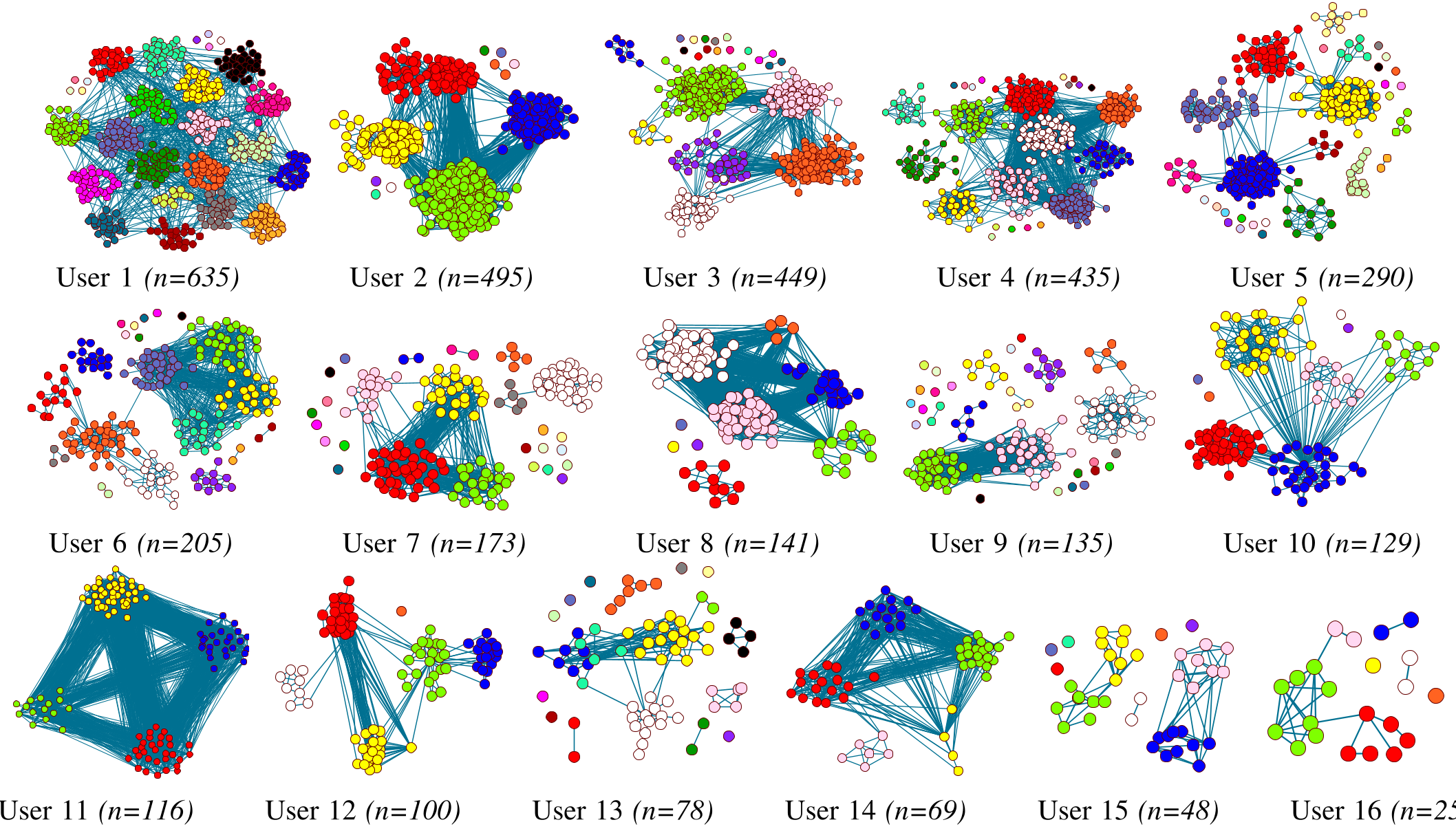 Figure 2: Analysis of friend inter-connections showing distinct community clusters used to optimize data lookups.
Results and Performance
- Bandwidth Efficiency: For multimedia, uploading once to a cloud link rather than sending P2P to 77 friends saved over 90% of the sender's bandwidth in certain scenarios.
- Connection Savings: By using the "Most Online" heuristic to find friends, users could eliminate over 50% of the necessary connections to update their news feed.
- Scalability: For an average user, a full year of social activity (photos/videos included) would only consume ~172 MB, well within the free tiers of most modern cloud providers.
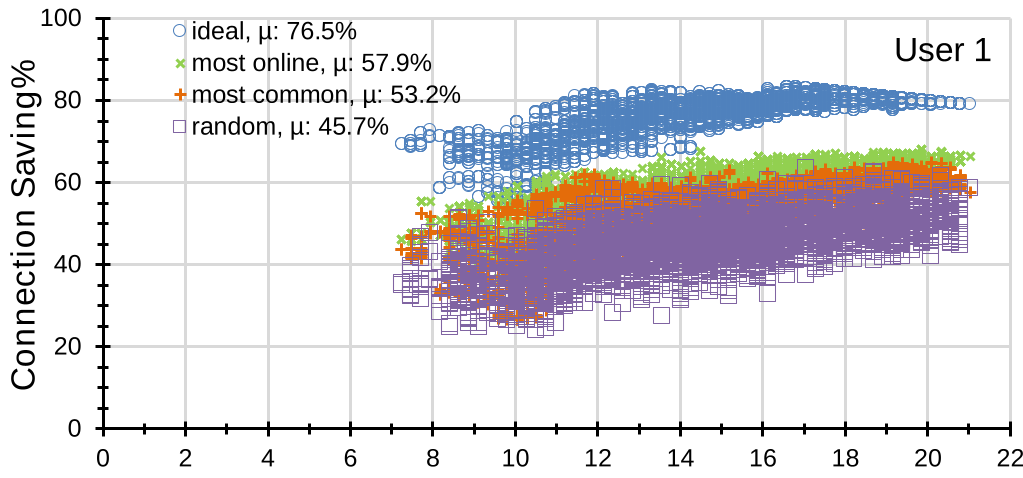 Figure 3: Efficiency gain of different peer-fetching strategies relative to the percentage of online friends.
Critical Insight: Why This Matters
The genius of POSN isn't just in the tech; it's in the anthropological alignment. By recognizing that humans typically interact with a "Dunbar number" of friends (~150), the system doesn't need to scale to billions in a single flat file. It scales naturally as a "network of networks," where the local complexity of a user's circle remains manageable even as the global network grows.
Conclusion & Future Work
The study concludes that decentralized OSNs are not just a privacy advocate’s dream but a technical reality. The transition from mobile-only P2P to a cloud-backed hybrid model solves the primary hurdle of data availability. Future developments will look into "encrypted search"—finding specific content within these distributed circles without compromising the underlying privacy of the data.
Project Link: POSN on GitHub