
EDPIT: Revolutionizing Energy Efficiency in Opportunistic Social Networks
An efficient data packet iteration and transmission algorithm in opportunistic social networks
The paper introduces EDPIT (Efficient Data Packet Iteration and Transmission), an energy-aware routing algorithm for Opportunistic Social Networks (OSNs). It leverages an iterative selection mechanism and "central nodes" to optimize data packet transmission, achieving a delivery ratio of 70% while significantly reducing energy consumption and network overhead.
TL;DR
In the world of Opportunistic Social Networks (OSNs), where connections are fleeting and intermittent, the "store-carry-forward" paradigm is king. However, this often comes at the cost of high energy consumption. The EDPIT (Efficient Data Packet Iteration and Transmission) algorithm addresses this by using social context and iterative filtering to select the most reliable "central nodes," boosting the delivery ratio to 70% while keeping energy costs at a minimum.
The Problem: The High Cost of "Opportunism"
Current opportunistic routing protocols often suffer from two extremes:
- Epidemic Routing: Floods the network with copies, leading to congestion and rapid node death.
- Spray-and-Wait: Limits copies but ignores the social "intelligence" of node movement.
The authors identify a critical pain point: redundancy. In social settings, people move in patterns, meeting the same neighbors frequently. Sending the same packet multiple times to the same group is a waste of precious battery life and bandwidth.
Methodology: Social Intelligence meets Iterative Logic
The core of EDPIT lies in its sophisticated definition of a node's value, termed Node Relevance Degree ().
1. The Five Pillars of Relevance
Instead of relying on a single metric, EDPIT calculates based on:
- Centrality (): How many routes pass through a node?
- Meeting Degree (): How often does it encounter others?
- Stabilization Degree (): How long do connections last?
- Recently Degree (): When was the last encounter?
- Similarity Degree (): Do these nodes share the same social circle?
2. The Power of "Central Nodes"
By identifying nodes with high values, the algorithm designates "Central Nodes." These act as the backbone of the transmission process. Before a packet is forwarded, the algorithm predicts the energy cost. If the node's remaining energy is insufficient, the transmission is bypassed to prevent node failure.
3. Iterative Selection (The XOR Logic)
To solve the redundancy problem, the algorithm uses an iterative process. As packets move from one communication area to another, only the difference in data (calculated via an XOR-like iteration) is prioritized.
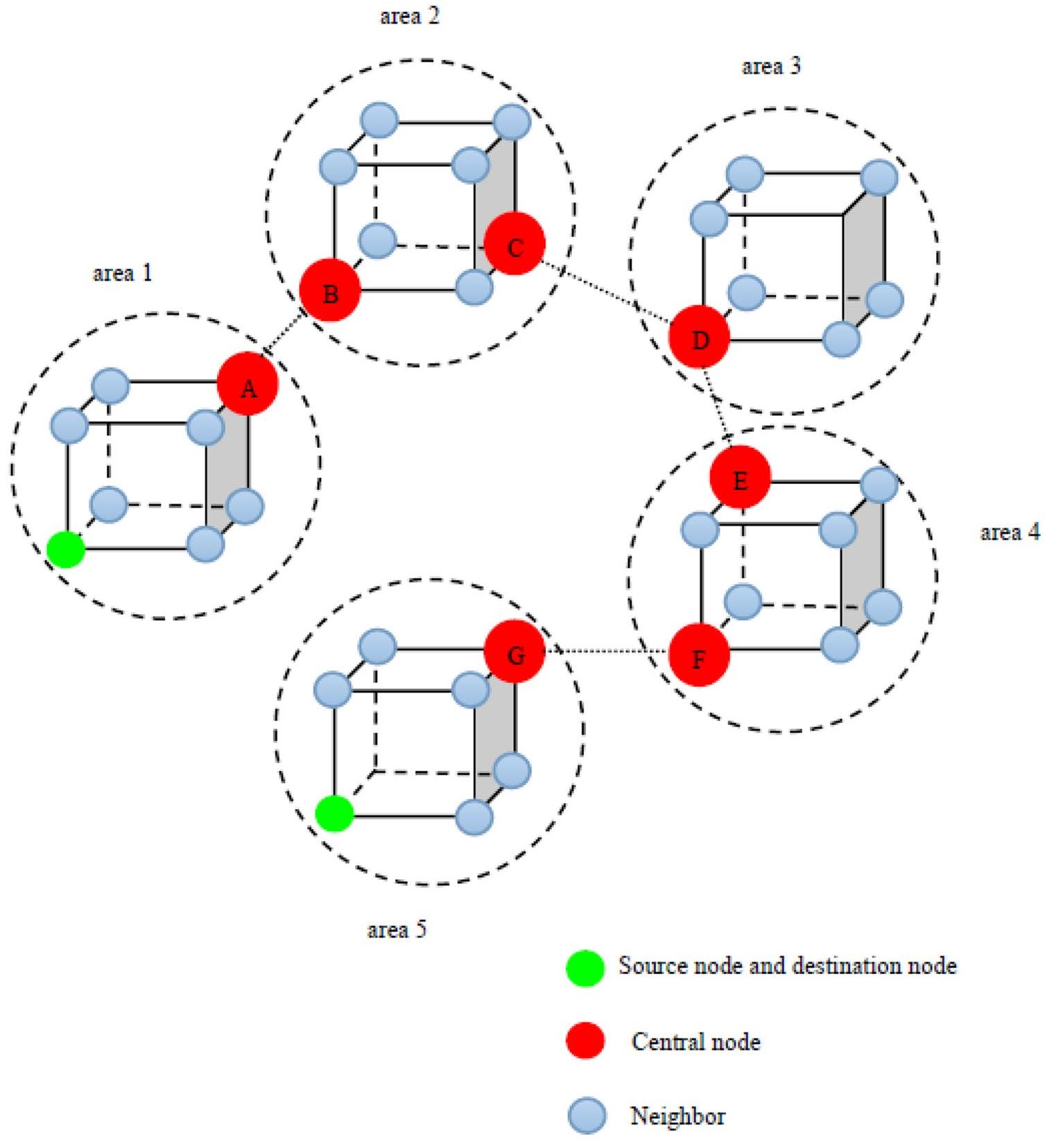 Figure: The process of iteration transmission across different communication areas.
Experimental Validation
Using The One Simulator with real-world map data (SPMBM model), the authors compared EDPIT against Epidemic, Spray-and-Wait, SCANE, and ETNS.
Key Findings:
- Delivery Ratio: EDPIT reached a peak of 70%, outperforming the flooding-based Epidemic(64%) and limited Spray-and-Wait(41%).
- Energy Consumption: EDPIT demonstrated significantly lower energy usage because it eliminates redundant packet copies through its iterative logic.
- Routing Overhead: While other algorithms showed fluctuating or high overhead as node numbers increased, EDPIT remained stable.
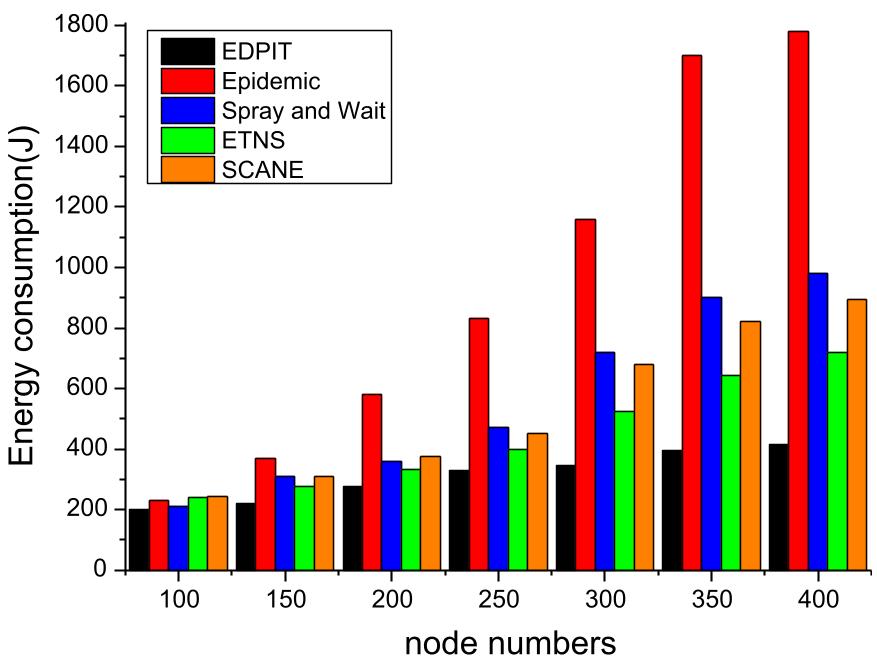 Figure: Comparison of energy consumption across different routing protocols.
Critical Insight & Future Outlook
The brilliance of EDPIT is that it treats an opportunistic network not just as a set of moving sensors, but as a social graph. By filtering data at the "central" hubs of this graph, it mirrors how information naturally flows through human communities.
Limitations: The algorithm currently relies on historical records to predict future encounters. In highly dynamic or unpredictable environments (e.g., a sudden disaster zone), the "Stabilization Degree" might be less reliable.
Future Work: The authors propose integrating Machine Learning and Timestamp Mechanisms to create trust-based routing tables, protecting the network from malicious nodes that might tamper with the routing process.
Conclusion
EDPIT proves that "more data" isn't always better. By being selective about who transmits and what they carry, we can build opportunistic networks that are both high-performing and energy-sustainable.