
ECEDT: Revolutionizing Data Persistence in Edge-Based Opportunistic Social Networks
An Efficient Data Transmission Strategy for Edge-Computing-Based Opportunistic Social Networks
The paper introduces the Edge-Computing-based Efficient Data Transmission (ECEDT) strategy for Opportunistic Social Networks (OSNs). By leveraging edge computing to evaluate node association degrees and reconstruct communities, ECEDT optimizes data forwarding through selected relay nodes, achieving a significantly higher delivery ratio compared to traditional Spray-and-Wait and Epidemic protocols.
TL;DR
The emergence of 5G has catalyzed the growth of Opportunistic Social Networks (OSNs), yet the "store-carry-forward" nature of these networks often leads to rapid battery depletion and data loss. This paper presents ECEDT, an efficient transmission strategy that uses Edge Computing to intelligently reconstruct communities. By distributing data fragments across social-associated relay nodes, the method dramatically reduces single-node energy consumption while maintaining a high delivery success rate.
Problem & Motivation: The "Loneliness" of the Source Node
In traditional OSN models, a source node is often an island. Algorithms like Epidemic or Spray-and-Wait depend on brute-force flooding or limited handshakes. The results are predictable:
- Energy Exhaustion: A single node carrying heavy data packets quickly depletes its 100J initial energy.
- Point of Failure: If the source node "dies" due to power loss, the information it carries is lost to the network.
- Low Efficiency: Without social context, data is often passed to nodes with low probability of meeting the target.
The authors' insight is to use Edge Computing as a "brain" to evaluate social associations and split the transmission burden across a community, ensuring that the death of one node doesn't mean the death of the data.
Methodology: Community Reconstruction and Dynamic Forwarding
The core of ECEDT lies in its mathematical definition of community stability.
1. Structural Degree and Partitioning
The authors define a structural degree to predict community changes. If the association between nodes meets specific weight thresholds (), a neighbor becomes a relay node. Three theorems are proven to handle:
- Sub-community Splitting: When it's mathematically optimal to divide a group.
- Node Retention: Why certain nodes stay in a community despite weight fluctuations.
- Community Joining: How new nodes are integrated based on structural gains.
2. The Step-by-Step Data Transmission Model
Instead of sending 100% of data at once, ECEDT uses a fractional strategy:
- Step 1-3: Source node finds a community and sends 50% of the data to relay nodes.
- Step 5-6: As moves to a second community, it sends 50% of the remaining data. Meanwhile, the first community broadcasts what it already has.
- The Result: Data coverage follows a geometric progression (), ensuring rapid diffusion without overloading any single path.
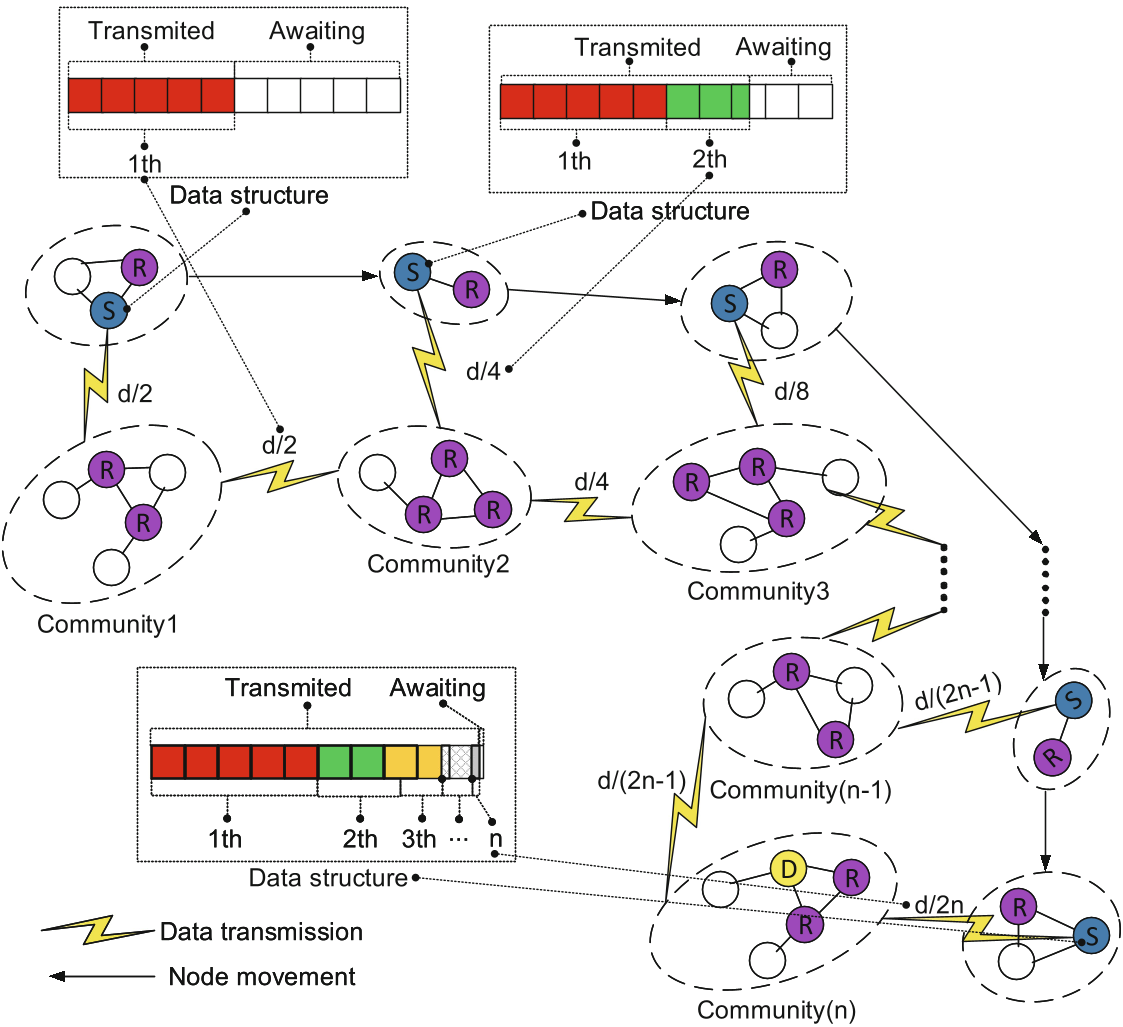 Figure 1: The ECEDT data transmission process showing iterative data sharing across communities.
Experiments & Results: Efficiency over Speed
Using the ONE (Opportunistic Network Environment) simulator, the authors compared ECEDT against SECM, ICMT, and Spray-and-Wait.
Key Findings:
- Delivery Ratio: ECEDT achieves the highest delivery ratio because it combines community multi-sensing with mobile edge intelligence.
- Energy Consumption: While Spray-and-Wait consumes energy linearly through "spraying" copies, ECEDT's energy overhead remains remarkably low and steady, as the burden is distributed.
- Routing Overhead: ECEDT’s overhead drops faster than competitors as node cache increases, proving its efficiency in resource-constrained environments.
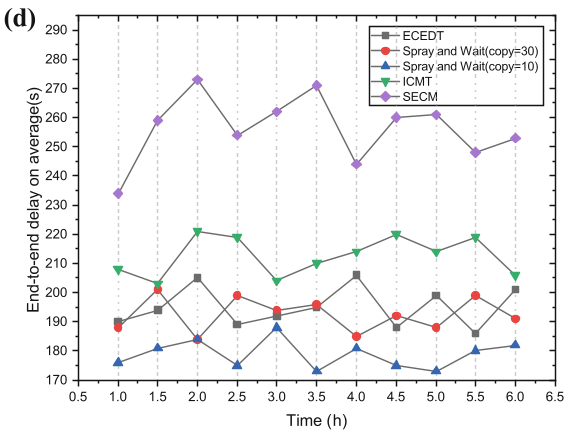 Figure 2: Relationship between simulation time and parameters like Delivery Ratio and Energy Consumption.
Critical Insight & Conclusion
While Spray-and-Wait still wins in terms of raw latency (due to its aggressive flooding nature), ECEDT is the superior choice for long-term network sustainability.
Takeaway: The future of OSNs isn't just about faster routing; it's about socially-aware data management. By treating communities as dynamic cache pools rather than static clusters, ECEDT ensures that even if individual nodes are mobile and energy-limited, the network's collective memory remains intact. Future iterations might further optimize the energy of relay nodes to ensure total network longevity.