
EPol: Decentralizing Trust in Social Networks Without Cryptography
Efficient and Decentralized Polling Protocol for General Social Networks
The paper introduces EPol, a decentralized and efficient polling protocol designed for general social networks that ensures vote privacy and result accuracy without a central authority or cryptography. It leverages a novel "m-broadcasting" property to handle general graph structures, achieving linear spatial and communication complexities while outperforming prior ring-based overlay methods.
TL;DR
EPol is a breakthrough polling protocol that allows users in a social network to vote privately and accurately without a central server or heavy-duty encryption. By moving away from rigid "ring-based" overlays and embracing general graph topologies through a new "m-broadcasting" property, EPol achieves near-linear efficiency and significantly higher tolerance for dishonest users than previous state-of-the-art methods.
Background & Motivation: The "Perfect Square" Trap
Decentralized Online Social Networks (OSNs) promise privacy by removing central points of failure. However, previous attempts at decentralized polling, such as DPol, suffered from three major limitations:
- Structure Rigidity: They required the network to be reshaped into a cluster-ring overlay, ignoring the actual social links and trust between friends.
- Mathematical Constraints: Optimal efficiency was only possible if the number of users was a "perfect square" (e.g., exactly 10,000 users).
- Byzantine Impact: Dishonest users could easily bias the result because the protocols couldn't efficiently verify data across general paths.
The authors of EPol ask: Can we build a protocol that works on the social graph as it exists, without needing a PhD in cryptography to run the math?
Methodology: Secret Sharing and Topological Ordering
EPol works in three distinct phases: Sharing, Broadcasting, and Aggregating.
1. The Secret Sharing Scheme
Instead of sending a "-1" or "+1" vote directly, a node generates shares. For a "+1" vote, it might generate two "+1"s and one "-1". These are distributed to "consumers" (neighbors). Even if a neighbor is dishonest, they only see a single share and cannot be certain what the original vote was.
2. The m-broadcasting Property
This is the core innovation. To prevent the network from being flooded with duplicate messages (a common issue in general graphs), EPol uses a topological ordering based on the source of the message.
- A graph satisfies the m-broadcasting property if every node can receive messages from at least preceding neighbors.
- The Decision Rule: A node doesn't just forward everything. It waits until it receives versions of the same data, chooses the "most represented" value (majority), and only then forwards that consolidated value to its successors.
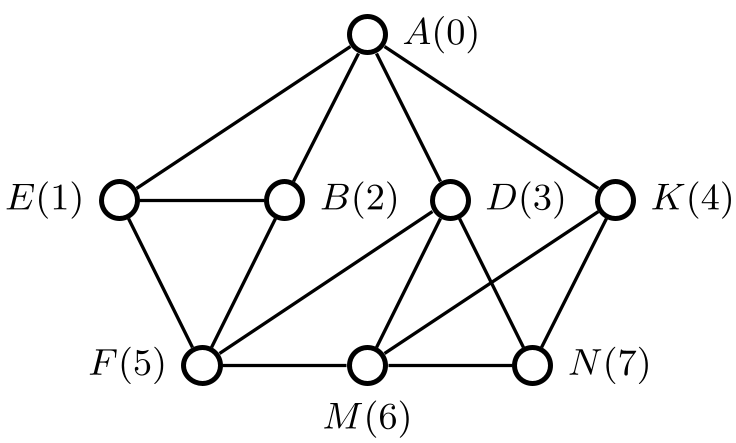 Figure 1: Example of node ordering and broadcasting flow from Source A.
Experiments and Results: Robustness Reborn
The authors compared EPol against DPol, MPOL, and other decentralized variants across several dimensions.
Performance vs. Honesty
EPol's tolerance for dishonest nodes is governed by the formula . This allows EPol to thrive even in networks with significant "dishonest coalitions."
| Metric | DPol [15/16] | EPol (This Work) |
|---|---|---|
| Graph Type | Overlay (Ring) | General Social Graph |
| Dishonest Tolerance | ||
| Message Complexity | $O(rk+ | gi |
| Accuracy Impact | (with more robustness) |
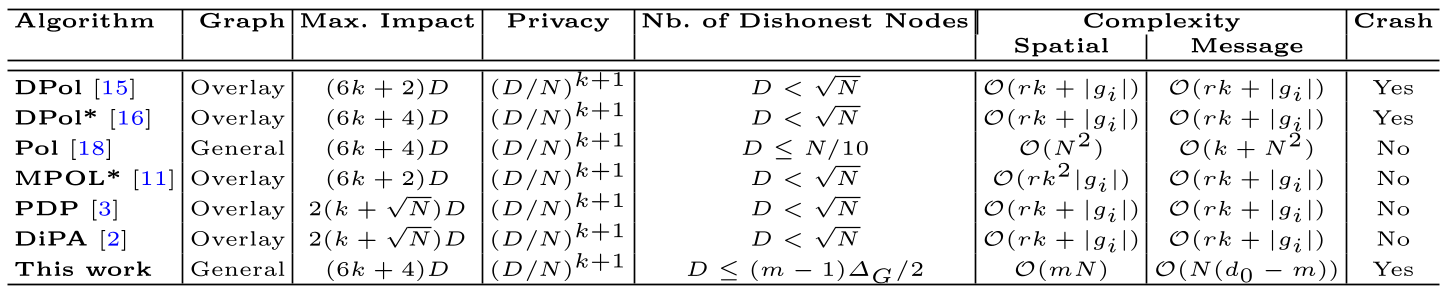 Table 1: Comparison of EPol with existing decentralized polling protocols.
The Privacy Trade-off
The paper uncovers a fascinating "Greedy vs. Non-Greedy" analysis. If dishonest users are "greedy" (trying to guess a vote after seeing just one share), their success rate is low. If they are "patient" and wait for more shares, their accuracy improves, but the protocol's design makes it statistically difficult to disclose a vote with certainty.
Critical Analysis & Conclusion
EPol represents a shift towards "Topological Security"—using the structure of the network itself as a security feature.
Key Takeaways:
- Linear Scaling: By using -broadcasting, the communication cost scales linearly with the number of users, making it suitable for massive OSNs like Diaspora or Tent.
- Flexibility: It does not require a "perfect square" of users or a forced overlay structure.
Limitations: While EPol handles node crashes and message loss better than DPol, it still assumes that dishonest nodes won't perform "Sybil attacks" (creating thousands of fake identities). While the authors suggest using tools like SybilGuard, integrating Sybil-resistance directly into the polling logic remains a future challenge.
In conclusion, EPol proves that decentralized networks can be both efficient and private by leaning into the complexity of social graphs rather than trying to simplify them into rings.