
Beyond Centralization: Adapting Gossip Protocols for Social Overlays
Efficient dissemination in decentralized social networks
The paper introduces HFLOOD, a specialized gossip protocol for decentralized Online Social Networks (OSNs) that operates over a social overlay. It addresses the inefficiencies of traditional epidemic algorithms in social graphs by combining message histories with "Anticentrality" and "Fragmentation-aware" selection heuristics, achieving near-zero residue and superior load balancing compared to direct mailing.
TL;DR
Online Social Networks (OSNs) are currently trapped in centralized silos, raising massive privacy concerns. While Decentralized OSNs (DOSNs) offer a solution, they struggle with efficient data dissemination. This paper presents HFLOOD, a gossip-based protocol that exploits social graph properties—like clustering and fragmentation—to deliver profile updates with low latency and balanced load, effectively outperforming both traditional epidemic algorithms and naive direct mailing.
The "Random Graph" Fallacy
Most classic gossip protocols, such as Demers’ rumor mongering, were designed for uniform random networks. In an ideal uniform graph, any random neighbor is as good as another. However, social networks are "weird":
- Irregular Clustering: Some friends are part of a dense "clique" (e.g., high school friends), while others are isolated bridges to other groups.
- Structural Bottlenecks: A single user often acts as the only link between two otherwise disjoint groups of friends.
In these environments, traditional gossip fails. A message gets trapped in a dense cluster, generating thousands of duplicates, while the nodes on the "outside" starve for information.
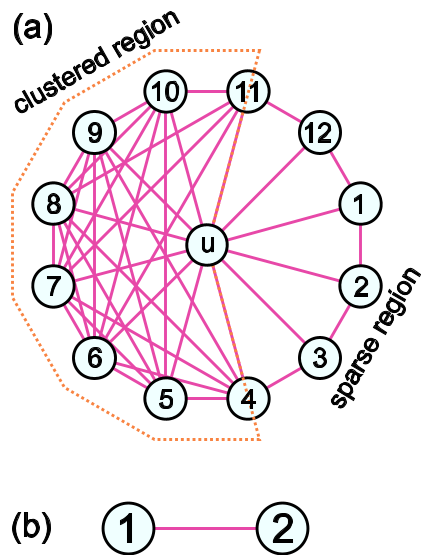 Fig 1: Why standard gossip fails—dense clusters (a) and bridge nodes (b) create massive efficiency imbalances.
Methodology: Engineering Social Awareness
The authors move away from "blind" gossip to Topological Awareness. Their solution, HFLOOD, rests on three pillars:
1. Message Histories (The "Anti-Starvation" Filter)
Instead of just sending the update, nodes piggyback a Bloom Filter containing a list of recipients who have already seen the message. If I know you’ve seen it, I won't send it again. This simple record-keeping reduces overhead by nearly 5x.
2. Anticentrality Heuristic
Intuitively, we want to talk to "popular" nodes. HFLOOD does the opposite. By picking nodes with a lower degree first, the protocol ensures that updates reach the "edges" of the social network quickly, preventing the update from getting stuck in a high-degree loop.
3. Fragmentation-Awareness (MaxComp)
If you remove the profile owner from their own social circle, the circle often breaks into several disconnected components. The MaxComp heuristic forces the sender to hit the largest components first. This effectively parallelizes the "spread," as each component can then disseminate the news internally.
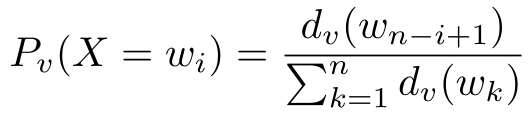 The Anticentrality formula: Assigning higher selection probability to lower-degree nodes within the specific social neighborhood.
Experimental Battleground: HFLOOD vs. The World
The researchers tested their protocols using a real-world crawl of an OSN, simulated in PeerSim.
- Latency: While Direct Mailing (sending to each friend one by one) scales linearly and slowly, HFLOOD maintains a nearly constant, low latency even as neighborhoods grow.
- Load Balancing: In Direct Mailing, the "root" (the person posting the update) carries 100% of the burden. In HFLOOD, the load is distributed across the neighborhood. The friends participate in the "heavy lifting," making the system much more resilient.
- Churn: Even when users go offline frequently (average session lengths of 2-4 hours), HFLOOD maintains high delivery rates by using its "safety net"—a secondary anti-entropy protocol that patches missing updates in the background.
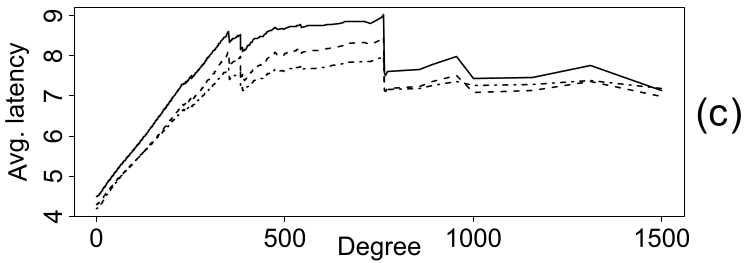 Fig 2: Latency comparison—HFLOOD variants (bottom lines) stay fast and stable while Direct Mailing (top line) explodes in latency as degree increases.
Critical Insight: The Value of "Social Locality"
The core genius of this work is the realization that social links are more than just wires. They represent trust and physical locality. By forcing communication to stay within the "Friend-to-Friend" (F2F) overlay, the authors not only improve privacy (no random strangers routing your data) but also exploit the fact that friends are more likely to cooperate and have geographically shorter network paths.
Conclusion
HFLOOD proves that decentralized social networks don't have to be slow or bandwidth-heavy. By intelligently utilizing the mathematical properties of social graphs—specifically by ignoring the "popular" nodes and focusing on neighborhood fragments—we can build dissemination systems that are as fast as Facebook but as private as a face-to-face conversation.
Future Outlook: The next step for this tech is moving from simulation to the "wild," potentially integrating with decentralized identity protocols like XMPP to handle real-world presence in a fully peer-to-peer ecosystem.