
EVE: Redefining Event Detection by Filtering Social Media Noise Through Authority
Efficient Event Detection in Social Media Data Streams
The paper introduces EVE (Efficient eVent dEtection), a novel hybrid framework for event detection in microblogging streams. It combines a HITS-based scoring mechanism with Probabilistic Latent Semantic Analysis (PLSA) and the Expectation-Maximization (EM) algorithm to identify real-world occurrences from noisy social media data.
TL;DR
Social media is a goldmine for real-time news, but it's buried under 40% "babble." The EVE (Efficient eVent dEtection) model breaks this bottleneck by using the HITS algorithm to identify high-quality posts and elite users. By feeding these "authority scores" into a PLSA-EM pipeline, EVE achieves a 300% boost in processing speed and significantly higher precision in identifying breaking news compared to traditional topic models.
The Noise Problem: Why Traditional Models Fail
In the world of Twitter and Sina Weibo, not all posts are created equal. Traditional models like LDA (Latent Dirichlet Allocation) or PLSA treat the data stream as a flat bag-of-words. This leads to two critical failures:
- Data Sparsity: Short posts (140 characters) don't provide enough context for standard co-occurrence logic.
- Signal-to-Noise Ratio: Meaningless updates ("bought a cake") drown out critical events like earthquakes or chemical explosions.
The authors of EVE realized that social context—who is talking and who is listening—is the key to separating the signal from the noise.
Methodology: The EVE Framework
EVE's architecture is built on the intuition that influential users beget high-quality posts, and vice versa.
1. HITS-Based Distillation
Instead of analyzing every tweet, EVE uses the Hypertext Induced Topic Search (HITS) algorithm. It constructs a bipartite graph of users and posts:
- Hub Score: A user's influence, calculated by the quality of posts they interact with (publish, forward, comment).
- Authority Score: A post's significance, calculated by the influence of the users who interact with it.
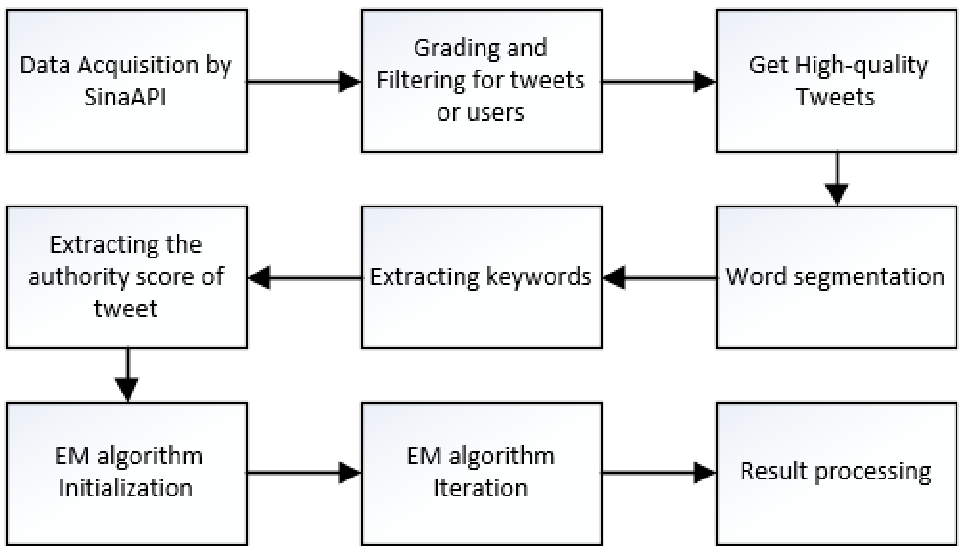 Figure 1: The EVE workflow from HITS scoring to PLSA clustering.
2. Authority-Aware Initialization
Typically, EM (Expectation-Maximization) starts with random parameters, often getting stuck in local optima. EVE introduces a "warm start": it initializes the document-topic distribution using the Authority Scores derived from HITS.
This ensures the model "attends" to the most credible information from the very first iteration.
3. Latent Semantic Discovery
Using PLSA, EVE maps the filtered posts into a latent topic space . The EM algorithm then refines these clusters to represent "Hot Events."
Experimental Results: Precision and Efficiency
The researchers tested EVE against a Sina Weibo dataset (approx. 50k posts).
Precision Benchmarks
EVE consistently outperformed vanilla PLSA across varied topics such as the Nepal Earthquake and the Fujian Plant Explosion.
| Event | Method | P@10 | P@30 |
|---|---|---|---|
| Nepal Earthquake | PLSA | 1.00 | 0.43 |
| Nepal Earthquake | EVE | 1.00 | 0.70 |
The Need for Speed
By filtering low-quality "babble" and using authority-based initialization, EVE reduced the total computational time from 22.7 minutes to just 7.0 minutes when the filtering threshold () was set to 0.4.
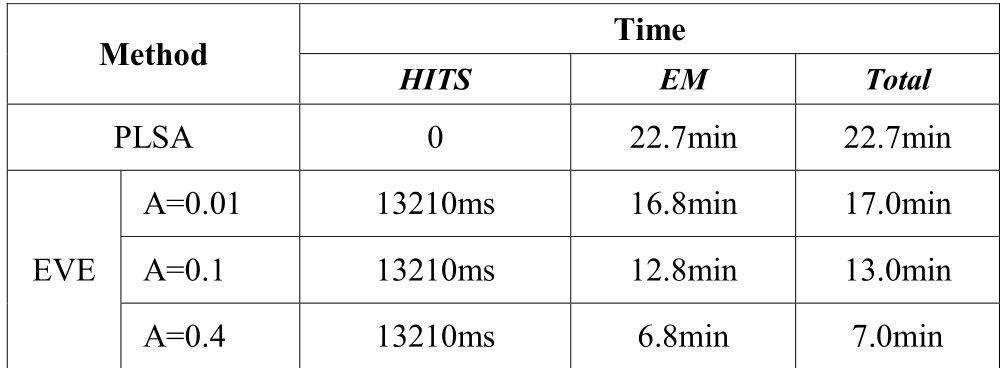 Table: Time efficiency comparison showing the impact of the filtering threshold.
Critical Insight & Conclusion
The genius of EVE isn't just in the clustering algorithm, but in the pre-filtering philosophy. In the era of LLMs and massive data, EVE reminds us that data quality > data quantity. By leveraging the social graph (HITS) to "supervise" the unsupervised learning (PLSA), the authors created a system that is both faster and more accurate for real-time monitoring.
Future Outlook: Moving forward, the integration of EVE's authority-based filtering with Dynamic Topic Models could allow for tracking the evolution of an event over months, not just days, providing a robust tool for crisis management and sentiment analysis.