
EEUICD: Mastering Dynamic Interest Communities in the Internet of People (IoP)
An Efficient Evolutionary User Interest Community Discovery Model in Dynamic Social Networks for Internet of People
This paper introduces the Efficient Evolutionary User Interest Community Discovery (EEUICD) model for the Internet of People (IoP). It combines a multi-objective genetic algorithm with label propagation and HITS-based preprocessing to detect high-quality interest communities in dynamic social networks like Twitter.
TL;DR
The EEUICD (Efficient Evolutionary User Interest Community Discovery) model addresses the instability and inefficiency of tracking community shifts in microblogging platforms. By merging a Multi-Objective Genetic Algorithm (MOGA) with a revised Label Propagation Algorithm (LPA), the authors created a system that balances current clustering quality with historical evolution, achieving state-of-the-art accuracy on real-world Twitter data.
Motivation: Beyond Static Topologies
In the era of the Internet of People (IoP), social networks are the heartbeat of personal information collection. However, traditional community detection is often "topology-blind" to the temporal dynamics of microblogs. Users don't just exist as nodes; their interests shift, and the "flow" of information is more telling than the static "link."
Current SOTA methods face a trade-off:
- Incremental Discovery: Fast, but sacrifices quality by only looking at local adjustments.
- Evolutionary Discovery: Accurate, but computationally expensive (e.g., DYNMOGA) and prone to "interest drift."
The Core Innovation: A Hybrid Evolutionary Approach
The authors propose a three-stage pipeline to solve the scalability and accuracy bottleneck:
1. HITS-based Preprocessing
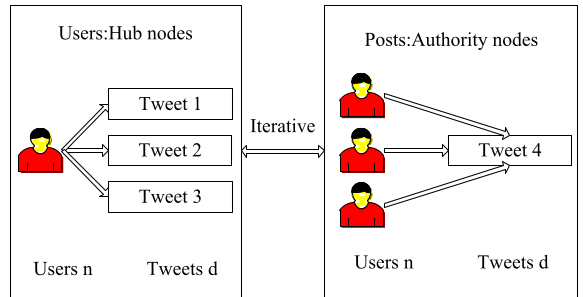
Before clustering, the model uses the HITS algorithm to identify "Hubs" and "Authorities." This filters out low-quality noise and random posts, ensuring the genetic algorithm iterates on meaningful "influential" data. It also introduces an s-step similarity matrix, calculating connections between users who aren't directly linked but are reachable within a threshold, effectively enriching the sparse adjacency matrix.
2. Genetic Algorithm Flowchart
The process transforms community discovery into a multi-objective optimization problem:
- Objective 1 (SC): Snapshot Quality, measured by Modularity (Q).
- Objective 2 (TC): Time Cost, measured via a modified F-measure to ensure temporal smoothness.
3. Mutation via Label Propagation
Perhaps the most "academic" contribution is the LPA-based Mutation. Instead of random gene flipping, the model uses label propagation to update a node’s community membership based on its neighbors. This "guided mutation" ensures the algorithm converges faster toward a physically meaningful structure rather than wandering in the search space.
Experimental Results
The model was tested against a massive dataset of 1,000,000 Twitter posts.
- Accuracy Boost: EEUICD consistently outperformed FacetNet and iDBLINK across various interest categories (Sports, Economy, Tech).
- Stability: By using a step-threshold () and attenuation factor (), the model balances local vs. global information. The authors found that a threshold of for small datasets and for large ones provided the best boundary definition.
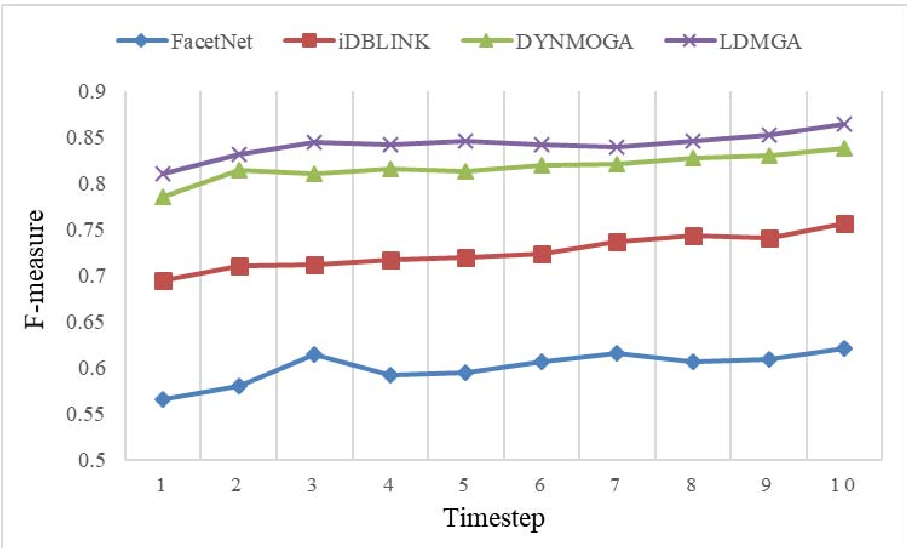
| Algorithm | Economy | Music | Technology |
|---|---|---|---|
| iDBLINK | 0.72 | 0.73 | 0.71 |
| DYNMOGA | 0.82 | 0.83 | 0.82 |
| EEUICD | 0.84 | 0.84 | 0.84 |
Critical Insight & Conclusion
The EEUICD model represents a significant step forward for IoP. By treating community discovery as a dynamic evolutionary process rather than a static snapshot, it captures the "living" nature of social media.
Takeaways for the Industry:
- Hybridization is key: Combining the global search capability of Genetic Algorithms with the local efficiency of Label Propagation is a robust template for large-scale graph mining.
- Contextual Filtering: Using HITS to weigh nodes before processing is a highly effective way to handle the extreme sparsity of social graphs.
While highly effective, the model's reliance on a fixed attenuation factor () suggests room for future work—perhaps an adaptive that adjusts based on the real-time velocity of information flow.