
[DeepMind 2024] Efficient Exploration at Scale: Shifting the Scaling Laws of RLHF by 1000x
Efficient Exploration at Scale
DeepMind introduces an online RLHF algorithm that achieves a 10x-1000x improvement in data efficiency for aligning Large Language Models (LLMs). The method combines incremental online updates, an "affirmative nudge" to stabilize training, and information-directed exploration using Epistemic Neural Networks (ENNs).
TL;DR
Reinforcement Learning from Human Feedback (RLHF) is the standard for aligning LLMs, but it is notoriously hungry for expensive human labels. Google DeepMind has unveiled an online learning framework that uses Information-Directed Exploration and Epistemic Neural Networks to achieve a staggering 10x to 1,000x gain in data efficiency. By actively selecting the most "confusing" response pairs for humans to judge, they matched 200,000 labels worth of offline training with just 20,000 labels.
Background: The Efficiency Crisis in Alignment
Current LLM alignment typically follows an "offline" recipe: collect a massive static dataset of human preferences, train a Reward Model (RM), and then optimize the policy. This approach is inefficient because much of the data is redundant—humans end up labeling pairs where the winner is obvious, providing zero new information to the model. Furthermore, offline models suffer from distribution shift as the policy evolves away from the static training data.
The Core Innovation: Why This Works
The researchers identified three specific bottlenecks and solved them with surgical precision:
1. The Epistemic Neural Network (ENN)
To explore effectively, a model must know what it doesn't know. The authors replaced standard linear reward heads with an ENN architecture. This uses an ensemble of MLP "particles" and "prior networks" to estimate reward uncertainty.
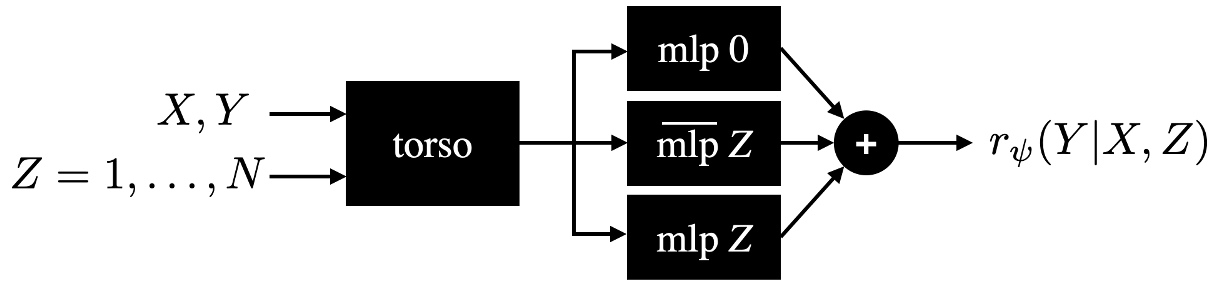 Figure: The ENN architecture allows the model to output a distribution of rewards rather than a single point estimate.
2. Information-Directed Sampling (IDS)
Instead of random sampling, the algorithm uses Information-Directed Exploration. It generates multiple responses and selects the pair where the reward model is most uncertain—specifically, it maximizes the variance of the choice probability. This ensures that every human click provides maximum "bits" of information to the reward model.
3. The Affirmative Nudge
Online RLHF is notoriously unstable and often "tanks" (performance drops off a cliff). The authors discovered that adding a small positive scalar (an Affirmative Nudge) to the reinforcement signal stabilizes the policy, preventing it from collapsing into low-entropy distributions.
Methodology: Active Loop
The workflow is a tight, incremental loop:
- Generate: Use the current policy to sample 16 responses.
- Select: Use the ENN to pick the most informative pair (Infomax).
- Label: Query the human (or simulator) for a preference.
- Update: Incrementally adjust both the Reward Model and the Language Model using the new data point.
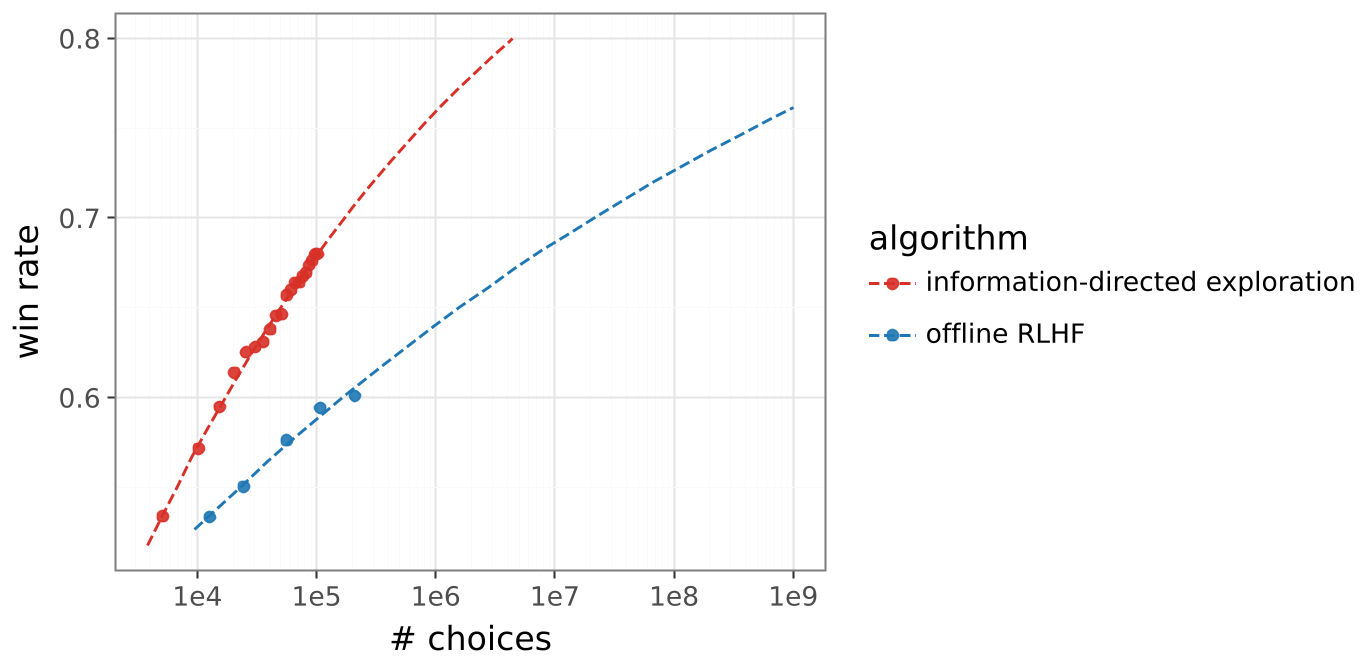 Figure: Performance vs. Number of Choices. Note the logarithmic x-axis showing the massive gap between efficient exploration and offline baselines.
Experimental Results: Breaking the 1,000x Barrier
The team tested their approach on Gemma 9B models using 200,000 diverse prompts.
- 10x Efficiency: At 20,000 human choices, the Information-Directed approach reached a win rate that the offline baseline required 200,000 choices to achieve.
- Projected 1000x: By extrapolating the scaling curves, the authors predict that with 1 million labels, the online algorithm will achieve the same performance as an offline model trained on 1 billion labels.
Qualitative Edge: Better Logic
The "Efficient Exploration" model doesn't just win on numbers; it produces more coherent reasoning. In math word problems, the offline model often becomes convoluted and arrives at wrong answers, while the efficiently explored model maintains concise logic and correct results.
Critical Analysis & Conclusion
This work represents a paradigm shift from "More Data" to "Better Data."
Takeaways:
- Active Learning is Essential: Static datasets are the "coal" of AI; active exploration is the "nuclear power."
- Uncertainty Matters: Modeling "epistemic" uncertainty (what the model hasn't seen yet) is the key to safe and efficient alignment.
Limitations: The computational overhead of maintaining an ensemble for the ENN and generating multiple responses for selection is higher than offline methods. However, compared to the cost of human labeling, this trade-off is massively favorable.
Future Outlook: This framework paves the way for AI-assisted feedback, where the model doesn't just ask for a label, but actively frames "debates" to help humans judge increasingly complex AI behaviors.