
Efficient Crowdsourcing: Solving the Complexity of Specialized Workflows
Efficient and Flexible Crowdsourcing of Specialized Tasks With Precedence Constraints
This paper introduces decentralized task allocation algorithms for specialized crowdsourcing platforms, addressing complex workflows with precedence constraints and multi-skill requirements. The authors propose the "Prioritized Greedy" framework, which achieves stability in heavy-traffic regimes and significantly outperforms existing industrial practices in turn-around time (TAT).
TL;DR
As crowdsourcing moves from simple microtasks to specialized "Impact Sourcing" (e.g., software dev, complex data labeling), traditional First-Come-First-Serve models fail. This paper provides a mathematical framework and decentralized algorithms to handle precedence constraints (Step B must follow Step A) and multi-skill matching, achieving up to 8x faster task completion in real-world deployments.
Background: Beyond Microtasks
The "Gig Economy" is maturing. We are moving away from simple image tagging toward "Knowledge Work" where a single job might involve architecture, programming, and testing. This creates a multi-dimensional challenge:
- Precedence: Steps have dependencies.
- Vector-Valued Skills: A step requires a specific "skill-hour" vector (e.g., 2 hrs Python, 1 hr Security).
- Flexibility: Can one worker do everything, or can multiple workers pool their time?
The Core Insight: Prioritized Greedy Allocation
The authors' most elegant contribution is proving that a Decentralized Greedy approach can be optimal if structured correctly. Instead of a massive centralized optimizer—which is NP-hard and limits user freedom—they propose the Prioritized Greedy algorithm.
1. Handling Precedence
They represent task dependencies as directed trees. By tagging steps based on their depth in the tree, the system ensures that "parent" tasks are offered to the crowd first. Once completed, the "children" tasks automatically move into the available pool for the next epoch.
2. Matching Flexibility
The paper categorizes systems by Flexible (F) or Inflexible (I) Agents and Steps:
- Inflexible Agents: Fixed hours per skill.
- Flexible Agents: Can split their total time across any subset of their skills.
For the most complex case (Flexible-Flexible), they use a randomized "loaded dice" strategy to assign workers to specific skill pools based on current demand, effectively turning a multi-dimensional resource problem into a set of stable parallel queues.
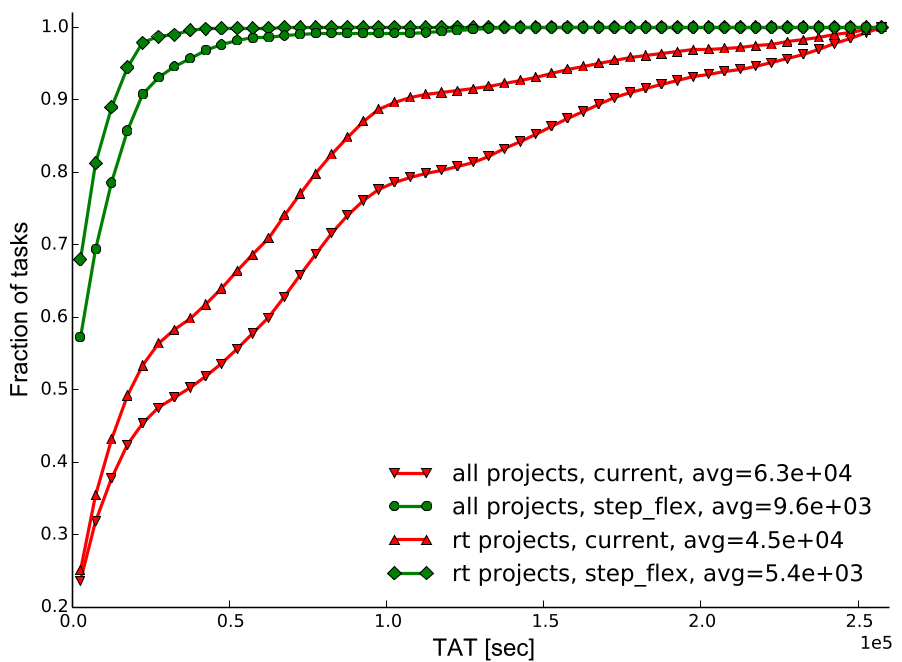 Figure: The improvement in Turn-Around Time (TAT) using the STEP-FLEX algorithm compared to the incumbent platform practice.
Methodology: From Math to Practice
The authors didn't just stop at theoretical stability. They derived an LP (Linear Programming) relaxation that allows the platform to calculate "shadow prices" or allocation probabilities that guide the decentralized agents.
The key formula for weight calculation in the centralized version incorporates a graph parameter (, the number of leaves in the subtree), which forces the algorithm to prioritize tasks that "unlock" the most downstream work.
Results & Performance
Using data from Samasource (a non-profit impact sourcing provider), the researchers tested their STEP-FLEX algorithm.
- Turn-Around Time (TAT): Reduced by over 85%.
- Stability: The system handles "heavy traffic" (high load) without the backlog exploding, maintaining a backlog of only .
- Utilization: Worker utilization remains high even under decentralized decision-making, proving that "freedom of choice" for agents doesn't have to ruin system efficiency.
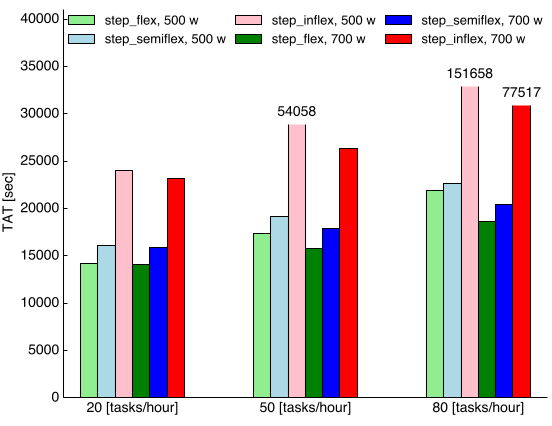 Figure: Performance on synthetic data. As system load increases, the prioritized greedy approach (STEP-FLEX) maintains stability where simpler methods (STEP-INFLEX) fail.
Critical Perspective
While the results are impressive, the "Crowd-Scaling" assumption—which requires the number of skills to scale slower than the number of tasks—is a key constraint. In extremely niche markets with as many unique skills as there are tasks, the decentralized guarantees might weaken. Furthermore, the model assumes workers are "honest" and always available for their full shift, ignoring the common "churn" found in freelance platforms.
Conclusion
This work bridges the gap between high-level operations research and practical platform design. By showing that simple depth-based priorities can solve the "precedence nightmare," it enables crowdsourcing platforms to take on much more complex, high-value engineering and data science projects that were previously too messy to manage.