
Efficient Group Processing: Scaling Reverse Geo-Social Queries for Big Data
Efficient Group Processing for Multiple Reverse Top-k Geo-Social Keyword Queries
The paper introduces an efficient group processing framework for Batch Reverse Top-k Geo-Social Keyword Queries (BRkGSKQ). It aims to identify all users who consider a given set of geo-social objects as their top-k results, shifting from single-query optimization to a batch processing paradigm that utilizes the GIM-Tree index to share computational overhead.
TL;DR
Processing "Reverse Top-k" queries for a single object is hard; doing it for a hundred objects at once is a computational nightmare. This paper introduces the Batch RkGSKQ (BRkGSKQ) framework, which utilizes a Group Processing (GP) strategy to share CPU and I/O costs. By organizing queries into a partition tree and pruning user search spaces collectively, the authors achieve performance gains of up to 100x compared to traditional iterative methods.
Background: The Rise of Geo-Social Marketing
Imagine you are a manager at Starbucks. You don't just want to know which users might visit one specific store; you want to identify potential customers for all your branches in a city to understand the overall market. This requires a Reverse Top-k Geo-Social Keyword Query (RkGSKQ).
The challenge? Each query must balance THREE factors:
- Spatial Distance: How far is the user from the store on a complex road network?
- Textual Similarity: Does the store's description match the user's interests (TF-IDF)?
- Social Relevance: Do the user's friends check in there?
Existing state-of-the-art (SOTA) methods handle these one by one, which is like a delivery truck returning to the warehouse for every single package instead of planning a round-trip route.
The Core Innovation: Group Processing (GP) Framework
The authors break away from the "one-at-a-time" bottleneck by introducing a three-stage pipeline.
1. Query Partitioning
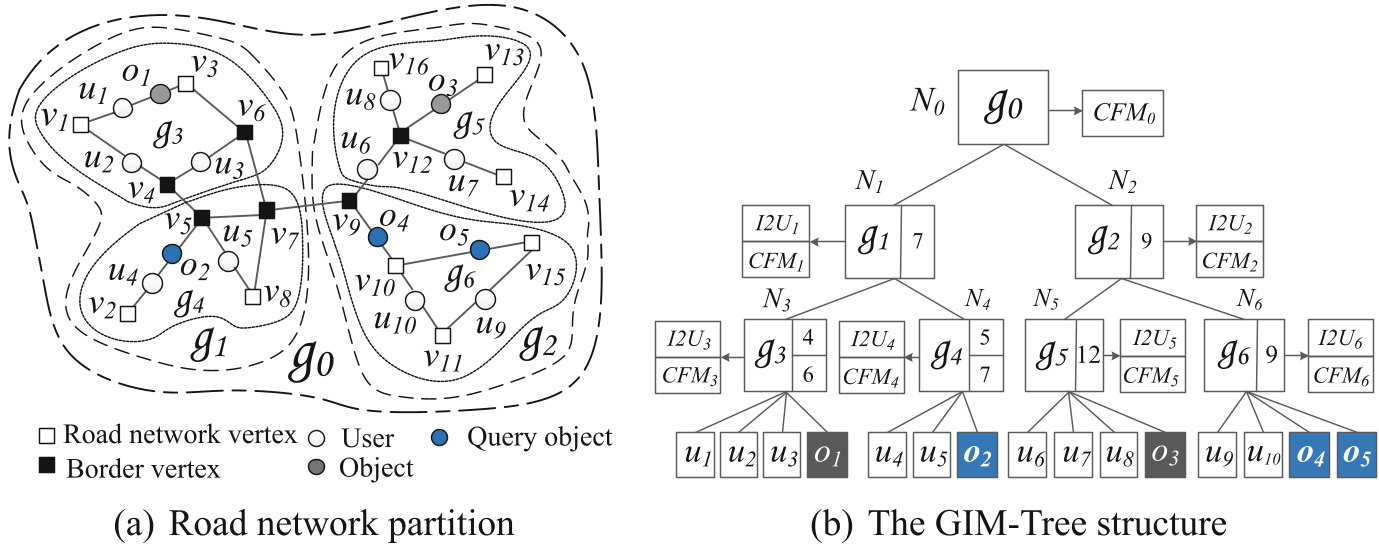
Instead of treating query objects as isolated points, the framework clusters them based on their position in the GIM-Tree (a spatial index). It builds a Query Partition Tree (QT). If multiple stores are in the same neighborhood, they are processed together, allowing the algorithm to evaluate high-level regions of the road network for all queries at once.
2. Group Filtering (The Pruning Power)
This is where the mathematical "heavy lifting" happens. The algorithm calculates a Lower Bound Counting List (U.CLl) for sets of users.
- The Intuition: If the "best possible" score a user set can get for a group of stores is still worse than the users' current top-k results, we can safely ignore those users for all those stores simultaneously.
- This "Group Pruning" happens in a single top-down pass of the index, drastically cutting down on I/O.
3. Group Verification
For the remaining candidate users, the system performs a GRP TkGSKQ. Instead of running a fresh search for every user, it expands the road network once and updates multiple users' Top-k heaps in parallel.
Experimental Results: Efficiency Reimagined
The authors tested their method against a baseline (BA) and the standard single-query algorithm (RG).
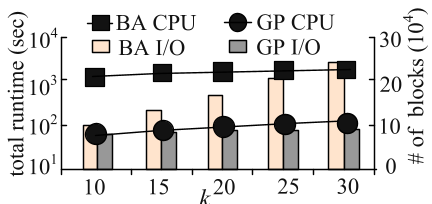
- Scalability: As the number of queries (|Q|) grows, the cost of the standard algorithm explodes linearly. The GP framework, however, remains remarkably flat because it excels at sharing the "heavy" parts of the computation.
- I/O Reduction: The GP method accesses only about 10% of the data blocks compared to the baseline, making it ideal for memory-constrained environments or massive datasets like the Gowalla (GOW) network.
Critical Insight: Why This Works
The fundamental "Aha!" moment of this paper is the realization that Reverse Queries are search-space problems. In a single query, you spend most of your time proving "where the result is NOT." By batching queries, the "proof of absence" for one store often covers the proof for many others nearby.
Conclusion & Future Outlook
The Batch RkGSKQ framework is a significant step forward for location-based social networks (LBSN). By shifting from individual query optimization to a holistic group-based approach, it solves the "redundant work" problem that has plagued reverse spatial queries for years.
Future Directions: While the current paper handles static queries, the next frontier is Dynamic Batching—how do we update these results in real-time as users move across the city and check in at new locations?