
Hybrid PSO-ITÖ: Redefining Influence Maximization through User Attitudes and Social Priority
An Efficient Influence Maximization Algorithm Based on Social Relationship Priority in Mobile Social Networks
This paper introduces an efficient Influence Maximization (IM) algorithm for Mobile Social Networks (MSNs) that identifies top-k seed nodes by integrating user attitudes and social priority. The core method, a hybrid of the ITÖ and Particle Swarm Optimization (PSO) algorithms, achieves an influence spread probability of up to 56%, nearing the theoretical optimization limit.
TL;DR
Finding the most "influential" users in a mobile social network (MSN) is not just about counting connections—it's about understanding human psychology. This paper presents a novel algorithm that combines the Particle Swarm Optimization (PSO) and the ITÖ stochastic process to identify top-k seed nodes. By incorporating "User Attitudes" (positive/negative) and "Social Priority," the proposed scheme achieves an influence coverage of 56%, effectively tackling the NP-hard challenge of Information Maximization.
The Missing Piece: Why Sentiment Matters
Most existing Influence Maximization (IM) models treat nodes like simple switches: if a neighbor is active, the node has a probability of becoming active. However, real-world MSNs are human-centric. A user might receive a message but reject it due to personal preference or negative sentiment toward the source.
The authors argue that ignoring these subjective attitudes leads to inefficient seed selection. They define the problem as finding nodes that not only have high reach but also generate high "positive" resonance among their neighbors.
Methodology: The Social Priority Framework
The researchers look at the problem through two lenses: structural connectivity and stochastic dynamics.
1. Identifying Influential Nodes
The paper defines an Influence Function () that balances two key factors:
- Contribution Factor (): A measure of how many neighbors hold a positive attitude () versus a negative one ().
- Intimacy Factor (): Based on in-degree and frequency of interactions, measuring the probability that information actually arrives at a node.
 Fig 1: Conceptual model of the Mobile Social Network (MSN) interactions.
2. The PSO-ITÖ Hybrid Algorithm
To solve the optimization, the authors map users to "particles" in a search space. While standard PSO is good at global searches, it often gets stuck in local optima. The ITÖ algorithm solves this by introducing:
- Drift Intensity: Represents the general trend of users moving toward influential information.
- Fluctuate Intensity: Mimics the "sudden changes" in human thought or attitude due to external environmental factors (modeled after Brownian motion).
 Equation: The velocity update formula for the hybrid PSO approach.
Experimental Validation
The authors tested their scheme on several datasets, including a real academic exchange network and Stanford's Wiki Vote dataset.
- Accuracy Check: The identified nodes showed a strong correlation (0.815) with Betweenness Centrality, proving that the "Influence Function" aligns with structural reality while adding a layer of behavioral insight.
- Propagation Efficiency: Using the Netlogo simulation platform, the researchers demonstrated that their Algorithm 1 could expand influence from a tiny 10-node seed set to over 56% of the network.
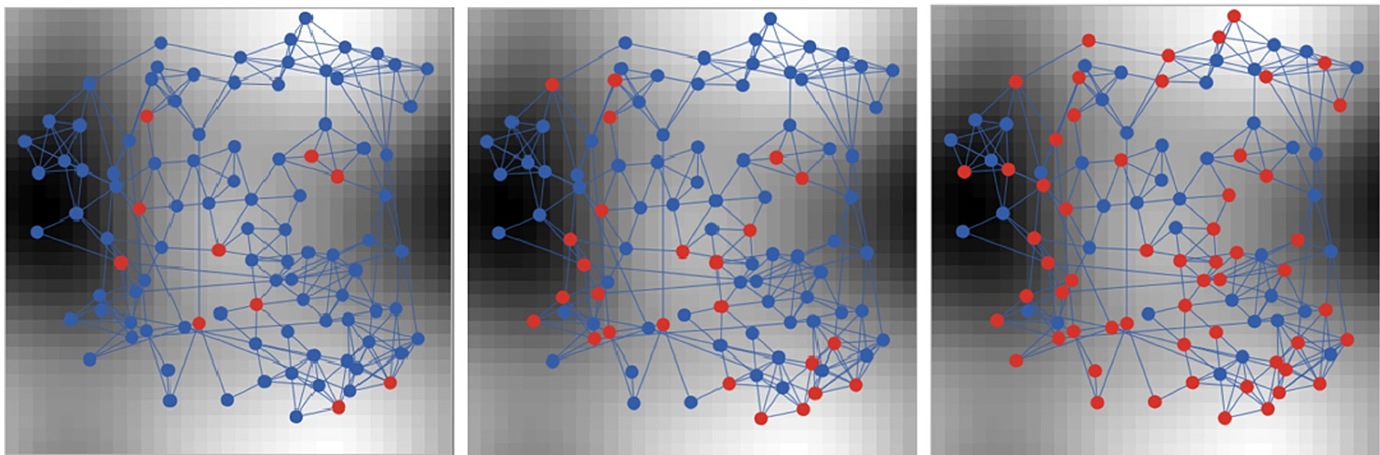 Fig 2: Simulation stages showing seed nodes (red) spreading influence over time in Netlogo.
Critical Insight & Conclusion
The true innovation of this work lies in treating social influence as a stochastic kinetic process rather than a static graph problem. By integrating the ITÖ algorithm’s drift and fluctuation components, the model captures the "unpredictable choreography" of social media trends.
Takeaway: For marketers and platform designers, the message is clear: To maximize reach, don't just look for the "loudest" nodes; look for the nodes that minimize negative friction and leverage the natural "fluctuations" of user sentiment.
Limitations: While the 56% reach is impressive, the study assumes a fixed user attitude initially. Future research could explore how these attitudes evolve dynamically mid-propagation.