
TSCM: Harmonizing Real-World Social Dynamics with Efficient Influence Maximization
Efficient influence maximization under TSCM: a suitable diffusion model in online social networks
This paper introduces the Three Steps Cascade Model (TSCM), a diffusion model tailored for online social networks based on the "Three Degrees of Influence" theory. To address the computational burden of influence maximization (IM), the authors develop the Three Layers Approximation Approach (TLAA) and the TLGreedy algorithm, achieving high scalability and state-of-the-art performance on million-node networks like Pokec.
Executive Summary
TL;DR: Researchers have long struggled with the gap between theoretical diffusion models and real-world social data. This paper presents the Three Steps Cascade Model (TSCM), inspired by the "Three Degrees of Influence" theory, and introduces TLGreedy, an algorithm that bypasses slow simulations to maximize influence in networks with millions of users. It proves that social influence rarely travels beyond three hops and uses this insight to boost computation speed by over 1,000x.
In the academic landscape, this work marks a shift from purely mathematical "infinite-path" models to "empirically-grounded" finite models that prioritize industrial-scale applicability without sacrificing theoretical guarantees.
Problem & Motivation: The "Infinite Path" Fallacy
Most Influence Maximization (IM) research relies on the Independent Cascade Model (ICM). However, the authors' analysis of Sina Weibo retweet trees reveals a glaring discrepancy: ICM expects deep, sprawling cascades, but real social media footprints are remarkably shallow.
- The Reality: Over 95% of cascades in networks like Twitter and Weibo stop within three degrees of the source.
- The Computational Gap: Standard greedy algorithms require thousands of Monte Carlo Simulations (MCS) to estimate "influence spread," leading to a complexity that crushes standard servers when dealing with graphs like Pokec (30M+ edges).
Methodology: The Three Steps Cascade Model (TSCM)
The core innovation is grounding the math in the Three Degrees of Influence (TDI) theory.
1. The TSCM Framework
The authors define activation probability as a function of the intrinsic link strength and a step-specific decay ratio . Crucially, . This hard limit reflects human social behavior and drastically narrows the search space for influence.
2. TLAA & TLGreedy
To eliminate the need for MCS, the authors proposed the Three-Layer Approximation Approach (TLAA). Instead of simulating outcomes, it calculates the activation probability of each node layer-by-layer:
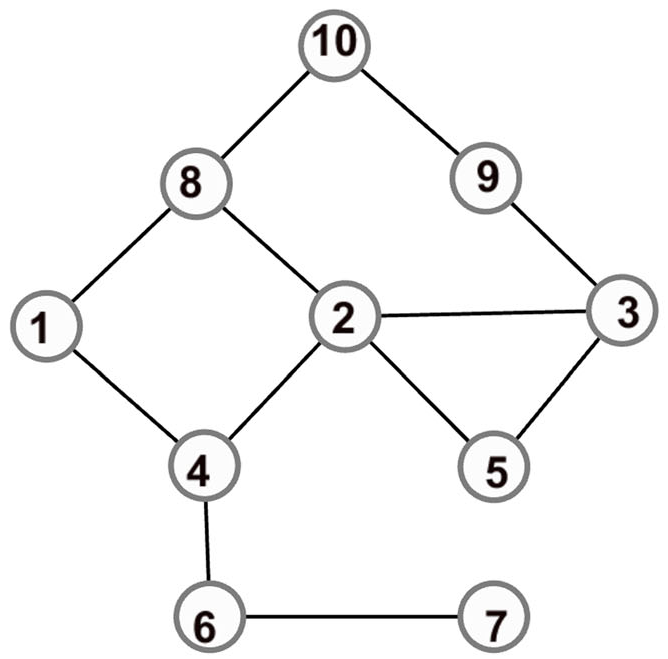
The TLGreedy algorithm leverages this layer structure to update influence gains incrementally. When a new seed is considered, the algorithm only re-calculates the changes within its 3-hop local neighborhood, rather than the entire graph.
Experiments: Scalability Meets Accuracy
The authors tested their method against several heavyweights, including CELFGreedy and PMIA, across datasets of varying scales.
Performance Benchmarks
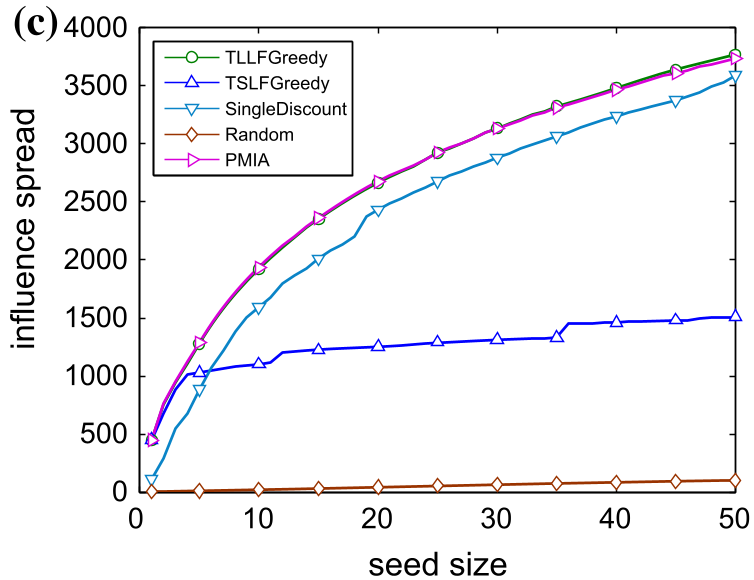
In the Pokec dataset (the largest tested), TLGreedy notably outperformed heuristic methods like SingleDiscount:
Efficiency Gains
The most striking result is the time complexity. By replacing MCS with TLAA, TLGreedy achieved a speedup of three orders of magnitude. While traditional greedy methods failed to complete on large graphs, TLGreedy processed the Pokec network efficiently, demonstrating near-linear growth in execution time relative to seed size .
Critical Analysis & Conclusion
Takeaway
The success of TSCM underscores a vital principle in AI and Network Science: inductive bias matters. By baking the reality of "three-degree limits" into the model architecture, the authors didn't just make a faster algorithm—they made a more accurate one for the social media era.
Limitations & Future Work
- Fixed Decay: The current model assumes fixed values. In reality, decay rates might vary between communities (e.g., niche hobbyist groups vs. general news).
- Static Topology: The model assumes a static graph. Adaptive TSCM for dynamic, time-evolving networks remains an open research frontier.
This work provides a robust blueprint for viral marketing systems that require real-time seed selection in massive-scale social environments.