
Efficient Influential Individuals Discovery: A Community-Based Approximation Approach
Efficient Influential Individuals Discovery on Service-Oriented Social Networks: A Community-Based Approach
The paper introduces two community-based approximation algorithms, BCAA and ICAA, designed for the Influence Maximization (IM) problem in service-oriented social networks. By leveraging network embedding (LINE) and community detection, the proposed methods shift the search for influential individuals from the global network to local communities, achieving a balance between high efficiency and performance guarantees.
TL;DR
This paper tackles the classic Influence Maximization (IM) problem—finding the top- nodes to maximize "word-of-mouth" spread—by shifting the focus from the whole network to its internal communities. By combining Network Embedding (LINE) with two new algorithms, BCAA and ICAA, the authors achieve a performance that is orders of magnitude faster than traditional greedy approaches while maintaining a rigorous theoretical approximation ratio.
Problem & Motivation
In service-oriented social networks like WeChat or Facebook, service providers want to find the most influential users to promote products. Formally, this is the IM problem.
The struggle in this field has always been the "Efficiency vs. Accuracy" wall:
- Greedy Algorithms: Great accuracy ( guarantee) but slow because they re-simulate influence for every node in every iteration.
- Heuristics: Very fast but can fail spectacularly in accuracy because they rely on simple rules like node degree.
The authors' Insight: Communities are dense internally and sparse externally. In the Independent Cascade (IC) model, influence is much more likely to stay within a community than jump between them. Therefore, looking for influencers inside communities is a high-fidelity shortcut.
Methodology: The Community-Driven Engine
The proposed framework consists of two main stages: Network Embedding Based Community Detection (NECD) and Optimized Influence Discovery.
1. NECD (Network Embedding Based Community Detection)
Instead of using traditional graph partitioning, the authors utilize LINE (Large-scale Information Network Embedding). LINE projects nodes into a -dimensional space while preserving both 1st-order (direct links) and 2nd-order (shared neighbors) proximity. Once nodes are represented as vectors, a simple K-means clustering defines the communities.
2. BCAA and ICAA
- BCAA (Basic Community-Based Approximation Algorithm): It follows the greedy selection but estimates the "marginal gain" (how many extra people a node influences) only within that node's community. This reduces complexity by a factor of (the number of communities).
- ICAA (Improved Community-Based Approximation Algorithm): This is the "Turbo" version. It uses a Priority Queue and the Submodularity Property. Because influence gains only decrease as we add more seeds, ICAA "lazily" recomputes gains only for the top candidate in the queue. Crucially, a seed added in Community A only requires re-checks for nodes in Community A, leaving other communities untouched.
 Figure 1: The ICAA logic utilizing a priority queue and community-aware updates.
Experiments & Results
The authors tested their methods on diverse networks: WeChat, Facebook, and Epinions.
- Speed: As shown in the running time charts, BCAA and ICAA (yellow and cyan lines) are significantly faster than the standard GA. ICAA, in particular, shows an almost flat time curve even as the number of seed nodes increases, whereas CELF++ still scales upward.
- Accuracy: The approximation ratio of BCAA/ICAA stays consistently above 0.9 and approaches 1.0 (the performance of the expensive Greedy Algorithm) as gets larger.
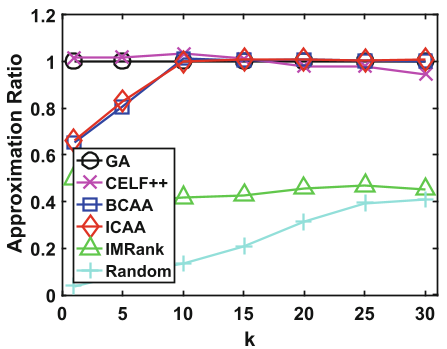 Figure 2: Running time testing on different datasets (Note the logarithmic scale for Time).
Critical Analysis & Takeaways
Key Contribution: The marriage of network embedding and community-based greedy selection provides a scalable way to handle IM without losing theoretical ground. The use of LINE ensures that the community boundaries are not just based on edges, but on structural similarity.
Theoretical Insight: The authors provide a new approximation bound: . This acknowledges that the "error" depends on —the influence that leaks out to other communities.
Limitations:
- The performance highly depends on the quality of community detection. If the network doesn't have a clear community structure, the approximation might degrade.
- The Independent Cascade (IC) model is the only propagation model tested; performance on the Linear Threshold (LT) model remains to be seen.
Future Work: This approach paves the way for "Local Influence Maximization" where massive global graphs are no longer a bottleneck for real-world marketing applications.