
HC-ELBLF: Boosting Efficiency in Multi-Category Social Relationship Recommendation
An efficient latent-factor-based approach to social relationship recommendation
The paper introduces HC-ELBLF, an efficient latent-factor-based recommender system designed for industrial multi-category social relationship prediction. It categorizes real-world social ties beyond simple friendship and optimizes the Extended Linear Bias Latent Factor (ELBLF) model using a hill-climbing algorithm for faster parameter selection.
TL;DR
Social recommendation is evolving from simple "friend suggestions" to complex industrial applications like human resource management and crime analysis. This paper presents HC-ELBLF, a framework that categorizes real-world social ties (colleagues, family, etc.) and utilizes an optimized Latent Factor (LF) model. By replacing exhaustive grid search with a hill-climbing strategy, the authors achieved state-of-the-art accuracy with a massive reduction in computational time.
Background: Beyond the "Friend" Button
Most social recommenders today are built for virtual communities, treating every connection as a "friendship." However, in industrial information systems—such as head-hunting or customer relationship management (CRM)—relationships are multi-dimensional. A colleague is not the same as a classmate, and a family member is not just another "contact."
The challenge lies in two areas:
- Data Sparsity: Real-world relationship categories are High-Dimensional and Sparse (HiDS).
- Computational Cost: Modern models like the Extended Linear Bias Latent Factor (ELBLF) model provide high accuracy by using bias vectors, but they are notoriously slow because they require "grid searching" for the optimal number of biases.
Methodology: High Accuracy Meets Greedy Efficiency
1. Multi-Category Data Modeling
The authors define social relationships through a category dimension (11 types including family, colleague, business, etc.) and a belonger dimension. They transform raw interaction data (like comment frequency on Flickr) into a structured user-relationship rating matrix.
2. The HC-ELBLF Algorithm
The core contribution is the integration of the Hill-Climbing (HC) algorithm into the ELBLF model. In standard ELBLF, the predicted rating is calculated as:

Where and are the lengths of user and item bias vectors. Finding the best usually involves checking every single combination (Grid Search). The authors' Hill-Climbing approach starts at a specific point and only looks at immediate neighbors, moving only if the error decreases.
Experiments and Results
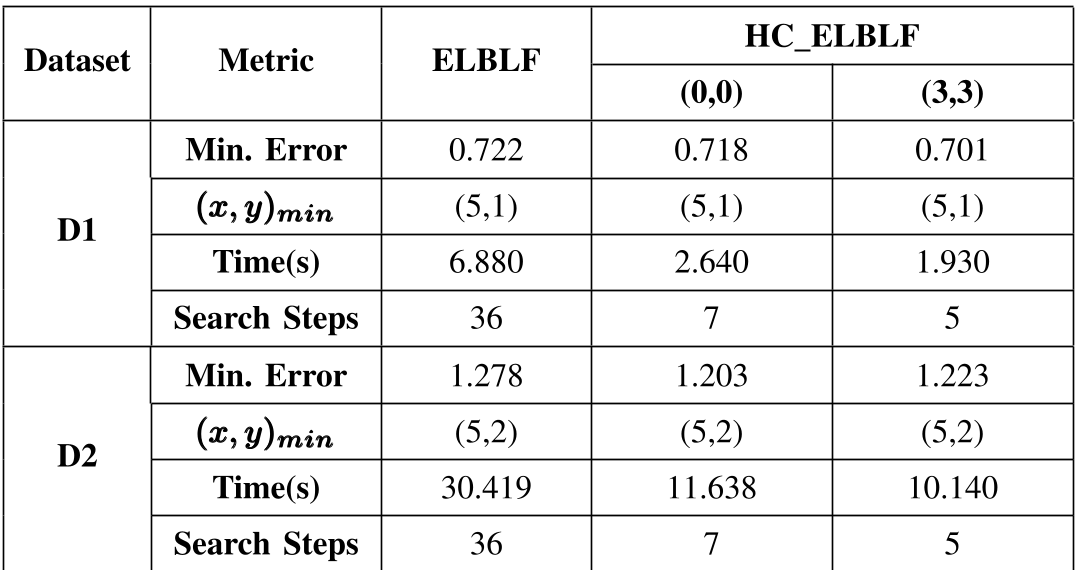
The model was tested on two industrial datasets from Flickr (PASCAL and ImageCLEF). The results demonstrate a clear "win-win" scenario:
- Accuracy: The Root Mean Squared Error (RMSE) remained virtually identical to the original ELBLF, proving that the local optimum found by hill-climbing is sufficient for industrial needs.
- Speed: Training time and search steps were cut drastically. On the D2 dataset, search steps dropped from 36 to just 5, nearly a 7x improvement in search efficiency.
Critical Insight: Why Greedy Works Here
In many machine learning problems, greedy algorithms like hill-climbing risk getting stuck in "local minima." However, the authors observed that in the bias-space of ELBLF models, 90% of the cases exhibit a single extreme value (a convex-like property). This empirical observation justifies why a simpler, faster search method can replace expensive exhaustive searches without losing accuracy.
Conclusion & Future Outlook
The HC-ELBLF approach proves that for industrial information systems, the complexity of real-world social categories can be modeled efficiently. By focusing on the physics of the parameter space—noting its single-peak nature—the authors moved away from "brute-force" computation toward "intelligent" searching.
Future Work: The next step involves refining "relationship strength" calculations and perhaps exploring if these greedy optimizations hold true for even higher-dimensional latent factor spaces or deep hybrid models.
Takeaway for Practitioners: Don't default to Grid Search for hyperparameter tuning. If your error surface is relatively smooth with a clear trend, a Hill-Climbing strategy can save you hours of compute time.