
Strategically Breaking Chains: The Art of Link Cuts in Social Networks
Efficient Link Cuts in Online Social Networks
This paper introduces CDegree Cut, a novel strategy for mitigating the spread of misinformation and malware in Online Social Networks (OSNs) by strategically removing links. By evaluating strategies against metrics like Average Inverse of Shortest Path Length (AIPL) and Rumor Saturation Rate (RSR) on real Facebook data, the authors identify optimal edge-cutting configurations based on allowable propagation delay.
TL;DR
In the digital age, we usually focus on connecting people. However, when rumors and malware spread like wildfire, the best defense is knowing which links to break. This paper introduces CDegree Cut, a strategy-based approach to slowing down misinformation. The key discovery? If you want to stop a rumor early, attack the "hubs" (popular nodes); if you want to limit its final reach, isolate the "leaves" (peripheral nodes).
Problem & Motivation: The Defense Gap
Most social network research focuses on Link Prediction—predicting who will become friends next to improve recommendations. But in the face of a "digital pandemic" (misinformation or viruses), there is a critical lack of research on Link Cuts.
The authors argue that simply cutting links randomly is inefficient. The challenge lies in the "highly connected" nature of modern OSNs like Facebook. Because these graphs are dense, traditional methods fails to account for how rumors bypass bottlenecks. The motivation was to find a computationally cheap yet effective way to prune a graph to minimize its Rumor Saturation Rate (RSR).
Methodology: The CDegree Cut Framework
The researchers proposed a systematic way to choose which edges to remove based on Node Degree. They split the decision into two parts:
- Node Selection: Which node's link do we cut first?
- Neighbor Selection: Which of that node's neighbors do we disconnect?
By combining "High," "Medium," "Low," and "Random" strategies for these two steps, they created 16 unique strategies (e.g., High-High cuts the link between two very popular people).
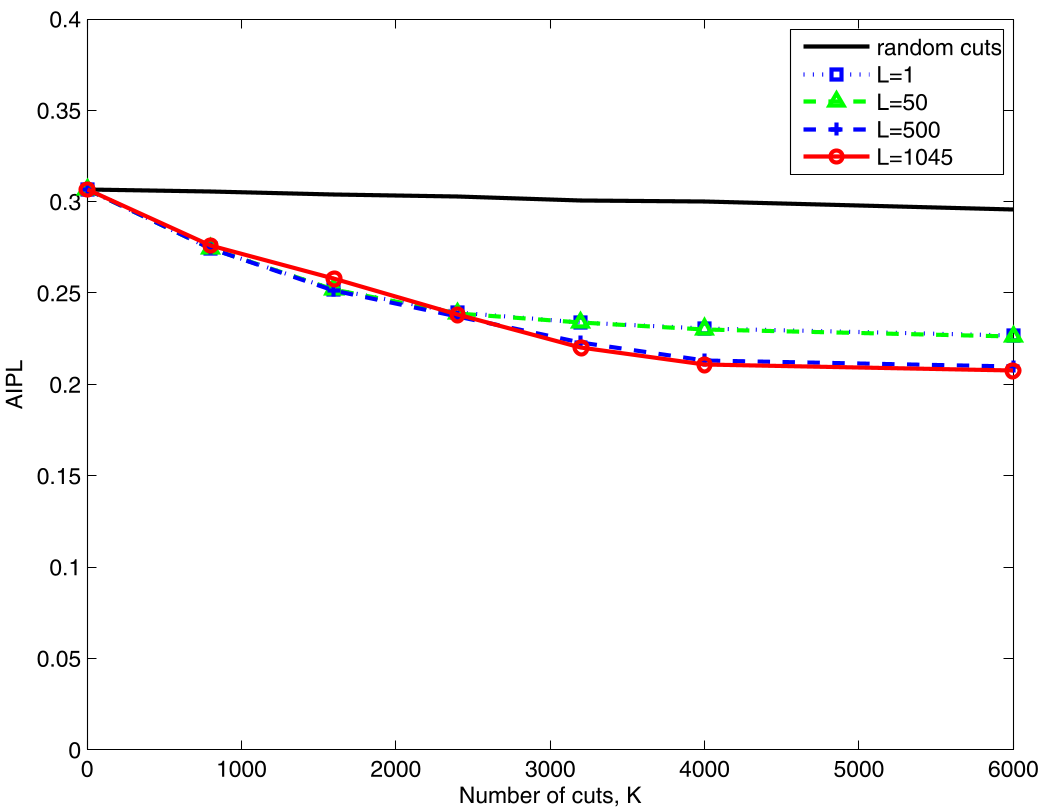 Note: The parameter acts as a "knob" to control how often the system re-calculates degrees after cuts, balancing accuracy with speed.
The Intuition of Delay ()
The most profound insight of this paper is that the "best" strategy depends on Time (Delay):
- Small Delay ( APL): The rumor hasn't gone far. Cutting "High-Random" (hubs) works best because it breaks the bridges rumors use to hop across the network quickly.
- Large Delay ( APL): The rumor has already saturated the core. "Low-Low" cuts work better here because they fully isolate peripheral nodes, ensuring the rumor can never reach them, regardless of time.
Experiments & Results
Using real-world Facebook data from SNAP, the authors tested these strategies against a baseline of random cuts.
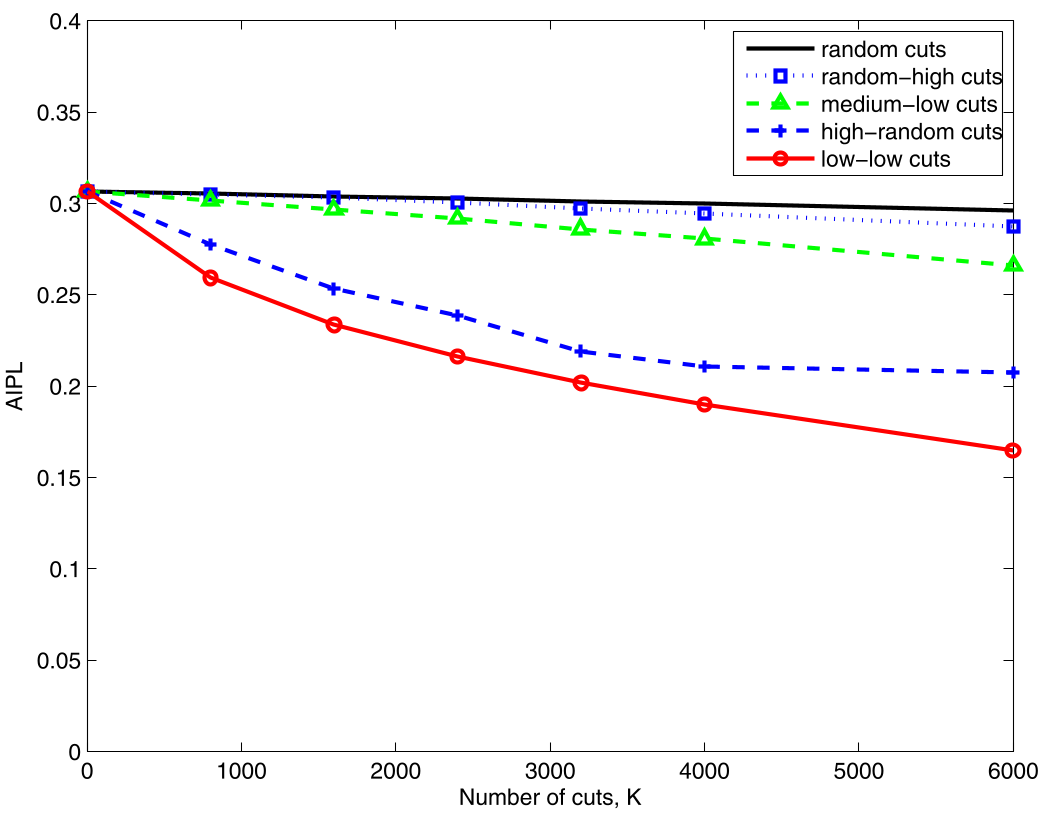 In terms of general communication efficiency (AIPL), Low-Low cuts appear to be the most destructive to the graph's connectivity.
However, when looking at the Rumor Saturation Rate (RSR), a more complex picture emerges. In the plots below, we see the crossover:
- For (S=2, D=5): Low-Low is the winner (lowest RSR).
- For (S=2, D=2): High-Random becomes more effective at the start.
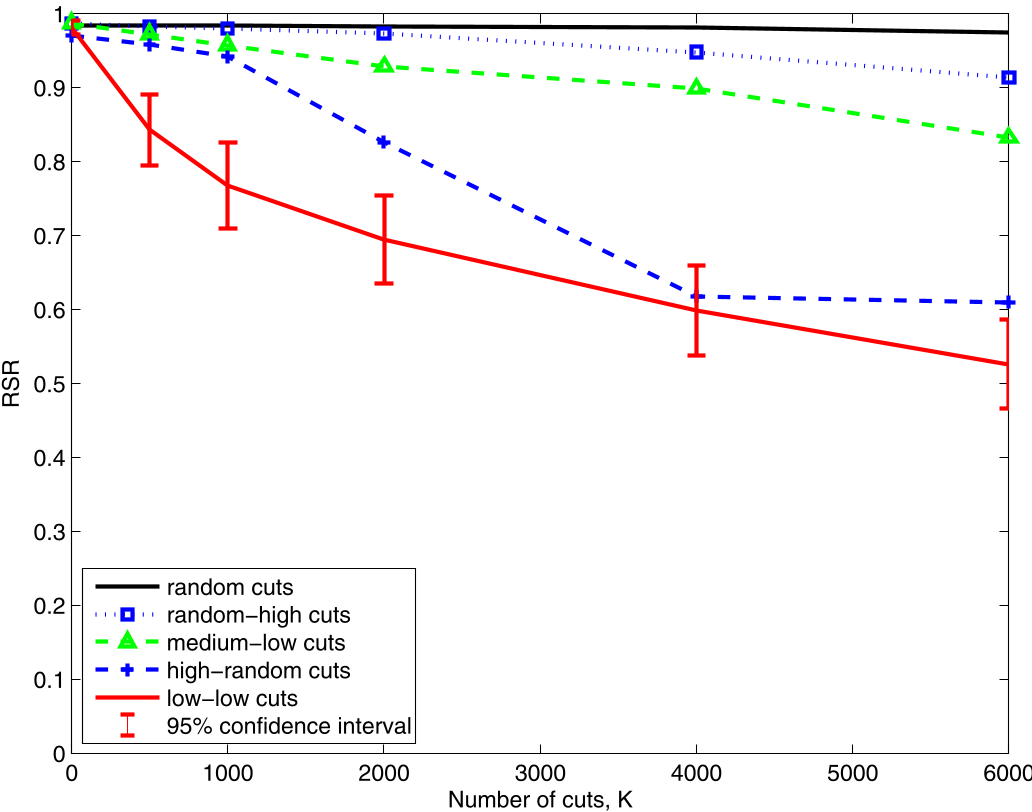 (Left: Long delay favors Low-Low; Right: Short delay favors High-Random)
Critical Analysis & Conclusion
Takeaway
This work shifts the focus from "growth" to "resilience." It proves that "degree-based" heuristics, while simple, are powerful tools for network defense if applied with an understanding of the rumor's propagation timeline.
Limitations
- Fixed Topology: The paper assumes we cut links on a static graph, but social networks are dynamic.
- Blind Sources: The strategy assumes we don't know who started the rumor. If the source is known, "neighborhood pruning" around the source would likely be even more effective.
Future Outlook
This research provides a foundation for automated "firewalls" in social media platforms. Future iterations could incorporate Machine Learning to predict which specific links are most likely to transmit misinformation based on content sentiment, not just node degree.