
LBSTS: Balancing the Scales in Spatial Crowdsourcing
Efficient and Load Balancing Strategy for Task Scheduling in Spatial Crowdsourcing
The paper proposes the Load Balancing based Spatial Task Scheduling (LBSTS) problem, aimed at optimizing task assignment in spatial crowdsourcing. It introduces the Load Balancing Algorithm (LBA) and a Divide-and-Conquer (DCA) variant to minimize the maximum workload among workers while ensuring high task completion rates.
TL;DR
In the world of on-demand services like Uber or Meituan, simply matching a worker to a task isn't enough. If one delivery rider has ten orders while another has none, the system fails both the worker and the customer. This paper introduces a novel scheduling framework called LBSTS (Load Balancing based Spatial Task Scheduling) that utilizes Location Entropy and Imbalance Ratios to ensure no single worker is overwhelmed, successfully reducing average travel costs by up to 30% while increasing task completion rates.
Background & Motivation: The Fairness Gap
Spatial crowdsourcing (SC) has moved from simple data collection to complex logistics (food delivery, ride-sharing). Traditional algorithms have focused on a "Global Optimum" of maximizing completed tasks (). However, this often creates a "bottleneck" effect:
- Worker Overload: Certain geographic hotspots overwhelm local workers.
- Long Wait Times: Overloaded workers cannot complete tasks within time-sensitive windows.
- Inefficiency: Workers in "cold" zones remain underutilized.
The authors argue that a truly efficient system must minimize the maximum workload of any single worker to ensure a fair and rapid response across the entire network.
Methodology: The Three Pillars of Balance
The core of the proposed Load Balancing Algorithm (LBA) rests on three mathematical insights:
1. Imbalance Ratio
Instead of just looking at the current task, LBA calculates the variance of workloads across all workers. It asks: "If I give this task to Worker A, how much does it increase the overall system's inequality?"
2. Task Location Entropy
Not all tasks are created equal. Some tasks are in remote areas where only one or two workers can reach them. These tasks have low entropy. LBA assigns these high-priority status because if those specific workers are assigned elsewhere, the task might never be completed.
3. Workload Utility
The algorithm prioritizes pairs of (Task, Worker) that provide the highest "ratio" of balance improvement per unit of workload added.
 The optimization formula combining Imbalance Ratio and Location Entropy.
Scalability: Divide and Conquer (DCA)
As the number of tasks () and workers () grows into the thousands, computing global imbalance becomes expensive. The authors introduce DCA, which:
- Partitions the map into balanced zones based on task density.
- Solves the LBA locally within those partitions.
- Merges unassigned tasks/workers in a final cleanup phase.
Experimental Validation
Using the Gowalla dataset and synthetic distributions (Uniform vs. Mixture), the researchers compared their Baseline (BLA), LBA, and DCA.
Key Findings:
- Effectiveness: LBA completed 1,286 more tasks than the baseline on the Gowalla dataset.
- Efficiency: Average travel cost dropped from 7.8 to 5.5, indicating more logical, localized routing.
- Scalability: DCA showed superior performance in "Mixture" distributions (clustered tasks), proving its robustness for real-world urban environments.
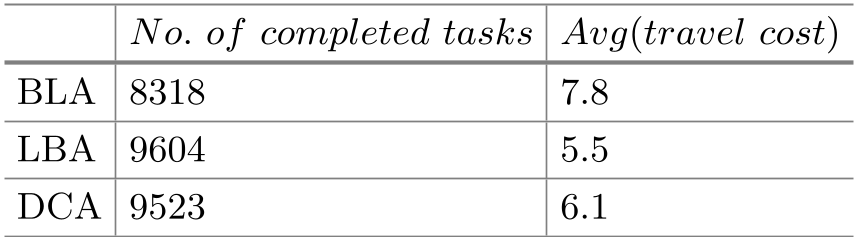 Numerical results showing LBA outperforming BLA in completion and cost.
Critical Insight & Future Outlook
The most striking takeaway is that Fairness = Efficiency. By preventing worker burnout and localized bottlenecks, the system naturally finds shorter paths and more reliable assignments.
However, the paper assumes a static scenario (all tasks known upfront). The next frontier for this research will be adapting these load-balancing heuristics to online/streaming environments where travel costs change in real-time due to traffic, and tasks expire in minutes.
Conclusion
LBSTS provides a mathematically rigorous way to handle the "Human Factor" in crowdsourcing. By treating worker capacity as a balanced resource rather than just a variable to be maximized, it paves the way for more sustainable and responsive O2O (Online-to-Offline) platforms.