
T-MONTE-K: Navigating the Complex Web of Social Trust through Bidirectional Monte Carlo
An Efficient Method to Find the Optimal Social Trust Path in Contextual Social Graphs
The paper introduces T-MONTE-K, an efficient approximation algorithm designed to find the optimal social trust path in Contextual Social Graphs (CSG). By mapping the multi-constrained trust evaluation problem to the NP-Complete Multi-Constrained Optimal Path (MCOP) framework, the authors combine Monte Carlo simulations with bidirectional search strategies to achieve high-quality path selection in polynomial time.
TL;DR
Trust is the currency of the digital age, yet finding the most reliable "connection path" in a massive social network is an NP-Complete challenge. This paper presents T-MONTE-K, an algorithm that uses a clever bidirectional Monte Carlo simulation to find optimal trust paths under multiple constraints (Trust, Intimacy, and Expertise) much more effectively than previous greedy approaches.
Background: Why Shortest Paths Aren't Enough
In traditional networking, the "shortest path" is king. But in Social Psychology, trust is not just about distance. If you are looking for a car recommendation, a path through a mechanic friend is far more valuable than a shorter path through a librarian.
Existing methods faced a wall:
- Complexity: Checking every path is computationally impossible.
- Context Blindness: Earlier models ignored social roles and relationship depth.
- Efficiency: Precise heuristics (Dijkstra-based) are too slow for real-time OSNs with millions of nodes.
Methodology: The "Twice-Monte Carlo" Strategy
The authors model the problem as a Multi-Constrained Optimal Path (MCOP) selection. The core innovation, T-MONTE-K, breaks the search into two distinct phases using the Monte Carlo method:
1. Quality of Social Trust Path (QoSTP)
The paper defines QoSTP using three dimensions:
- Social Trust (): Direct belief in a node's competence.
- Social Intimacy (): The strength of the relationship tie.
- Role Impact (): The expertise level of the participant.
2. The Algorithm Mechanics
- Backward Search (Target to Source): The algorithm starts at the target and searches backward to find a "feasible" route. It minimizes a violation function , identifying nodes that are likely to lead to a path satisfying all constraints.
- Forward Search (Source to Target): Armed with the "foreseen" feasibility from the backward pass, the forward search identifies the path that maximizes Utility ().
- K-Path Strategy: Instead of exploring every neighbor, it only keeps the top candidates at each step, drastically reducing the search space to , where is simulations and is max outdegree.
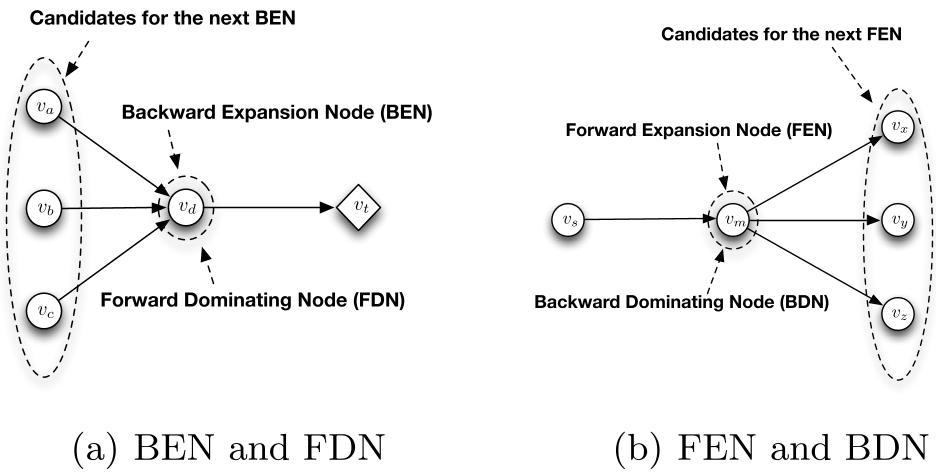 Figure: The interaction between Forward Expansion Nodes (FEN) and Backward Expansion Nodes (BEN) during the search process.
Experiments and Results
Testing on the Epinions dataset (88k nodes, 717k links), T-MONTE-K was pitted against the previous SOTA, MONTE K.
- Path Quality: T-MONTE-K delivered a 37.2% higher average utility. By considering both feasibility and utility, it avoided "dead-end" paths that were valid but low-quality.
- Robustness: As simulation times increase, T-MONTE-K converges to the optimal solution, whereas greedy methods often get stuck in local optima.
- Efficiency Trade-off: While execution time is higher than the basic MONTE K (due to the double-pass), it remains significantly more efficient than full heuristic searches, proving to be a viable middle ground for large graphs.
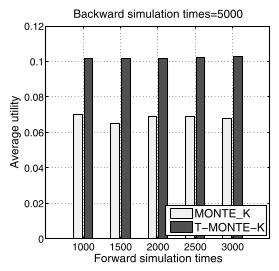 Figure: Comparison of Average Path Utility where T-MONTE-K consistently outperforms the baseline.
Critical Insight: The Power of Foresight
The brilliance of T-MONTE-K lies in the Strategy 4 (Forward Dominating Nodes). By storing the results of the backward pass at intermediate nodes, the forward search doesn't just "wander" toward the target—it makes informed decisions based on what lies ahead. This "look-ahead" capability turns a probabilistic search into a highly effective optimization tool.
Conclusion
T-MONTE-K bridges the gap between theoretical social psychology and high-performance graph computing. By formalizing trust through and and employing a bidirectional Monte Carlo approach, it provides a robust framework for applications ranging from expert search to decentralized finance and recruitment.
Future Work: The authors aim to test this on even larger datasets to further prove the scalability of the complexity in hyper-scale social networks.