
IPLWAH-Miner: Taming Sparse Big Data in Social Network Analytics
Efficient Mining of 'Following' Patterns from Very Big but Sparse Social Networks
The paper introduces IPLWAH(k)-Miner, a specialized algorithm for discovering frequent "following" patterns in massive but sparse social networks. It leverages a novel Improved Position List Word-Aligned Hybrid (IPLWAH) bitwise compression scheme to perform efficient pattern mining directly on compressed data, significantly reducing memory overhead.
Executive Summary
TL;DR: In the era of billion-user platforms, social networks are "Big but Sparse"—most users follow only a tiny fraction of the available entities. This paper presents IPLWAH(k)-Miner, a high-performance mining framework that uses an improved bitwise compression scheme to discover frequent "following" patterns. By embedding significant "1" bits directly into compressed "0" fill-words, the authors achieve a 10x reduction in memory footprint and drastic speed improvements over traditional mining algorithms.
Positioning: This work is a SOTA optimization in the field of frequent pattern mining (FPM), moving beyond simple tree-based or array-based structures to "Compressed-Domain Analytics."
The "Sparsity" Bottleneck
Modern social networks like Twitter or Weibo are represented mathematically as adjacency matrices. However, these matrices are incredibly sparse. If you represent every follower-followee relationship with a bit, you end up with a "sea of zeros" peppered with occasional ones.
Previous works (like FoP-Miner) struggle because:
- Memory Bloat: Storing uncompressed bits is impossible at scale.
- Computation Waste: Traditional algorithms scan across long sequences of zeros, wasting CPU cycles.
- Random Access: Most compression schemes require decompressing the whole stream just to check a single relationship, making iterative mining (like finding triplets of followed users) painfully slow.
Methodology: The Magic of IPLWAH(k)
The core innovation is the Improved Position List Word-Aligned Hybrid (IPLWAH) scheme.
From WAH to PLWAH
Standard WAH compression splits data into 32-bit words. A "Fill Word" represents a long run of 0s. However, most fill words don't use the full 30 bits available for the "length" of the run.
IPLWAH exploits this by taking the position of a '1' in a literal word and storing it inside the preceding fill word.
- IPLWAH(1): Stores one '1' position within the fill word.
- IPLWAH(k): Uses bits to capture the positions of ones.
 Table: The internal array structure of IPLWAH(3), showing how literal positions are embedded into fill words.
Mining Without Decompressing
The IPLWAH-Miner algorithm performs "conceptual cuts" on the SocialTable. Instead of regenerating a new database for each mining step, it uses the compressed bit vectors to jump directly to the users who follow a specific group, utilizing bitwise AND and OR operations directly on the compressed words.
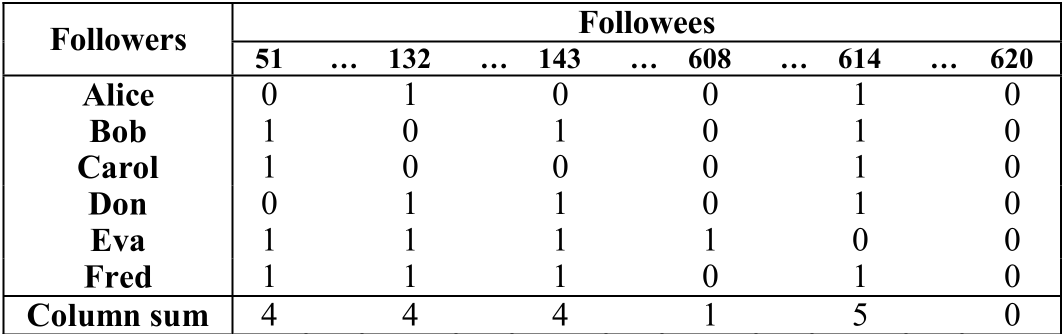 Table: The logical representation of a SocialTable where followers and followees are mapped; the algorithm identifies frequent clusters like {51, 132, 143}.
Experimental Results
The authors tested the algorithm on various datasets, including the Stanford Large Network (Twitter) dataset.
- Memory Efficiency: The compressed table consumed only 13% of the memory required for the raw data.
- Runtime Performance: By finding the "next 1 bit" in time rather than , the algorithm outperformed the existing FoP-Miner and WAH-Miner across all sparsity levels.
- Scalability: Unlike FP-Growth, which crashes when the tree structure exceeds RAM, IPLWAH-Miner remains stable due to its linear compressed storage.
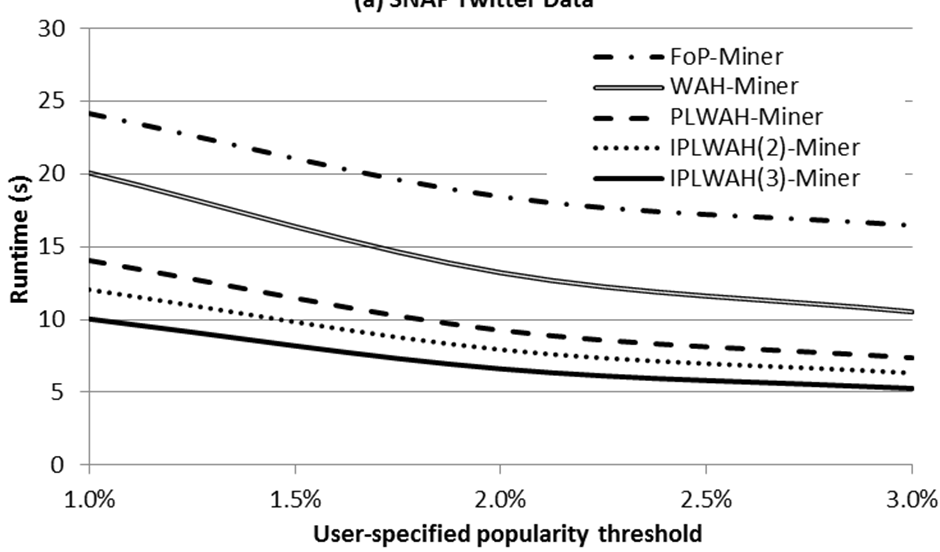 Table: Analytical proof that Level-1 SocialTable can be conceptually derived for frequently followed pairs.
Critical Insight & Conclusion
The genius of this paper lies in its Index-ready Compression. Most compression is designed for storage; IPLWAH is designed for computation. By treating the compressed bits as a searchable index rather than just a zipped file, the authors eliminate the "decompression tax" that slows down Big Data analytics.
Limitations: The value of (the number of stored '1' positions) must be tuned. If is too high, there isn't enough space to store the length of the zero-run (). Furthermore, the method is highly optimized for "following" relationships but may need adaptation for more complex, weighted social interactions (e.g., frequency of interaction).
Future Outlook: As social graphs move towards the "Trillion-edge" scale, techniques that merge bitmap indexing with pattern mining—like IPLWAH—will be essential for real-time recommendation engines.