
SMAP-Mine: Synchronizing Movement and Service Patterns for the Intelligent Mobile Web
Efficient mining and prediction of user behavior patterns in mobile web systems
This paper introduces SMAP-Mine, a novel data mining algorithm designed to discover Sequential Mobile Access Patterns (SMAP) that integrate both user movement and requested services. It achieves state-of-the-art performance in mining efficiency and prediction accuracy for location-based services (LBS) in mobile web systems.
TL;DR
In the mobile web era, understanding where a user is going is only half the battle; knowing what they will ask for at that destination is the "Holy Grail" of service optimization. This paper presents SMAP-Mine, an efficient framework that mines integrated movement-service sequences and uses an extended N-gram model to predict future user transitions with high precision and scalability.
Problem & Motivation: The Silo Effect in Mobile Mining
Traditional mobile behavior analysis has long suffered from a "Silo Effect." Researchers focused either on Mobility Mining (predicting the next cell tower or GPS coordinate) or Web Usage Mining (predicting the next URL).
However, in a real-world scenario—such as a tourist in Soho looking for a restaurant after visiting a Broadway theater—the location and the service are inextricably linked. Previous methods failed to capture this joint distribution, leading to suboptimal resource prefetching and less relevant recommendations. The authors' insight is simple yet powerful: The "Where" and the "What" must be mined as a unified sequence.
Methodology: SMAP-Tree and Dual-Layer Mining
The core innovation lies in the SMAP-Tree architecture, which allows for frequent pattern mining without the expensive overhead of candidate generation.
1. The Data Structure
Unlike traditional FP-Trees, the SMAP-Tree employs a hierarchical approach:
- Main SMAP-Tree: Tracks the sequential movement of users (e.g., Location A -> B -> C).
- SR-Tree (Service Request Tree): Attached to the tail nodes of the movement sequences, it stores the specific services requested associated with that path.
2. The SMAP-Mine Algorithm
The algorithm utilizes a depth-first search (DFS) approach to recursively construct conditional trees. Its primary advantage is efficiency: it requires only one physical scan of the database to build the initial tree, after which all frequent patterns are extracted in-memory.
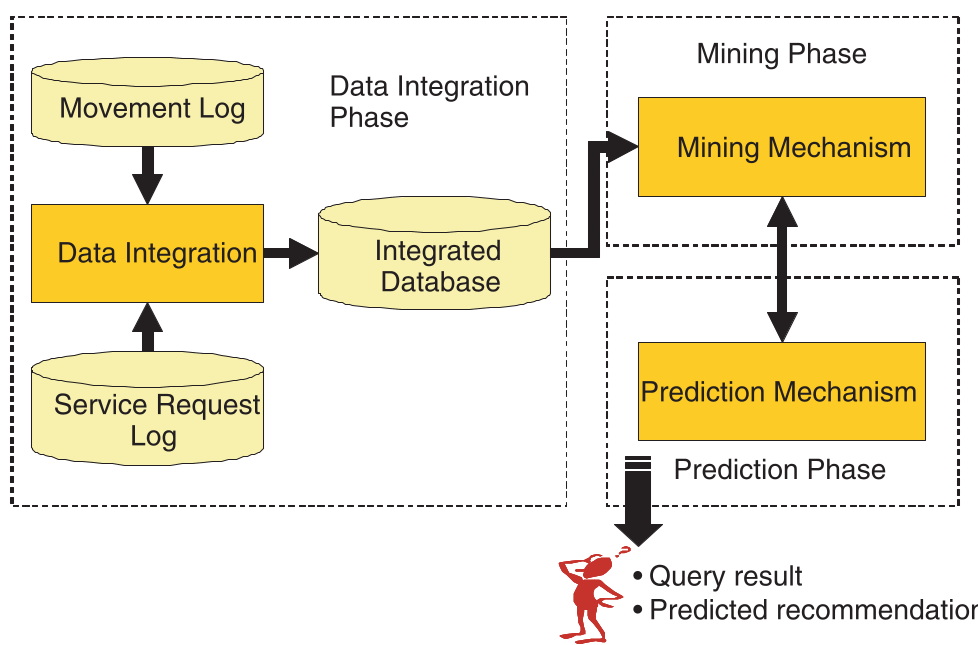 Fig 1. The three-phase workflow: Data Integration, Mining (SMAP-Mine), and Prediction.
Prediction Strategies: Beyond Accuracy
The paper introduces Sequential Mobile Access Rules (SMAR) categorized into three prediction types:
- SMAR-L: Predicting the next location ().
- SMAR-S: Predicting the next service ().
- SMAR-L&S: Predicting the joint pair ().
A critical technical detail is the use of Strength instead of just Confidence.
This prevents the system from over-relying on "rare but certain" rules that only apply to a tiny fraction of users—a common pitfall in real-world recommendation systems.
Experiments & Results
The authors conducted extensive simulations involving 100,000 users and 10,000 distinct services.
Scalability and Efficiency
The execution time for SMAP-Mine grows linearly with the number of users, proving its readiness for large-scale deployments. Interestingly, a variation called CMAP-Mine (Continuous Mobile Access Patterns) was even faster, as it enforces stricter adjacency requirements, resulting in a smaller search space.
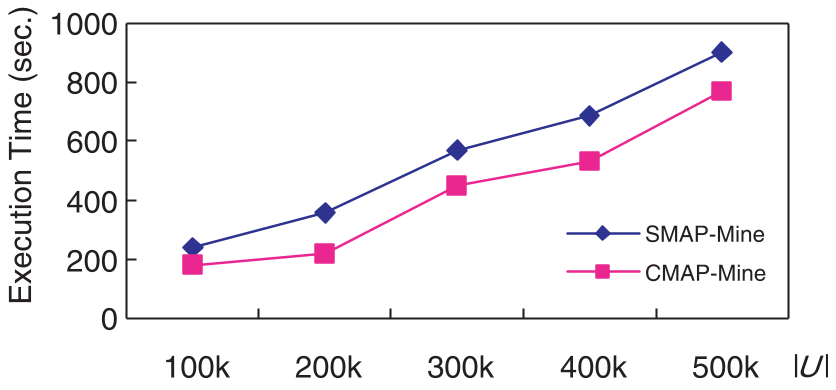 Fig 2. The algorithm retains high efficiency even as the support threshold decreases, outperforming standard sequential mining benchmarks.
The Impact of TOP-N Constraints
In a mobile system with limited bandwidth, you can't prefetch everything. The experiment on TOP-N constraints demonstrated that the Strength ranking consistently yields a higher Hit Ratio than Confidence ranking. When the system is limited to the top 2-4 predictions, picking the most "popular and likely" ones is far more effective than just the "most likely."
Critical Analysis & Conclusion
Takeaway: SMAP-Mine effectively bridges the gap between mobility and service mining. By treating the location-service pair as a single "atom" of user behavior, it creates a much richer context for LBS.
Limitations:
- Temporal Dynamics: The model treats sequences as logical steps but largely ignores the time interval between steps (e.g., a 5-minute gap vs. a 5-hour gap).
- Cold Start: Like most frequent-pattern-based methods, it struggles with new users or rarely visited locations where support is below the threshold.
Future Outlook: Integrating these tree-based structures with modern Graph Neural Networks (GNNs) could capture even more complex spatial dependencies, while retaining the explainability and efficiency that SMAP-Mine offers.