
Beyond Single Tasks: Orchestrating Complex Mobile Crowdsourcing for Smart Cities
Efficient Processing of Mobile Crowdsourcing Queries with Multiple Sub-tasks for Facilitating Smart Cities
The paper introduces "MCmS" (Mobile Crowdsourcing queries with multiple Sub-tasks), a framework for handling complex urban informatics tasks by decomposing them into interdependent sub-tasks. It proposes two novel processing schemes, BMS (Broker-based) and DMS (Distributed), which optimize task allocation to mobile peers based on proximity and performance history.
TL;DR
This research introduces a paradigm shift from simple single-task sensing to MCmS (Mobile Crowdsourcing with multiple Sub-tasks). By proposing two complementary architectures—the broker-led BMS and the fully decentralized DMS—the authors provide a roadmap for solving complex urban queries (like finding a parking spot then checking restaurant ambiance) using the power of mobile peers.
Problem & Motivation: The Gap in Urban Informatics
Smart city initiatives often rely on "crowdsensing," where users contribute data about traffic or parking. However, real-life needs are rarely isolated. If a user wants to visit a spa, they don't just need to know if the spa is open; they need a parking spot nearby within a specific time window and information on current wait times.
Existing SOTA methods treat these as independent events. This paper argues that this creates massive inefficiencies. The core challenge is spatio-temporal dependency: sub-tasks must be completed within a specific radius and before a hard deadline to make the overall query "successful."
Methodology: Coordination via Brokers vs. Peers
The authors suggest two distinct paths for task allocation:
1. BMS (Broker-based processing of Multiple Sub-tasks)
In this scheme, "Brokers" (such as a restaurant manager's laptop or a stationary high-power device) act as local orchestrators.
- The Ranking Logic: Brokers assign sub-tasks using a scoring formula () that weights two factors:
- Distance: How close the peer is to the task location.
- Reputation: The peer's historical reliability (Score).
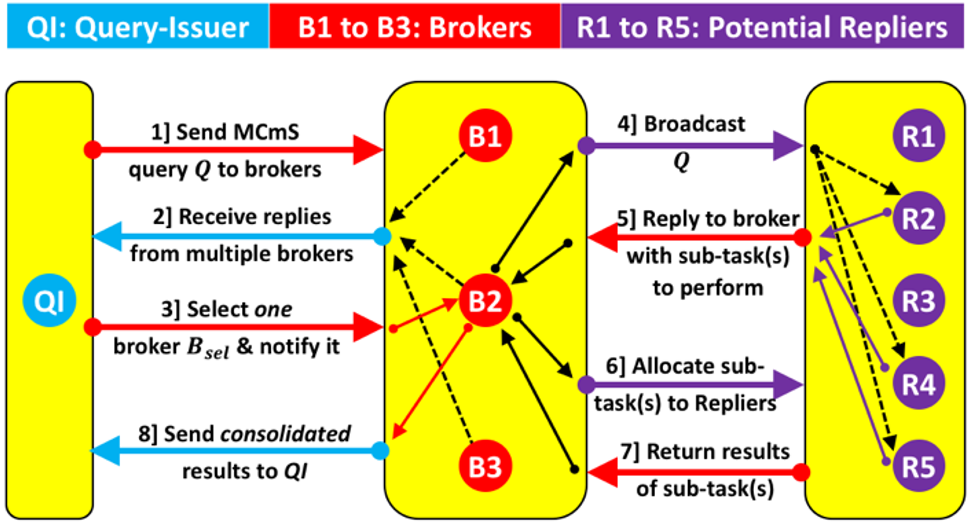 Figure 1: The BMS flow shows the Broker (B2) acting as a central clearinghouse for mobile peers (R2, R4, R5).
2. DMS (Distributed processing of Multiple Sub-tasks)
For environments where no trusted broker exists, the DMS scheme allows the Query-Issuer (the user) to coordinate directly.
- The Insight: To minimize communication overhead, DMS prioritizes peers who can handle multiple sub-tasks effectively. It calculates the average distance a peer would have to travel to cover all its requested tasks and sorts them to find the most "local" multi-taskers.
Experiments & Results: Performance vs. Efficiency
The researchers evaluated the models using OMNET++ simulations with 100 mobile peers.
Key Findings:
- Success Rate (SR): BMS consistently outperformed DMS in success rates because the brokers filtered out unreliable participants using the score mechanism. As the number of sub-tasks increased from 2 to 6, both models saw a dip in success rate, proving that complex queries are inherently harder to satisfy.
- Message Overhead: DMS proved to be the "lean" choice. Because it bypasses the broker layer, it generates significantly fewer messages (MSG), making it ideal for congested networks.
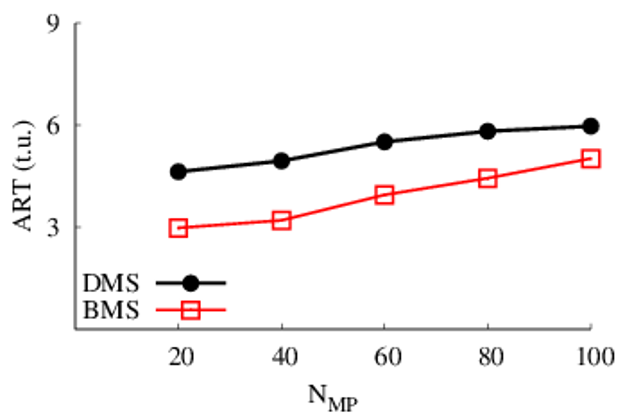 Figure 2: Impact of increasing sub-tasks on Response Time and Success Rate.
Critical Analysis & Conclusion
Takeaway
The paper successfully demonstrates that incorporating reputation scores (in BMS) is the single most effective way to improve query success in mobile environments. While proximity is intuitive, a peer's past behavior is an Inductive Bias that shouldn't be ignored.
Limitations
- Incentives: The paper assumes incentives are already in place. In the real world, the "all or nothing" reward system (no reward for partial completion) might discourage users from joining complex tasks if the risk of one sub-task failing is high.
- Fixed Roles: The distinction between brokers and peers is somewhat rigid. A hybrid approach where high-resource mobile peers "evolve" into brokers dynamically would be more robust.
Future Outlook
The move toward "Urban Informatics 2.0" will require even more complex task graphs. Integrating Multi-Agent Reinforcement Learning (MARL) to optimize these task allocations in real-time could be the next logical step beyond the heuristic-based scoring used here.