
NodeMCU and WSN: A Low-Cost, Cloud-Integrated Strategy for Precision Environmental Monitoring
An efficient approach to monitoring environmental conditions using a wireless sensor network and NodeMCU
This paper presents the design and implementation of an end-to-end IoT monitoring system using a Wireless Sensor Network (WSN) based on the NodeMCU (ESP8266) platform. The system leverages cloud analytics and a custom Web API to provide real-time environmental data visualization and automated alert notifications via web and mobile applications.
Executive Summary
TL;DR: This paper introduces an efficient, affordable Wireless Sensor Network (WSN) system designed around the NodeMCU (ESP8266) to monitor temperature and humidity in critical environments. By integrating a custom Web API and cloud-based mobile applications (Firebase), the system provides real-time monitoring and automated alerts, achieving a significant balance between low power consumption and high data availability.
Positioning: This work serves as a practical, high-value implementation guide in the IoT domain, demonstrating how commodity hardware can be transformed into a professional-grade monitoring solution for sensitive sectors like healthcare and telecommunications.
Problem & Motivation: The High Cost of Precision
In many developing regions and specific industrial contexts (like Kosovo's medical labs), environmental monitoring is either neglected or implemented via prohibitively expensive proprietary systems. The challenges are three-fold:
- Wiring Hazards: Physical cables are difficult to install in established labs or server rooms.
- Power Constraints: Most Wi-Fi-enabled sensors drain batteries rapidly.
- Data Silos: Measurement data often stays local, lacking the remote accessibility needed for immediate intervention.
The authors' insight was to move away from "always-on" heavy-edge processing. By utilizing the NodeMCU’s ability to interface with multiple sensors and its low-power sleep modes, they envisioned a system that is both autonomous and globally accessible.
Methodology: The Edge-to-Cloud Pipeline
The system architecture is built on a distributed WSN model. Each node consists of a NodeMCU interconnected with specialized sensors (DHT11 for air, DS18B20 for soil/water).
Architecture Breakdown
- The Node: The heart of the system is the ESP8266-based NodeMCU. It captures digital and analog signals, performs light preprocessing, and then transmits data via a Wi-Fi bridge.
- Power Management: Crucially, the code utilizes a duty-cycle approach where measurements are taken every 15 minutes, followed by an immediate transition to sleep mode.
- The Cloud Backend: A PHP-based Web API handles incoming JSON data, while Google's Firebase provides real-time synchronization for mobile users.
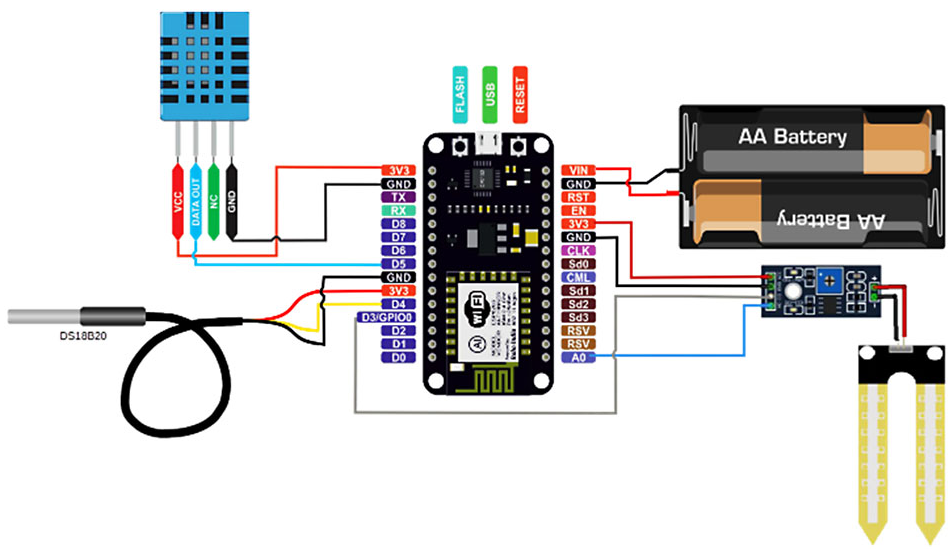 Figure 1: Comprehensive connection diagram of the NodeMCU with DHT11, DS18B20, and YL-69 sensors powered by Li-Po batteries.
Experiments & Results
The system was deployed in two high-stakes environments: a medical laboratory (QKMF) and a Telecom server room.
1. Medical Laboratory (QKMF)
In the lab, equipment requires a strict 15–25 °C range. Over 5 days of monitoring with four sensor nodes, the system accurately captured environmental shifts, providing data points every 5 minutes and confirming that the lab's climate control was functioning within parameters.
2. Telecom Server Room
Monitoring the 18–27 °C range required for server longevity, the system demonstrated its reliability in high-interference electronic environments.
Key Performance Metric: Battery Longevity
A significant finding was the transition from standard Alkaline batteries to 3.7V Lithium Polymer batteries, which extended the operational lifespan of a single node from a mere 5 days to over 14 days, validated through internal system testing.
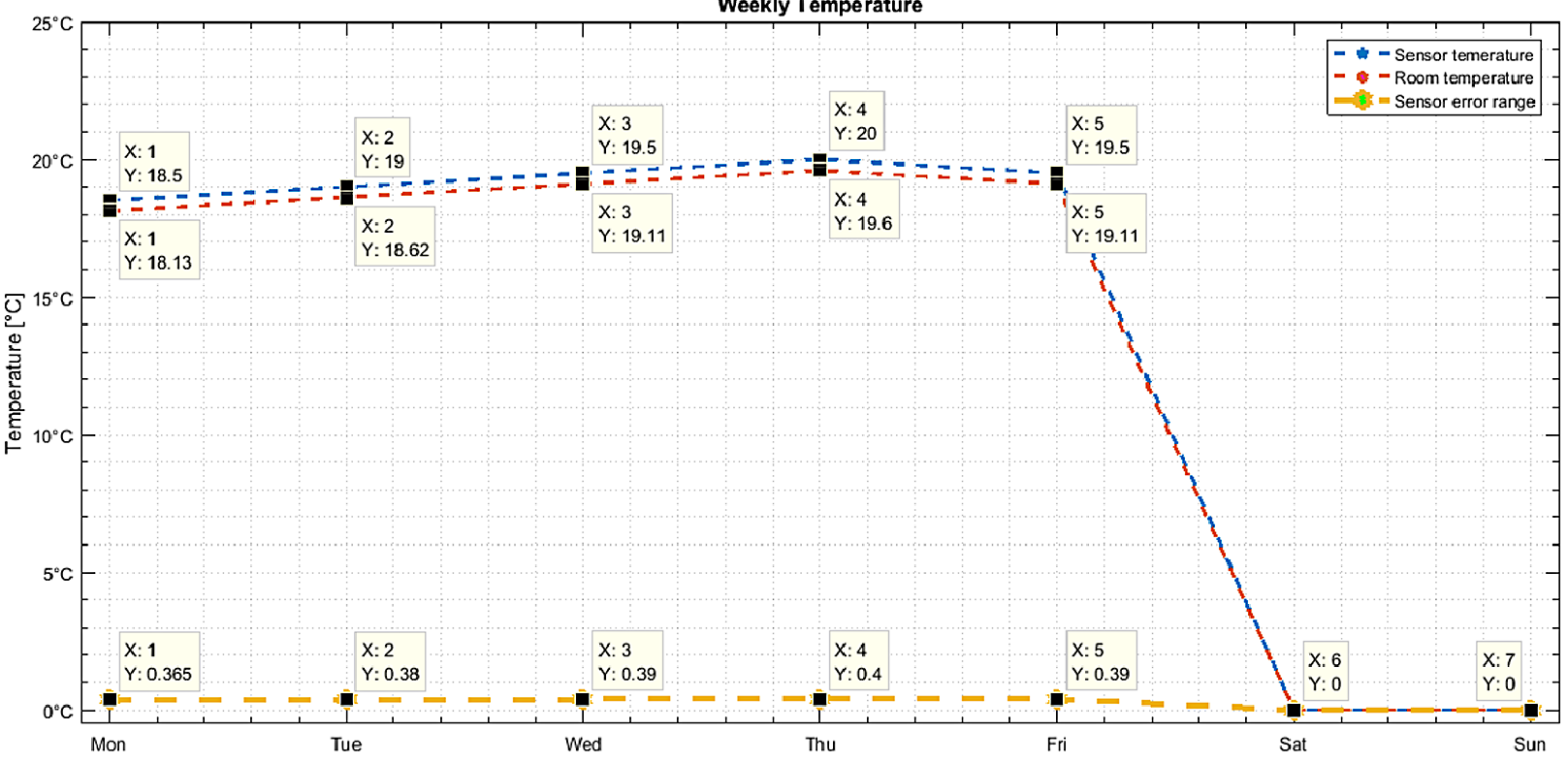 Figure 2: Real-time temperature data visualization from the QKMF laboratory, showing stable environmental maintenance.
Critical Analysis & Conclusion
Takeaway
The integration of NodeMCU with modern cloud platforms like Firebase proves that "industrial-grade" monitoring does not require "industrial-price" hardware. The shift towards lightweight analytics at the edge and heavy analytics in the cloud is the correct design pattern for sustainable IoT.
Limitations
- Security: The paper focuses on connectivity but does not deeply explore encryption or secure authentication for the Web API.
- Scalability: While Wi-Fi is accessible, its range is limited compared to LoRaWAN or Zigbee for larger-scale agricultural or outdoor deployments.
Future Outlook
The authors suggest moving toward the ESP32 platform to incorporate Bluetooth/Wi-Fi dual-mode communication and enhancing the physical durability of nodes (IP67 standards). This work paves the way for a transition from simple monitoring to "Predictive Maintenance" using the accumulated cloud data.