
MultiView: Revolutionizing Real-Time Monitoring for the Social Semantic Web
Efficient multi-view maintenance in the social semantic web
The paper introduces "MultiView," a novel framework for the Social Semantic Web (SSW) designed to efficiently maintain multiple subgraph views simultaneously. It leverages common substructures across different views to optimize RDF and social network data updates, achieving substantial speedups over traditional individual view maintenance.
TL;DR
As social media and semantic data converge into the "Social Semantic Web" (SSW), the challenge of monitoring thousands of complex patterns in real-time has hit a bottleneck. This paper introduces MultiView, an algorithm that merges multiple subgraph views to eliminate redundant processing. By exploiting structural overlaps, it achieves an average 477% speedup in maintenance tasks on datasets containing hundreds of millions of edges.
The Scalability Wall in Social Streams
With over 60 million tweets per day (a figure from the paper's era that has only grown), marketers and analysts need to track specific semantic patterns—such as "Who is an expert in Business Analytics that has been retweeted by a Health Care professional?"
In technical terms, these patterns are subgraph views. Historically, if you had 100 researchers tracking 100 different patterns, the system would update each view independently. This is catastrophically inefficient. Why? Because many queries seek the same middle-man or share the same "backbone" structure.
Methodology: The Power of the "Merged View"
The authors' core insight is that view maintenance should focus on the update (the new edge being added) rather than the query itself.
1. Optimal Merging
Instead of treating View A and View B as separate entities, the researchers "overlay" them. They define an Optimal Merge—a way to combine queries such that the shared edges and vertices are maximized. Finding the absolute best merge is NP-hard, so the paper introduces a heuristic search that provides near-optimal results in negligible time.
2. The MultiView Engine
When a new edge enters the system, the MultiView engine identifies its type and triggers the corresponding merged view. Instead of running ten different searches, it runs one search that tracks "partial matches" for all encapsulated queries simultaneously.
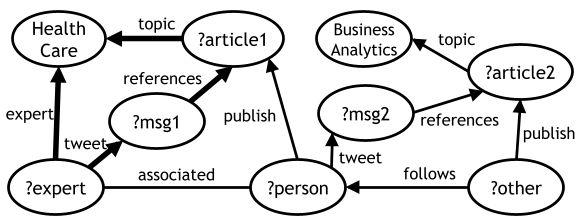 Above: Example of a specific query (Q1) focused on personnel and topics. MultiView identifies parts of this structure that are shared with other queries (Q2).
Experimental Results: Scaling to Half a Billion Edges
The team tested their approach across 6 real-world SSW datasets, ranging from small graphs to massive networks with 540 million edges.
Key Findings:
- Efficiency: MultiView outperformed the baseline in nearly 95% of cases.
- The "Overlap" Bonus: In datasets like Flickr, where queries often share common social links, MultiView was 9 times faster than traditional methods.
- Robustness: Even as the complexity of queries increased (up to 16 edges per query), the MultiView efficiency remained stable, proving its readiness for "Production-grade" semantic monitoring.
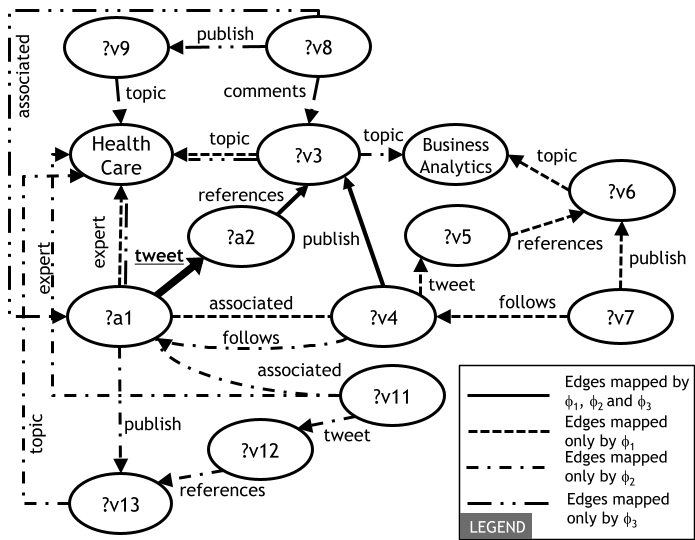 Figure 4: The clear performance gap where MultiView (grey dots and bars) consistently crushes the baseline maintenance speed across diverse datasets.
Critical Insight & Future Directions
The true genius of this work lies in shifting the paradigm from Query-Centric to Update-Centric maintenance. By orienting the search around the incoming data rather than the stored query, the authors unlocked a way to scale that mimics how the human brain processes multi-contextual information.
Limitations: While MultiView excels at edge insertions, its performance during massive graph deletions or structural "re-shuffling" remains an open area for further optimization. Furthermore, as we move into the era of LLMs, integrating these structural subgraph views with vector embeddings could represent the next frontier in "Hybrid Social-Semantic Search."
Conclusion
MultiView provides the scaffolding for "Social Semantic Web View Servers" that can support thousands of concurrent users without breaking a sweat. For any developer or researcher working with RDF, SparQL, or large-scale Social Graphs, the principles of Structural Overlap presented here are essential reading.