
Efficient Multimedia Sharing in MSN: Reclaiming Data Ownership via Outsourced CP-ABE
Ensuring efficient multimedia message sharing in mobile social network
This paper introduces an efficient multimedia data sharing framework for Mobile Social Networks (MSN) based on Ciphertext-Policy Attribute-Based Encryption (CP-ABE). The core method utilizes an outsourced encryption and decryption strategy to provide fine-grained access control while offloading heavy computation to a proxy server, ensuring secure sharing even against untrusted service providers.
TL;DR
As Mobile Social Networks (MSN) like WeChat and QQ become central to multimedia sharing, the "trust gap" between users and service providers widens. This paper proposes a data sharing framework that uses Ciphertext-Policy Attribute-Based Encryption (CP-ABE) to give users ownership of their data. By outsourcing the heavy mathematical lifting (bilinear pairings) to a proxy, it achieves fine-grained privacy on mobile devices with a 6x speedup in encryption time and significantly reduced storage overhead.
Problem & Motivation: The "Centralized Trust" Trap
In current MSN architectures, service providers are essentially the "gods" of the data they host. They can examine personal photos and videos for advertising or other secondary purposes. While we want fine-grained access control (e.g., "only my colleagues in the Engineering department can see this video"), standard tools like CP-ABE are mathematically "expensive."
On a standard smartphone, complex encryption policies can take over 20 seconds to process—an eternity for a user trying to post a quick update. The authors identified this computational bottleneck as the primary barrier to widespread adoption of user-centric privacy in social media.
Methodology: Delegated Encryption and Anonymous Keys
The technical heart of this paper is a architecture that splits the workload between the Data Owner (DO) and a Proxy.
1. Model Architecture
The system involves five parties: the Service Provider (Cloud), a Certificate Authority (CA), the Data Owner, the Data User, and the Proxy. The Proxy acts as a "computational engine" that helps the mobile device without seeing the actual content.
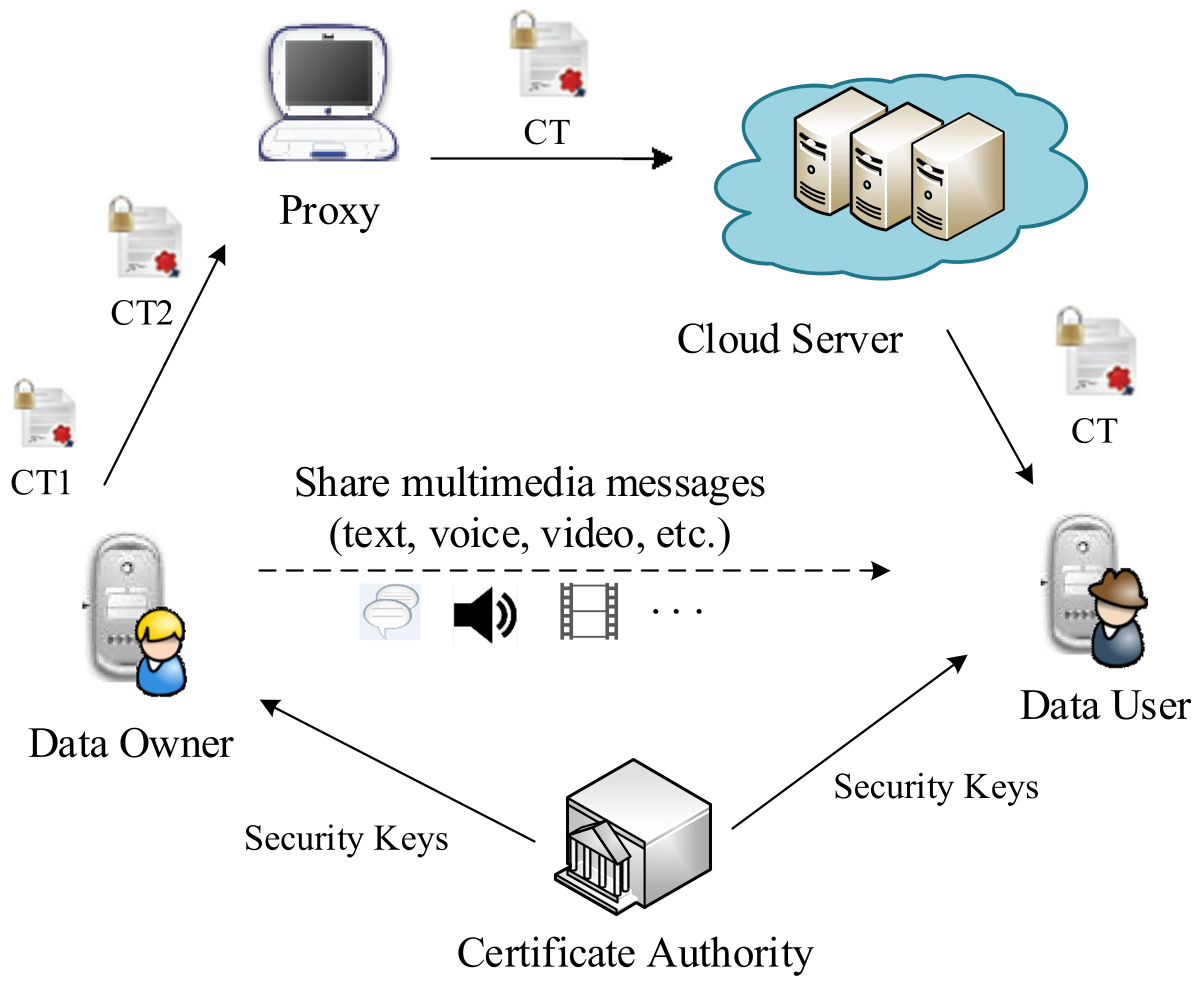
2. The Outsourcing Mechanism
Instead of performing the full LSSS (Linear Secret Sharing Scheme) matrix exponentiation, the Data Owner performs a partial encryption ().
- One-way Anonymous Key Agreement: The DO establishes a session key with the Proxy using a protocol that hides the DO's identity.
- Encryption Offloading: The Proxy takes the coarse-grained ciphertext and transforms it into a full CP-ABE ciphertext.
- Security Guarantee: Because the Proxy does not have the master secret or the Data Owner's original secret 's', it remains a "blind" assistant—it does the work but cannot read the message.
Experiments & Results: Real-World Efficiency
The authors tested their scheme across multiple platforms, including high-end Intel processors and ARM-based Android and iOS devices.
Performance Gains
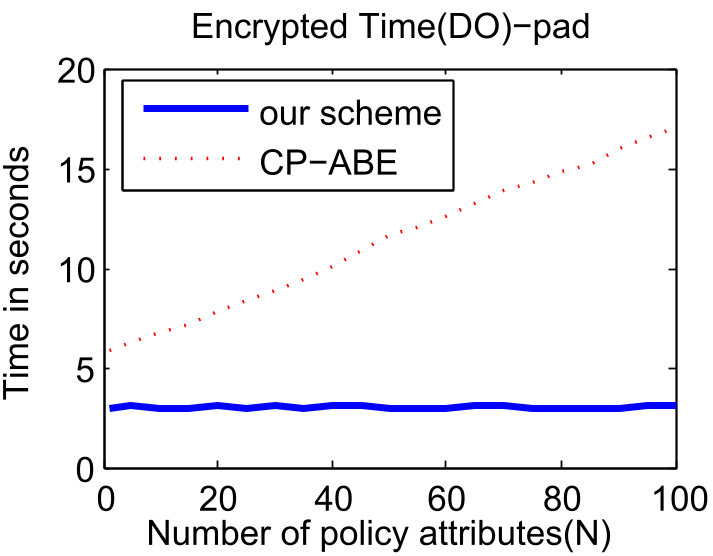
The most striking result is found in the Encryption Time comparison. For a complex policy involving 100 attributes:
- Without Outsourcing: A phone took ~20.16 seconds.
- With the Proposed Scheme: The same operation took only 3 seconds.
- iPhone 6s Performance: On more modern hardware (at the time of the paper), encryption dropped to a mere 0.2 seconds.
Storage Efficiency
By offloading the generation of the full ciphertext structure, the local storage requirement for the mobile device was reduced significantly. As seen in Fig. 3a, the partial ABE ciphertext is roughly 1/4th the size of a standard ABE ciphertext ( bytes vs bytes in the experimental parameters).
Critical Analysis & Conclusion
Takeaway
This paper successfully bridges the gap between high-level privacy theory and mobile reality. It proves that we don't need to sacrifice privacy for performance; we just need to re-architect where the "math" happens.
Limitations
- Proxy Reliability: The model assumes the proxy is "honest-but-curious." If a proxy colludes with a cloud server, the security bounds might be stressed, though the ABE structure provides mathematical protection against simple access.
- Dynamic Revocation: A major challenge in attribute-based systems is what happens when a "friend" is no longer a friend. The authors note that attribute revocation remains a focus for future work.
The Future of MSN
As we move toward a more decentralized internet (Web3 concepts), schemes like this will be fundamental. By ensuring that the service provider only sees encrypted "blobs" while the user controls the keys via attributes, we move closer to a social network where the user, not the corporation, truly owns the data.