
D-MCBA: Navigating the Trust Maze in Real-Time Social Networks
An Efficient Multiple Trust Paths Finding Algorithm for Trustworthy Service Provider Selection in Real-Time Online Social Network Environments
The paper introduces D-MCBA, a double Monte Carlo-based approximation algorithm designed to find multiple social trust paths in Online Social Networks (OSNs). It models the problem as a Multi-Constrained K Optimal Path (MCOP-K) selection problem, aiming to identify trustworthy service providers in real-time environments.
Executive Summary
TL;DR: In modern Online Social Networks (OSNs), finding a trustworthy service provider — like a developer on LinkedIn or a seller on Facebook — requires navigating thousands of "trust paths." This paper presents D-MCBA, an approximation algorithm that uses a double Monte Carlo approach to find the best trust paths in real-time. It doesn't just look for "high trust"; it balances social intimacy and expertise (Role Impact) under strict user constraints, outperforming previous methods by over 37%.
Academic Context: This work advances the field of Service-Oriented Social Networks by transforming path-finding from a simple graph search into a multi-constrained optimization problem (MCOP-K), which is traditionally NP-Complete.
Problem & Motivation: The Real-Time Dilemma
Imagine you want to hire a C++ expert. You have ten friends, who have hundreds of friends, resulting in a combinatorial explosion of possible trust recommendations.
The Pain Points:
- Computational Infeasibility: Checking every path is impossible in a social network with millions of nodes.
- Context Blindness: Old algorithms often look for the "shortest" path or the "highest trust" value, ignoring whether the recommender is actually an expert in the relevant field (Role Impact) or just a close friend (Intimacy).
- Real-Time Pressure: Social data changes every second. Decisions must be made in milliseconds, making traditional slow heuristics (like Dijkstra-based H-OSTP) useless.
Methodology: The Core Genius of D-MCBA
The researchers formalize Quality of Trust (QoT), a multi-dimensional metric combining:
- Social Trust (): Direct interaction reliability.
- Social Intimacy Degree (): Strength of the social bond.
- Role Impact Factor (): Expertise of the recommender.
The Double Monte Carlo Strategy
Unlike greedy algorithms that search blindly, D-MCBA uses a "Two-Way" search logic:
- Backward Search (Pruning): It starts from the target provider and searches back toward the consumer. It calculates a deviation value () to see if paths are even capable of meeting the consumer's constraints.
- Forward Search (Optimizing): It then searches from the consumer to the provider, using the "foreseen" information from the backward search to avoid dead ends and focus on high-utility paths.
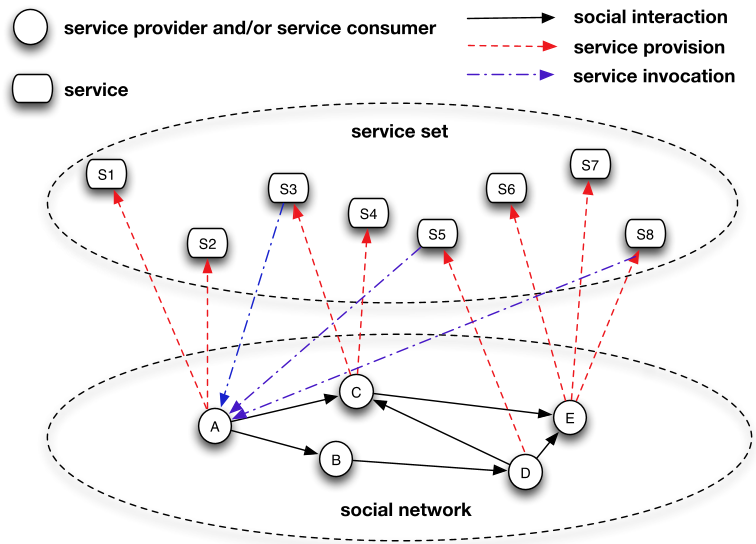 Figure 1: Illustration of a Service-Oriented Social Network where multiple paths link consumers to providers.
Dominating Node Optimization
A key innovation is the management of Dominating Nodes (nodes with high degree). D-MCBA stores locally optimal values at these junctions, ensuring that even with random sampling (Monte Carlo), the algorithm "remembers" the best sub-paths it has encountered so far.
Experiments & Results
The authors tested D-MCBA on the Epinions dataset (88,180 nodes, 717,667 links). They compared it against MONTE K, the existing gold standard for fast trust inference.
Key Findings:
- Utility Boost: D-MCBA's paths had 37.2% higher aggregate utility.
- Path Volume: It found 52.7% more feasible paths that stayed within the defined constraints.
- Efficiency: As shown in the performance charts, D-MCBA delivers a higher "trust score" for the same amount of computation time compared to MONTE K.
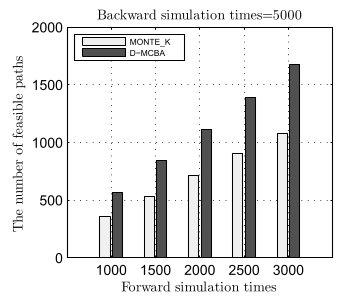 Figure 2: The number of feasible paths identified increases significantly as the simulation count (BST) grows.
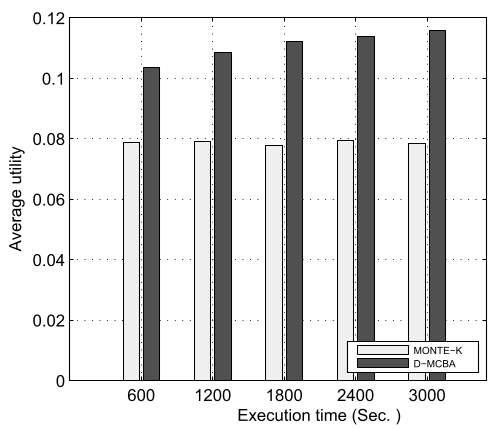 Figure 3: Under the same execution time, D-MCBA provides significantly better utility than previous methods.
Critical Analysis & Conclusion
Takeaway
D-MCBA successfully bridges the gap between theoretical trust modeling and real-world performance. By acknowledging that "not all paths are equal" and using a dual-search strategy to prune the search space, it makes complex trust evaluation viable for real-time apps.
Limitations
While effective, the algorithm relies on the availability of Social Impact Factors (Intimacy, Role Impact). In many privacy-conscious OSNs, mining these values is a massive hurdle in itself. Additionally, the algorithm assumes that "Trust" follows a multiplicative aggregation rule, which might over-penalize longer paths in specific social contexts.
Future Outlook
The researchers plan to integrate this into Social CRM systems, allowing companies to identify "trustworthy" influencers and customers through deep social graph analysis. As social commerce grows, algorithms like D-MCBA will be the "engine" behind every "Recommended by your network" button we see online.