
Efficient MULQ Authentication: Securing Group Recommendations in Social Networking
An efficient multiple-user location-based query authentication approach for social networking
This paper introduces an efficient Multiple-User Location-based Query (MULQ) authentication approach using a novel MRS-tree index and a bitmap-based dominance comparison algorithm. The system ensures the soundness, correctness, and completeness of query results for a group of users with individual preferences when query processing is outsourced to an untrusted service provider.
TL;DR
As social networking apps like Facebook and Google Places evolve, the need for group-based location queries (e.g., "Find a restaurant that suits Alice, Bob, and Cindy's various preferences") has surged. This paper presents an authenticated query framework called MULQ that uses a specialized MRS-tree and bitmap-based pruning to ensure that an untrusted cloud provider returns results that are 100% genuine, complete, and optimal for the whole group.
Background: Why Group Queries are Hard to Authenticate
In a standard data outsourcing model, a Data Owner (DO) gives their data to a Service Provider (SP). To prevent the SP from returning "lazy" or incorrect results, the DO usually signs the data.
However, in a Multiple-User Location-based Query (MULQ), the "best" result depends on the real-time locations and subjective weights of the users. Since the DO cannot know these weights in advance, they cannot sign the final result. The system must instead provide a way for users to verify that the SP didn't skip better Point-of-Interest (POI) candidates during its search.
Methodology: The MRS-Tree and Bitmap Dominance
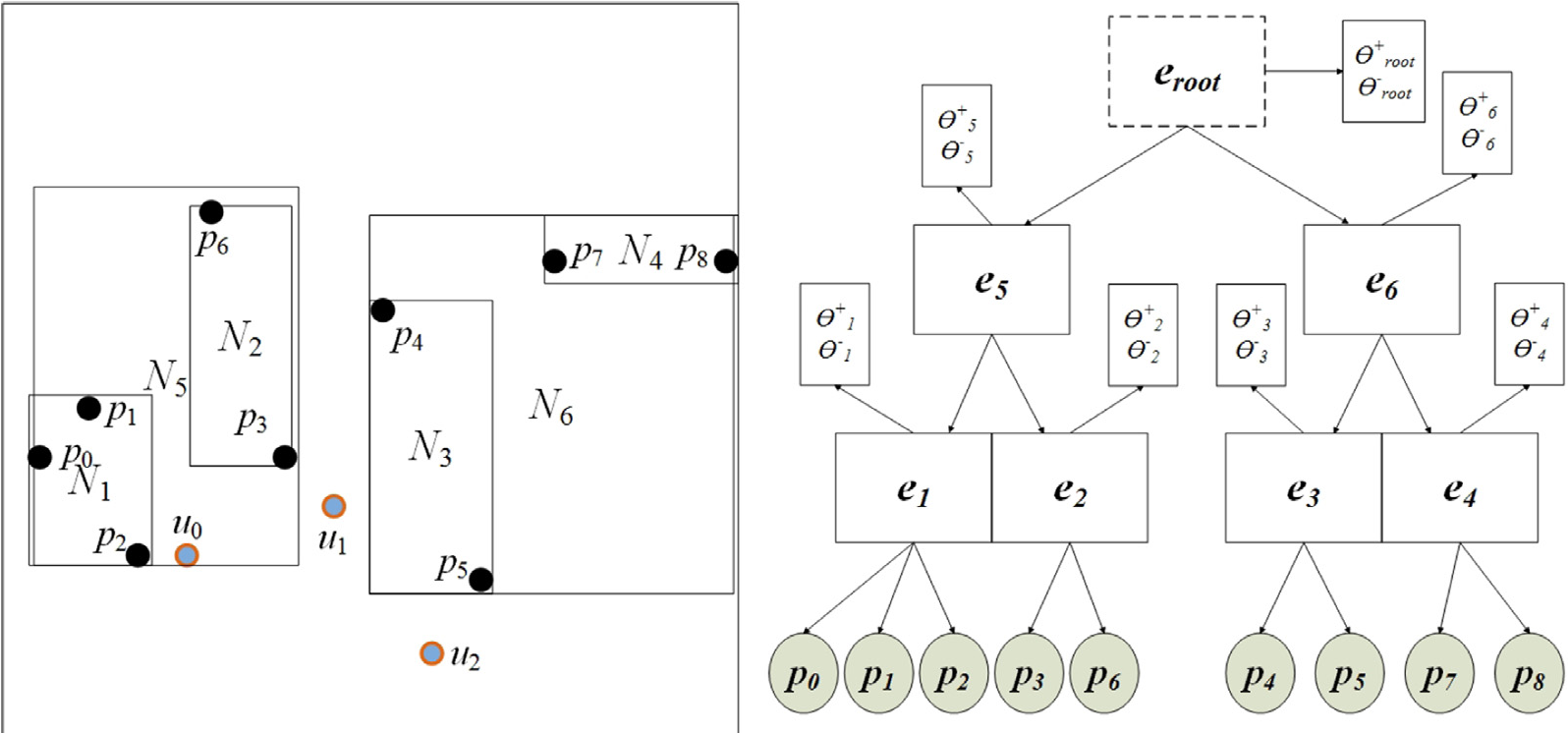
1. The MRS-Tree (Multi-criteria R-tree with Signatures)
The authors extend the R-tree structure to store not just spatial boundaries (MBRs), but also the ranges of non-spatial attributes (like price or rating).
- Digest Construction: Each node in the tree contains a cryptographic hash (digest) that summarizes its children.
- Pruning Power: By storing the minimum and maximum attribute values within each MBR, the SP can quickly determine if a whole branch of the tree is "dominated" by another result, allowing it to skip unnecessary calculations.
2. Bitmap-Based Dominance Comparison
Comparing two POIs across multiple dimensions (Distance, Rating, Price) is computationally expensive if done via standard loops. The authors propose a Bitmap Index:
- Each attribute value is encoded into a bitstring.
- Dominance is checked using a bitwise AND operation between POI bitstrings.
- If
f_ij = S_i & S_j = 1, then dominates . This allows the server to filter thousands of candidates in microseconds.
Verification Workflow
When the users receive the results () and the Verification Object ():
- Soundness: They reconstruct the root hash of the MRS-tree using and . If it matches the DO’s signature, the data is authentic.
- Correctness: They check if any result in is dominated by another result in .
- Completeness: They verify that no POI in the (the discarded set) is better than those in .
Experimental Performance
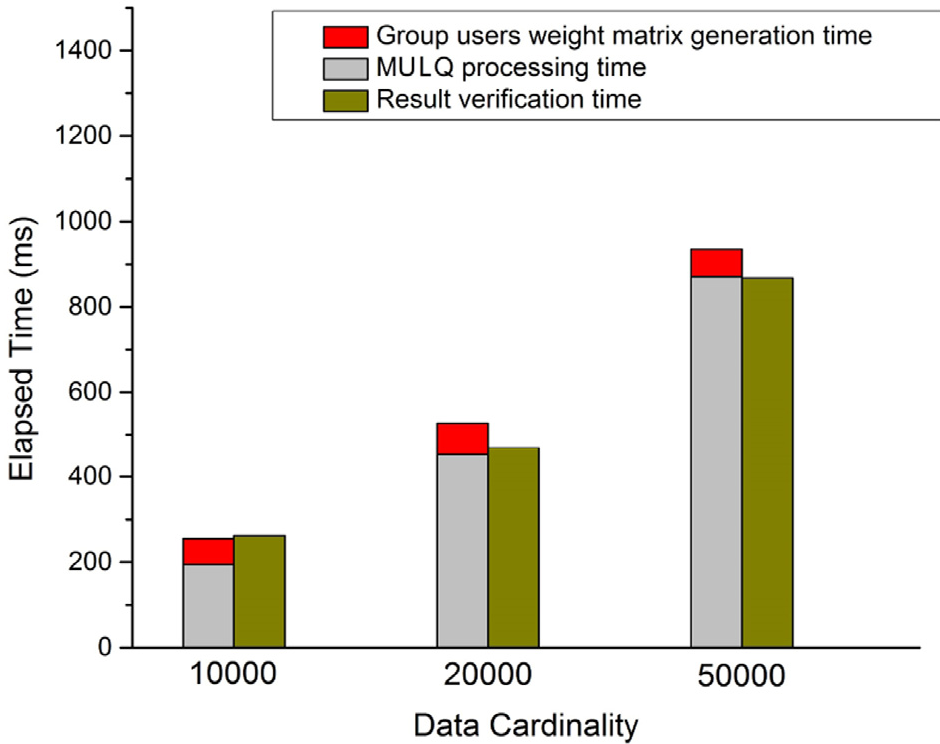
Testing on the Gowalla dataset showed impressive scalability:
- Latency: Even with 50,000 POIs, the total processing time was less than 1.4 seconds.
- Communication: The VO size (the "proof" sent to the user) is highly optimized, remaining under 4MB even for large datasets, which is crucial for mobile users on limited bandwidth.
Critical Insight
The brilliance of this work lies in the Bitmap optimization. By transforming a multi-dimensional geometry problem into a bit-level logic problem, the authors bypassed the "curse of dimensionality" typically found in multi-criteria Skyline and Top-k queries. This makes the approach particularly suitable for real-time social applications where response time is a key user experience metric.
Conclusion
This paper bridges the gap between privacy-preserving data outsourcing and complex group decision-making. Future work could likely adapt this MRS-tree structure for Road Networks (where distances aren't Euclidean) or integrate Differential Privacy to hide the exact locations of the users from the SP while still maintaining verifiability.