
Efficient Multiview Maintenance: Scaling Structural Monitoring in Massive Social Networks
Efficient Multiview Maintenance under Insertion in Huge Social Networks
The paper introduces MultiView, a novel framework for the efficient incremental maintenance of multiple subgraph views in massive social networks. By leveraging common substructures among different views through an optimal merging strategy, the system significantly reduces redundant computations during edge insertions.
TL;DR
In the era of "streaming" social data, keeping track of complex patterns (views) is a nightmare for performance. This paper introduces MultiView, a system that identifies common "sub-patterns" across hundreds of different user queries. By merging these queries into a single unified execution graph, the system can update all views at once when a new edge arrives, achieving nearly 5x faster processing than traditional methods on networks with over half a billion edges.
The Problem: The Redundancy of "One-at-a-Time"
Imagine a law enforcement agency monitoring a social network for three different criminal behaviors. Many of these behaviors might share a common foundation—for example, all three might involve "a person who posted a specific link and has at least two common followers."
Current state-of-the-art systems treat these as three separate queries. When a new post is added, the system re-runs the logic three times. On massive graphs like Orkut (540M edges) or Twitter, this redundancy creates a massive computational debt that makes real-time monitoring impossible.
Methodology: The Power of the Merge
The authors' core insight is that view maintenance should not start from the query, but from the incoming data.
1. The Merged View Concept
The system builds a "Merged View" for every possible edge label (e.g., Follows, Tweets, Likes). When a new edge with the label "Tweets" appears, MultiView immediately identifies all patterns that involve a "Tweet" edge and processes them together.
2. AddView: Finding the Optimal Overlap
To create these merged structures, the authors developed AddView. It solves the NP-hard problem of finding the maximal common subgraph between queries. While the optimal search is complex, their Greedy "Top-k" variant achieves 99.7% of the optimal score while being orders of magnitude faster.
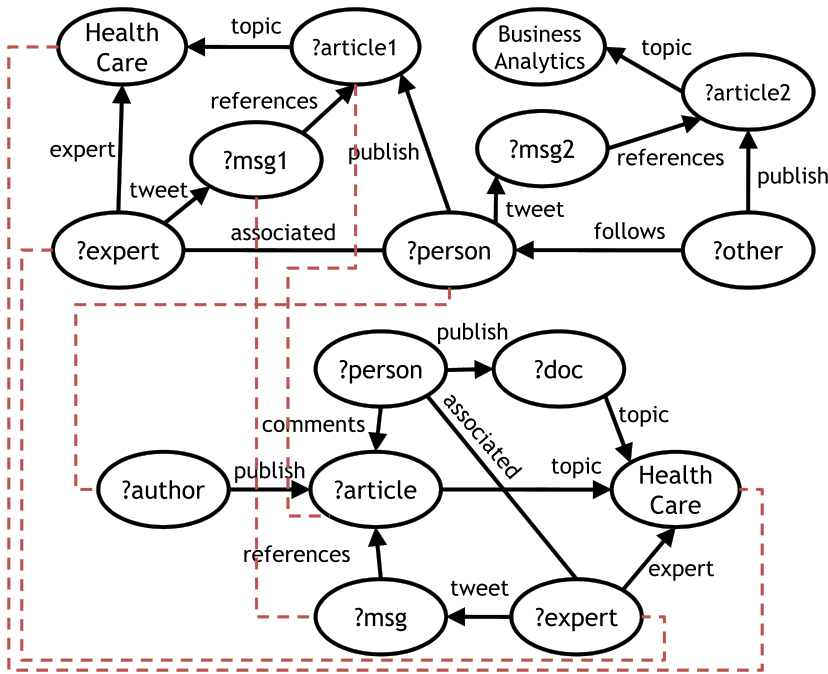 Figure: How distinct query graphs (Q1, Q2) are mapped to a common structural backbone.
3. The MultiView Algorithm
Unlike standard subgraph matching that searches the whole graph, MultiView starts at the Center Edge (the newly inserted data) and propagates outwards. It only explores paths that are relevant to the active set of queries, essentially "multitasking" the search.
Experimental Results: Slaying the Baselines
The researchers stress-tested MultiView against six massive datasets. The findings were conclusive:
- Scalability: While traditional Relational Databases (RDBMS) crashed or ran out of disk space on large datasets like LiveJournal, MultiView handled them with ease.
- Efficiency: On average, MultiView was 470% faster than the baseline (ViewBasic).
- Density Impact: The system performed best on dense networks (like Flickr), where the probability of overlapping paths is higher.
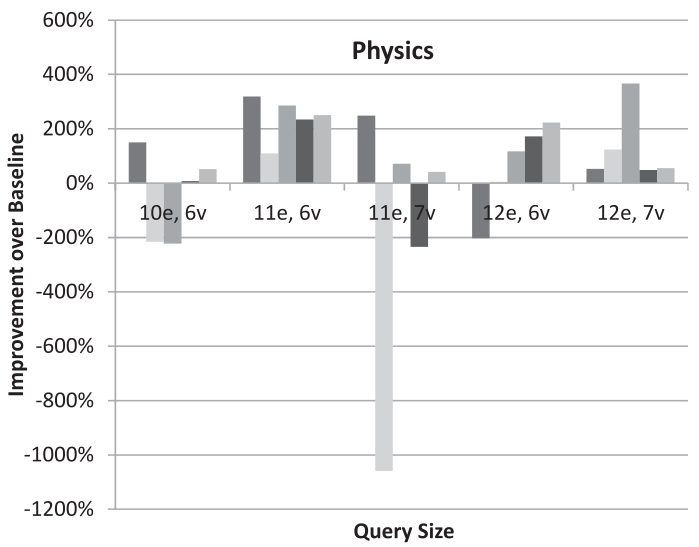 Figure: Performance gains across different datasets. Higher bars represent MultiView's speedup over the baseline.
Critical Insight & Perspectives
The brilliance of this work lies in its "Graph-Native" philosophy. By treating the set of views as a communal structure rather than isolated silos, it aligns the computation with the reality of social data—high redundancy and localized updates.
Limitations: The current paper focuses solely on Insertions. In real-world social networks, "Unfollowing" or "Deleting" is common. Future iterations would need to handle deletions, which often require tracking "provenance" (why a view exists) to ensure a deletion doesn't remove a result that is still supported by other edges.
Summary for the Tech Lead
If your platform involves real-time monitoring of social or RDF data, the takeaway is clear: Stop optimizing individual queries. Invest in a merging layer that identifies structural overlaps. As your user base (and their "standing queries") grows, the benefits of MultiView's shared execution will scale super-linearly, turning a linear bottleneck into a manageable, shared cost.