
bigGraph: Mastering Concurrent Operations on Large-Scale Dynamic Social Networks
An Efficient Parallel Method for Optimizing Concurrent Operations on Social Networks
The paper introduces bigGraph, a high-performance parallel framework for managing concurrent read (shortest distance queries) and write (edge updates) operations on large-scale directed social networks. By combining optimized adjacency list structures with a heuristic-driven bidirectional BFS (bBFS), it achieves state-of-the-art processing speeds on datasets with millions of nodes.
TL;DR
Social networks are massive, dynamic, and constantly queried. This paper presents bigGraph, a parallel method designed to handle hundreds of thousands of concurrent edge updates and shortest-distance queries simultaneously. By utilizing a smart 30-bit vertex encoding, a "look-ahead" bidirectional BFS, and the Cilk Plus parallelism framework, the authors outperformed previous SOTA solutions from the SigMod 2016 programming contest.
Problem & Motivation: The Dynamic Graph Dilemma
In a social network like Facebook or Twitter, the graph is "elastic." Every second, thousands of friendships are formed (Add Edge) or dissolved (Delete Edge), while users simultaneously search for connections (Shortest Distance Query).
The technical challenge is twofold:
- Consistency: How do you ensure a query sees the correct state of the graph if an update is happening at the same millisecond?
- Throughput: Standard Breadth-First Search (BFS) is computationally expensive on large graphs. Sequential processing simply can't keep up with real-world traffic.
Previous works like NetworkX or SNAP are either too generic or lack the specific parallel optimizations needed for high-frequency concurrent operations.
Methodology: The bigGraph Architecture
1. Smart Data Representation
Memory latency is the enemy of graph processing. bigGraph uses Sorted Adjacency Lists. To save space and handle edge states, they use a clever encoding:
- 30 bits for the vertex ID.
- 2 bits for the edge state (ALIVE, DEAD, or UNKNOWN). This ensures that the CPU cache stays hot, maximizing the "cache hit rate" during traversals.
2. Parallelizing Updates without Locks
Instead of using expensive Mutexes or Locks, bigGraph uses a Two-Phase Commit style approach for batches:
- Phase 1: Mark modifying edges as
UNKNOWN. - Phase 2: Use Algorithm 2 to parallelize insertions into sorted vectors based on a thread-index modulo strategy (
u mod maxThread). - Phase 3: Once queries are done, "commit" the states to
ALIVEorDEAD.
3. Heuristic-Driven Bidirectional BFS
Standard bBFS expands the direction with the fewest nodes in the immediate queue. bigGraph takes this further with a Look-Ahead Heuristic. It calculates the sum of the current queue plus the children of those nodes.
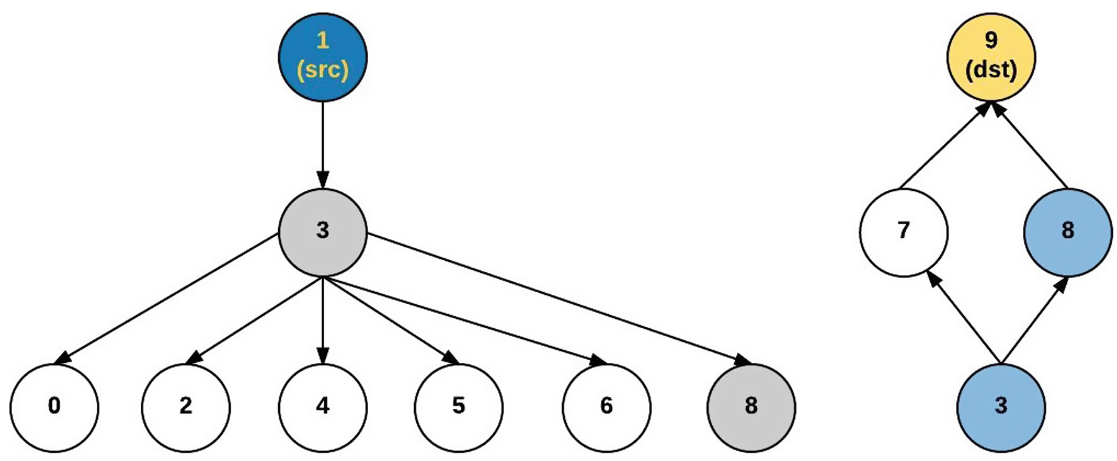 Figure: By looking one level deeper, the algorithm chooses the path that minimizes the total expanded search space.
Experiments & Results: SOTA Performance
The authors benchmarked bigGraph against the top-5 algorithms from the SigMod 16 contest using datasets like Pokec (1.6M nodes, 68M edges) and LiveJournal.
- Scalability: In the Pokec 5-4-1 workload (50% queries, 40% inserts, 10% deletes), bigGraph's execution time dropped consistently as thread counts increased to 32.
- Winning Margin: It achieved a execution time of 1,442ms, beating the H minor free team (1,690ms) and the uoa-team (2,857ms).
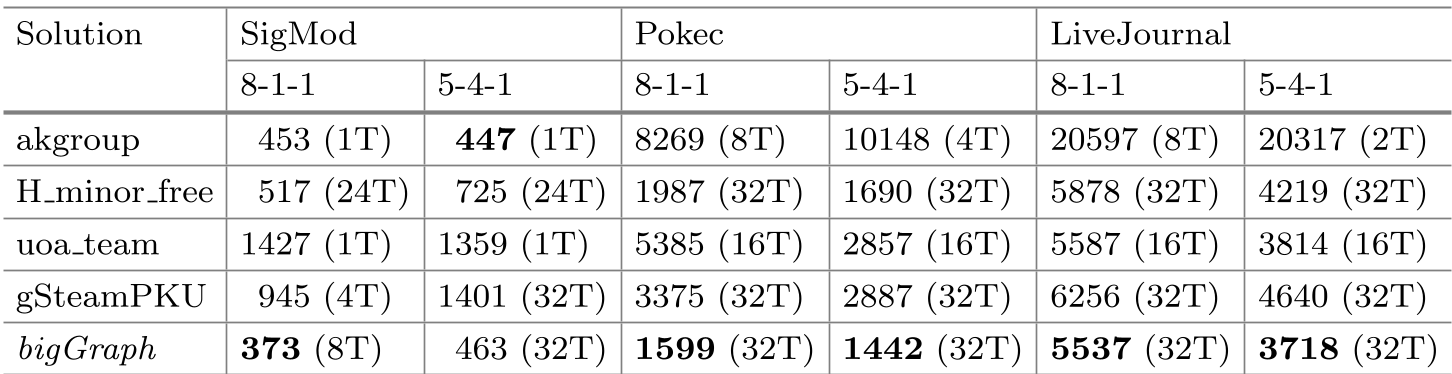 Table: bigGraph (bottom row) consistently shows the lowest latency across different datasets and thread counts.
Critical Analysis & Conclusion
The beauty of this work lies in its simplicity and efficiency. By avoiding complex distributed systems (like GraphX or Spark) and focusing on high-performance C++ with Cilk Plus, the authors prove that a well-optimized single-node system can handle massive social network workloads.
Takeaway: If you are building a real-time graph engine, don't just parallelize—optimize your search heuristics. Choosing the right direction in a bBFS can save more time than adding 10 extra CPU cores.
Limitations: The current method is optimized for unweighted graphs. In the real world, "social distance" often involves weights (interaction frequency). Extending this parallel logic to Dijkstra-style weighted searches remains a future challenge.