
Hybrid RDF Management: Solving the Path Query Bottleneck in Social Networks
Towards Efficient Path Query on Social Network with Hybrid RDF Management
The paper proposes a hybrid RDF management framework designed to accelerate property path queries in Social Networks. By splitting RDF data into in-memory topological relations and disk-based attribute data, it replaces expensive join operations with an efficient in-memory BFS (Breadth-First Search) operator.
TL;DR
Property path queries (like finding a friend-of-a-friend) are essential for social network analysis but perform poorly in standard RDF databases. This paper introduces a hybrid framework that keeps the graph's "skeleton" (relationships) in memory for fast traversal while keeping the "flesh" (attributes like job titles or names) on disk. This results in significantly faster queries without the massive memory overhead of pure in-memory systems.
The "Join" Problem in Social Graphs
In the world of Semantic Web (RDF), social networks are stored as triples. When you want to find a connection across multiple "hops," traditional databases like Jena or Sesame translate this into a sequence of Joins.
Imagine searching for a path that is 5 hops long; the database has to join the same table five times. On massive social graphs, this process is computationally catastrophic. While some research suggests building reachability indices (pre-calculating who can reach whom), these indices are expensive to build and consume massive amounts of memory.
Methodology: The Best of Both Worlds
The authors observe that in typical Social Network data, only about 25% of the triples define the actual graph topology (who knows whom). The remaining 75% are just attributes (user profiles, timestamps).
1. Architectural Split
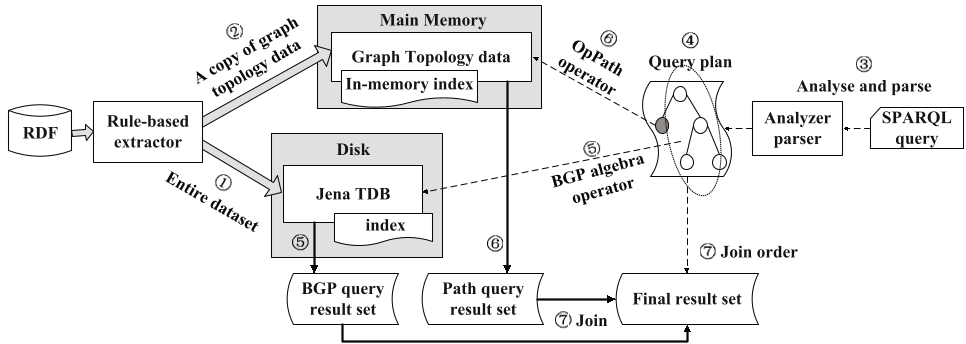
The framework acts as a plugin for Jena TDB. During data loading, it filters triples:
- Graph Topology (): Stored in main memory using optimized forward and backward indices (PSO/POS) for fast bi-directional traversal.
- Attributes (): Stored on disk in the standard triple store.
2. The OpPath Operator
Instead of using standard SQL-like joins, the authors created OpPath. This operator performs a Breadth-First Search (BFS) directly in memory.
- Complexity: It reduces the time complexity from (Nested-loop joins) to (Linear traversal).
- Cost Estimation: To fit into the query optimizer, they use a mathematical formula based on binomial distributions to estimate how many results a path query will return, helping the engine decide when to run the path search versus other filters.
Experimental Results
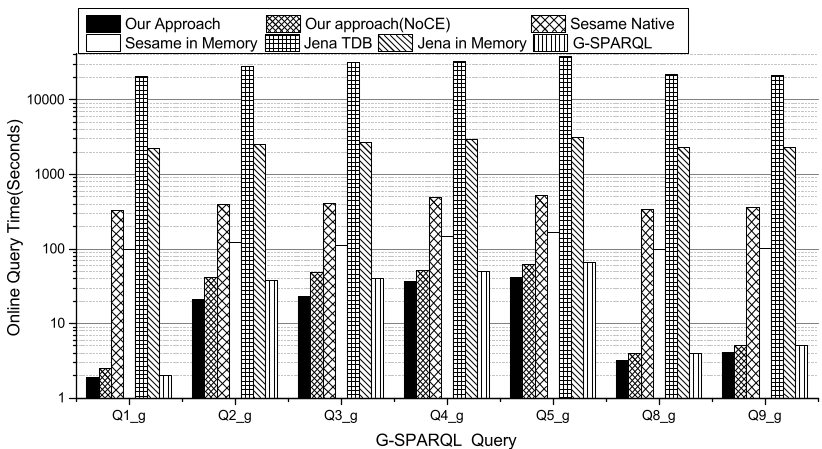
The researchers tested their system against industry standards (Jena, Sesame) and academic competitors (G-SPARQL).
- Memory Efficiency: By only caching the graph skeleton, they used significantly less memory than pure in-memory stores while being faster than disk-based ones.
- Performance: On the SNIB benchmark, the hybrid approach was the clear winner in query latency.
Critical Insight & Analysis
The real brilliance of this work lies in its Semantic Awareness. By recognizing that a "friendship" edge is qualitatively different from a "hasName" attribute, the system optimizes for the physical reality of how we query social data.
Limitations
- Static Heuristics: The cost estimation relies on a graph generation model . If the real-world social network does not follow this densification power law, the query optimizer might make poor decisions.
- Memory Pressure: While it only caches 25% of the data, the absolute size of for a billion-node graph could still exceed single-machine memory, suggesting a need for a distributed version of this hybrid model.
Conclusion
This paper provides a pragmatic "middle way" for RDF management. By acknowledging that not all data is created equal, the hybrid approach allows us to perform complex social network analysis at scale without needing a supercomputer's worth of RAM.