
PTIoMT: Securing the Internet of Medical Things with Traceable, Policy-Hiding Encryption
Efficient Policy-Hiding and Large Universe Attribute-Based Encryption With Public Traceability for Internet of Medical Things
The paper introduces PTIoMT, a specialized Ciphertext-Policy Attribute-Based Encryption (CP-ABE) scheme for the Internet of Medical Things. It uniquely combines partial policy hiding, large universe support, and public traceability, achieving SOTA efficiency by reducing bilinear pairing operations to a constant.
TL;DR
In the rapidly evolving landscape of the Internet of Medical Things (IoMT), protecting Patient Electronic Health Records (EHR) requires more than just encryption. This paper presents PTIoMT, a novel security framework that solves the trilemma of privacy (hiding sensitive policies), scalability (supporting infinite attributes), and accountability (tracing key leakers), all while achieving a breakthrough in decryption speed by reducing complex bilinear pairing operations to a constant.
The "Privacy-Accountability" Paradox
Conventional Attribute-Based Encryption (ABE) is excellent for fine-grained access control, but it has three critical flaws for medical applications:
- Policy Leakage: If a policy says "Only Doctors at the Psychiatric Ward can decrypt," the ciphertext itself reveals the patient is likely seeking mental health care.
- The Scalability Wall: "Small universe" schemes require public parameters to grow with every new hospital department or role added to the system.
- The Insider Threat: If a doctor sells their decryption key on the dark web, standard ABE provides no way to prove which doctor leaked it, as keys are tied to roles, not identities.
Methodology: The PH-LU-CPABE Architecture
The core of PTIoMT is the PH-LU-CPABE (Policy-Hiding, Large Universe, CP-ABE) scheme. The authors utilize composite order bilinear groups () to partition the mathematical space into functional, semi-functional, and identity-tracking dimensions.
1. Partial Policy Hiding
Unlike "full" hiding which is computationally expensive, PTIoMT hides only the sensitive values. For example, the label "Hospital" is public, but the value "Stanford Medical" is hidden. This balances searchability with privacy.
2. Public Traceability
The authors embed a hashed identity directly into the secret key structure. If a malicious user shares their key, any third party can run the Trace algorithm to extract the unique UID without needing the Master Secret Key.
3. Decryption Test & Pairing Efficiency
One of the most significant technical contributions is the Decryption Test. Before committing to the heavy math of full decryption, the system performs a quick check. If the attributes don't match, it aborts early.
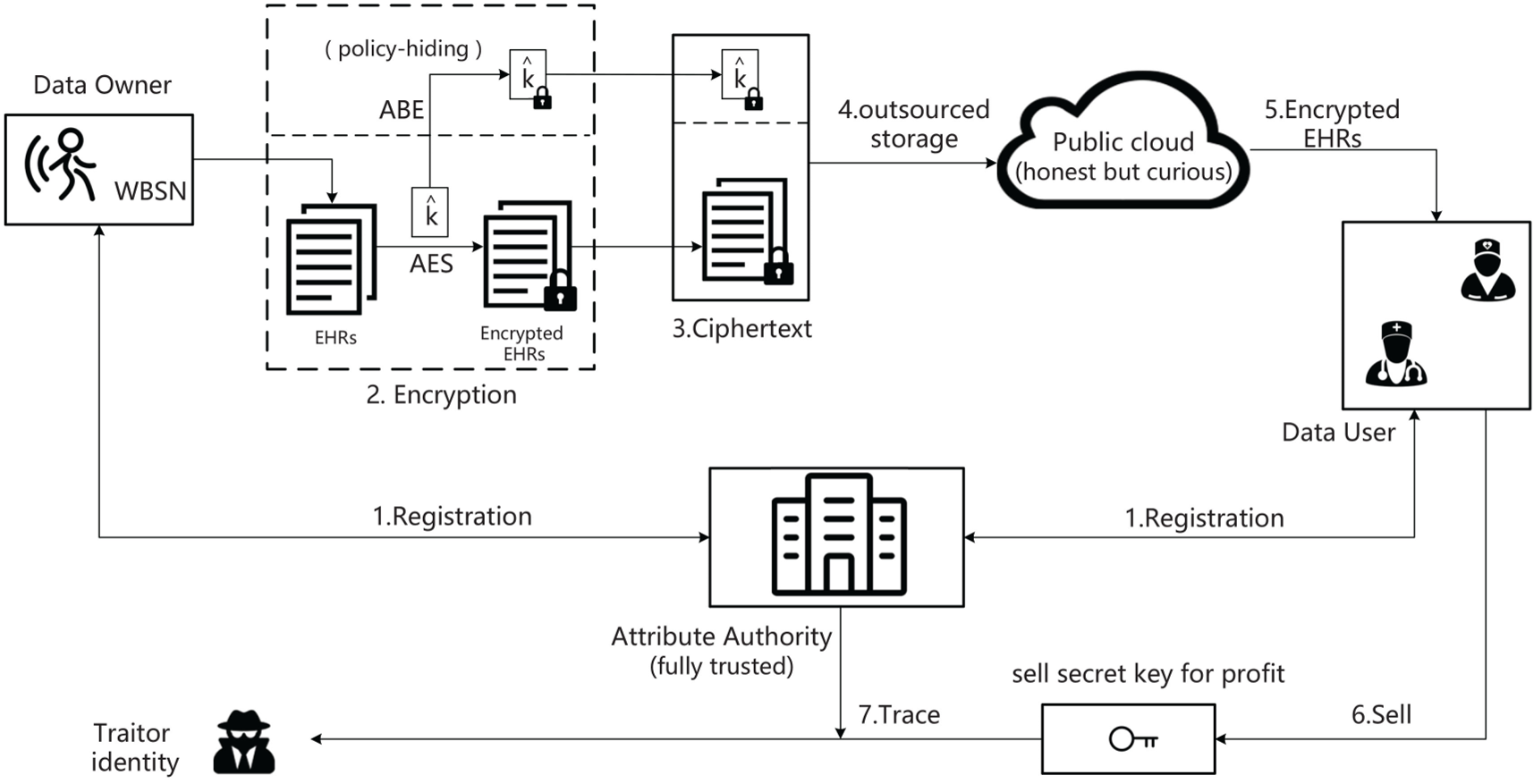 Figure 1: The PTIoMT architecture involving Data Owners, Users, Public Cloud, and the Attribute Authority.
Performance: Breaking the Linear Complexity
In most ABE schemes, decryption time grows linearly with the number of attributes (). PTIoMT breaks this trend. By carefully structuring the LSSS (Linear Secret Sharing Scheme) constants, they have reduced the most expensive part—bilinear pairings—to a constant of 2.
 Figure 2: Scaling of Ciphertext Size against the number of attributes. PTIoMT maintains a lower slope compared to prior SOTA works like Zhang et al.
Key Experimental Metrics:
- Ciphertext Size: Reduced by approximately 33% compared to the 2018 SOTA (Zhang et al.).
- Decryption Cost: Remains nearly flat even as the complexity of the access policy increases, thanks to the constant-pairing design.
Critical Insight & Future Outlook
The primary innovation here is the realization that Identity can be treated as a mathematical "anchor" within an attribute-based key without breaking the security of the attribute logic itself. This allows for "traceable anonymity"—users are anonymous until they misbehave.
Limitations: The scheme relies on composite order groups, which generally require larger group elements than prime order groups to maintain the same security level. Future work might look into "translating" this to prime-order settings (e.g., using Dual System Groups) to further optimize for mobile IoMT devices.
Conclusion
PTIoMT is a significant step toward practical, secure, and accountable medical data sharing. It proves that we do not have to sacrifice speed for privacy, making it a highly viable candidate for real-world EHR systems.