
Token Superposition: Slashing Pre-training Costs by 2.5x Without Changing the Model
Efficient Pre-Training with Token Superposition
The paper introduces Token-Superposition Training (TST), a two-phase pre-training method that uses input embedding averaging and a multi-hot cross-entropy (MCE) loss to predict "bags of tokens." By increasing token throughput per FLOP, TST achieves a 2.5x reduction in pre-training time to reach equal loss on a 10B Mixture-of-Experts (MoE) model.
TL;DR
Researchers from Nous Research have unveiled Token-Superposition Training (TST), a simple yet powerful modification to the LLM pre-training pipeline. By grouping multiple tokens into a single "superposed" representation during the initial training phase, they managed to train a 10B MoE model to the same loss level as a baseline while using less than half the compute. Crucially, the final model remains a standard Transformer, requiring no changes for inference.
Perspective: Why Run when You Can Leap?
Current LLM training is "compute-bound"—we are limited by how many tokens we can feed through a GPU per second. Traditional methods try to make the model smarter (better architectures) or the data cleaner. TST asks a more radical question: Can we increase the data throughput per FLOP by temporarily changing how the model "sees" language?
The authors argue that the standard "one-token-at-a-time" prediction is unnecessarily granular for the early stages of learning. By using coarser representations, the model learns the "statistical gist" of the data much faster.
Methodology: The Magic of Superposition
The TST workflow is divided into two distinct phases:
1. The Superposition Phase (The Sprint)
Instead of processing tokens individually, TST averages their embeddings into a single "s-token."
- Input: The model sees a "bag" of tokens.
- Output: The model uses a Multi-hot Cross-Entropy (MCE) Loss to predict the next bag of tokens simultaneously.
- Efficiency: Since one s-token represents real tokens, for the same amount of math (FLOPs), the model digests times more data.
2. The Recovery Phase (The Refinement)
After a certain ratio of steps, the "superposition" training is turned off. The model reverts to standard Next-Token Prediction. Remarkably, the model "recovers" almost instantly, with its loss dropping rapidly below the baseline.
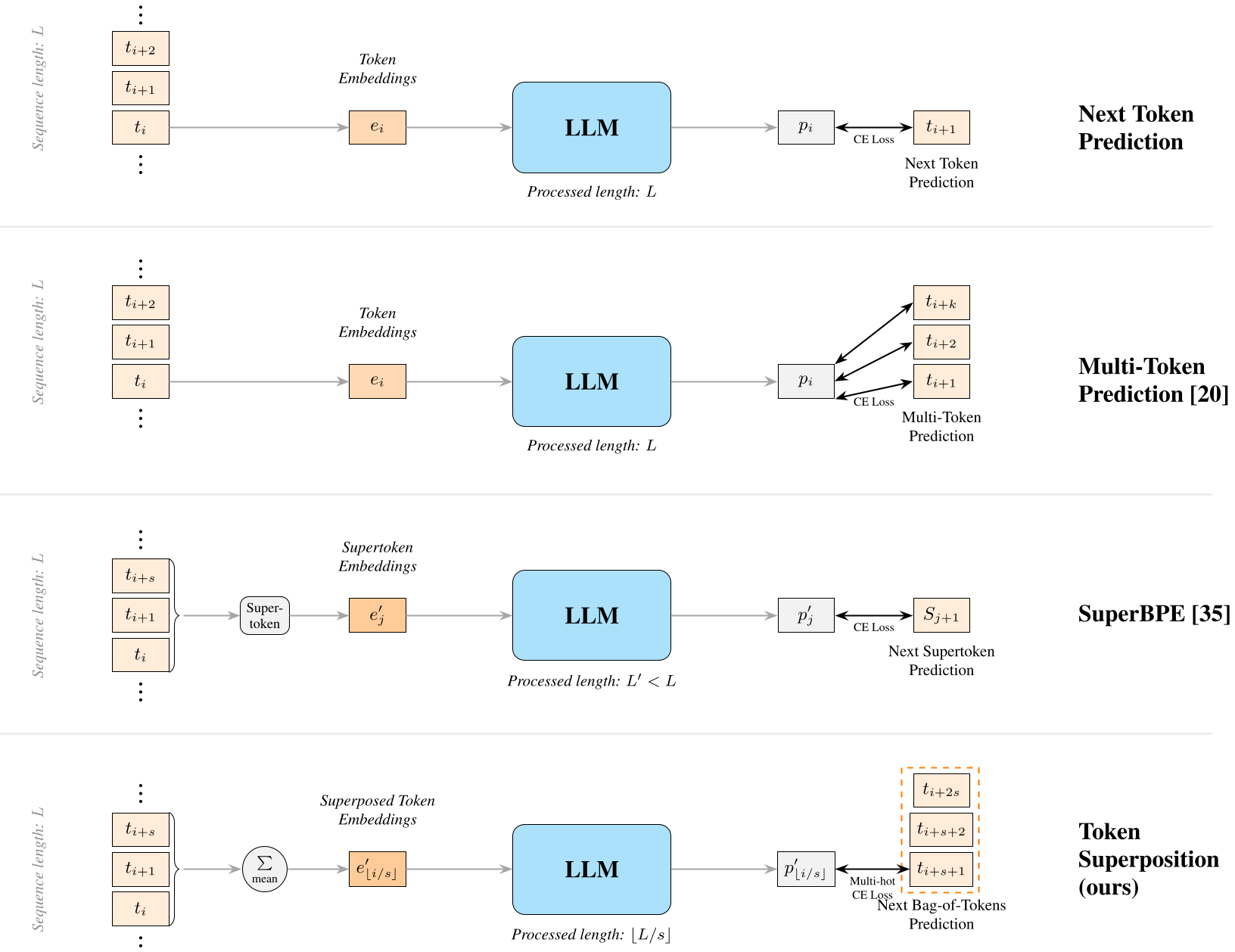 Figure: TST vs. Standard Training. Note how TST predicts a "bag" rather than a single point.
Why Does it Work? (The Intuition)
Two mechanisms are at play:
- Inductive Bias: The first phase acts as a "pre-pre-training," teaching the model global co-occurrence and topic structure before it has to worry about the exact sequence of characters.
- Implicit Regularization: Averaging embeddings forces the model to learn a more robust, linearly separable latent space.
A key finding in the paper is that Representation Alignment is vital. If you re-initialize the embeddings or the output head between phases, the gains vanish. The model needs the "memory" of the superposed states to excel in the second phase.
Experimental Results: Breaking the 2x Barrier
The team tested TST across various scales, but the most impressive results came from the 10B A1B MoE model:
- Baseline: 12,311 B200-GPU hours to process 1.05T tokens.
- TST: Reached the same loss in 4,768 hours (2.5x faster).
- Downstream Evals: On benchmarks like ARC-C and MMLU, the TST-trained models consistently outperformed or matched the baselines, proving that the efficiency didn't come at the cost of "intelligence."
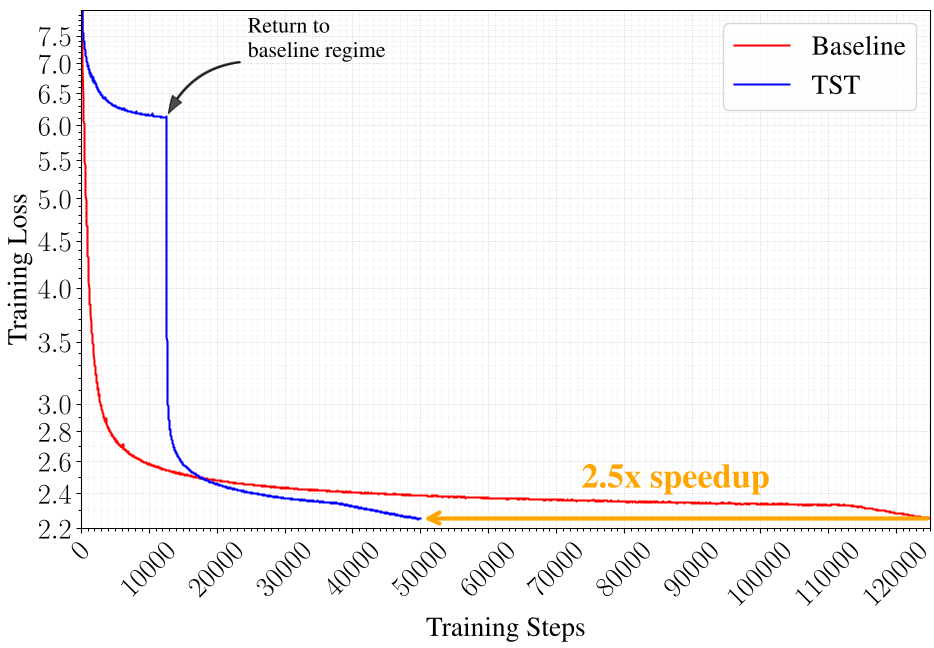 Figure: The "Recovery" effect is clear; once TST is switched to standard training, the loss plummets faster than the baseline.
Critical Analysis & Conclusion
TST is a significant "architectural-agnostic" win. Most efficiency papers require you to use a specific type of Attention or a new MoE layer. TST is a drop-in training strategy.
Limitations:
- It assumes we are in a "compute-bound" regime. If the world runs out of high-quality data (becoming "data-bound"), the s-fold increase in data consumption might be a drawback.
- Finding the optimal "Bag Size" () and "Switch Point" () requires some tuning, though the authors suggest and as a robust starting point.
In conclusion, Token-Superposition Training proves that how we schedule the granularity of information is just as important as the model itself. For researchers and companies looking to train powerful models on a budget, TST just became a mandatory item in the pre-training toolkit.