
Driving Privately: Secure Interest Discovery and Expertise Verification in VSNs
Efficient Privacy-Preserving Chatting Scheme with Degree of Interest Verification for Vehicular Social Networks
This paper introduces an efficient privacy-preserving chatting scheme for Vehicular Social Networks (VSNs) that enables drivers to find peers with common interests and verify their "Degree of Interest" (DOI). The methodology integrates Attribute-Based Encryption (ABE) for interest matching and Homomorphic Encryption to solve Yao's Millionaires' Problem for DOI verification.
TL;DR
Vehicular Social Networks (VSNs) allow drivers to chat about road conditions or hobbies, but sharing interests and "experience levels" (DOI) risks privacy. This paper proposes a hybrid cryptographic scheme using Attribute-Based Encryption (ABE) and Homomorphic Encryption to allow drivers to find like-minded peers and verify their expertise without revealing their specific profile or location-identifiable data to strangers.
Context & Motivation: The Privacy Paradox in VSNs
In a VSN, a driver might want to ask, "Is there anyone experienced (DOI > 5) in Tennessee football to talk about the game?" Currently, this requires broadcasting your interests to everyone nearby, including "curious" nodes or potential trackers. Existing solutions suffer from two major flaws:
- High Overhead: They often require multiple "handshakes" to realize two cars don't even share an interest.
- Binary Matching: They only tell you if someone likes a topic, not how much they know about it (the Degree of Interest, or DOI), which is vital for useful conversations.
Methodology: The Cryptographic Engine
The paper’s innovation lies in its two-stage verification process:
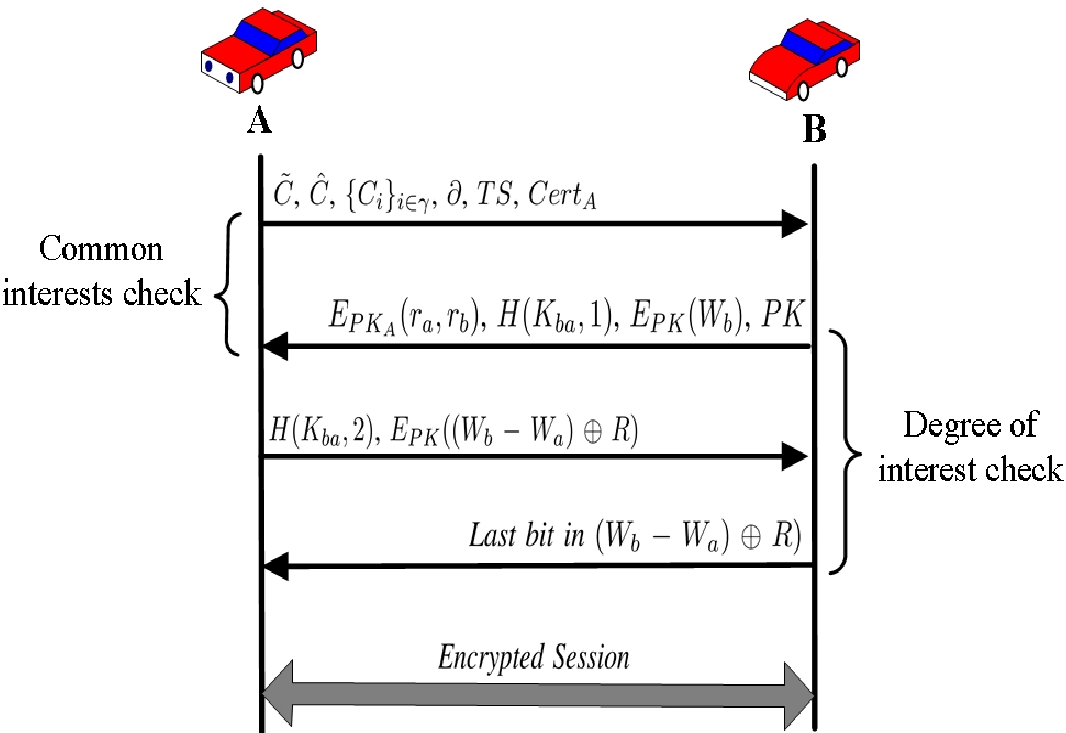
1. Anonymous Interest Verification (ABE)
The system uses CP-ABE (Ciphertext-Policy Attribute-Based Encryption). The Trusted Authority (TP) assigns secret keys linked to specific interests.
- The Intuition: Instead of sending "I like Football," a sender broadcasts a ciphertext that can only be decrypted if the receiver has the same interest keys.
- The Optimization: To avoid expensive pairing operations for every neighbor, the authors add a hash-based check (). If the hash doesn't match the receiver's local interest set, they instantly discard the packet without performing heavy math.
2. Private DOI Verification (Homomorphic Encryption)
Once two drivers find a common interest, they need to check if the responder meets the sender's DOI requirement. The authors solve Yao’s Millionaires’ Problem. By using Homomorphic Encryption, Driver A can compute data involving Driver B's DOI () while it is still encrypted.
- How it works: Driver A sends an encrypted random number and their threshold. Driver B performs computations on this "black box" ciphertext and returns a single bit indicating if their value is higher. No exact numbers are ever exchanged.
Performance & Security Analysis
The experimental results focus on the feasibility of these operations in a fast-moving vehicular environment.
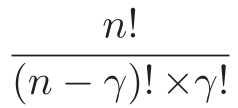
- Communication Efficiency: The initialization packet is very compact ( bytes for typical interest sets), allowing it to be broadcast comfortably over DSRC or LTE-V.
- Computational Speed: Decoding a request takes about ms. Using a 3GHz processor, this is well within the safety margins for VSN applications.
- Anonymity: By using short-term pseudonyms (Certificates) and changing random values () in every session, the scheme ensures Unlinkability—even if a car broadcasts the same interest twice, an eavesdropper cannot tell it's the same car.
Critical Insight & Conclusion
This paper successfully bridges the gap between theoretical multi-party computation and the high-speed requirements of VANETs.
Takeaway: The real value here is the interest revocation mechanism. Unlike many ABE schemes that struggle when a user "unsubscribes," this paper utilizes Roadside Units (RSUs) to distribute update values () that refresh secret keys without the RSU ever seeing the actual keys.
Limitations: The scheme assumes a centralized Trusted Party (TP) and synchronized clocks. In a fully decentralized, global scenario, managing the "interest-to-key" mapping would remain a significant scaling challenge.