
EPDP: Reconciling Privacy and Real-Time Efficiency in E-Healthcare Disease Prediction
An Efficient and Privacy-Preserving Disease Risk Prediction Scheme for E-Healthcare
EPDP is an efficient and privacy-preserving disease risk prediction scheme for e-healthcare that integrates Naive Bayesian training and real-time diagnosis. It utilizes the Okamoto-Uchiyama (OU) homomorphic cryptosystem, super-increasing sequences for data compression, and Bloom Filters for high-speed membership-based prediction.
TL;DR
Predicting disease risk using big data is a cornerstone of modern e-healthcare, but it often hits a "privacy-performance" wall. EPDP (Efficient and Privacy-Preserving Disease Prediction) breaks this wall by combining Naive Bayesian learning with the Okamoto-Uchiyama (OU) cryptosystem and Bloom Filters. It achieves a 100% accuracy rate on benchmark datasets while being orders of magnitude faster and lighter than previous SOTA methods.
The "Performance Gap" in Privacy-Preserving Mining
While e-healthcare systems promise rapid diagnosis, the sensitive nature of Personal Health Information (PHI) requires robust encryption. Previous solutions relied on Bilinear Pairings or complex Secure Multiplication (SM) protocols. These are mathematically "expensive"—they require high computational power and involve massive data transfers, making them unsuitable for mobile medical sensors or emergency responses where every second counts.
Methodology: The Core Innovations
1. The Super-Increasing Sequence "Compressor"
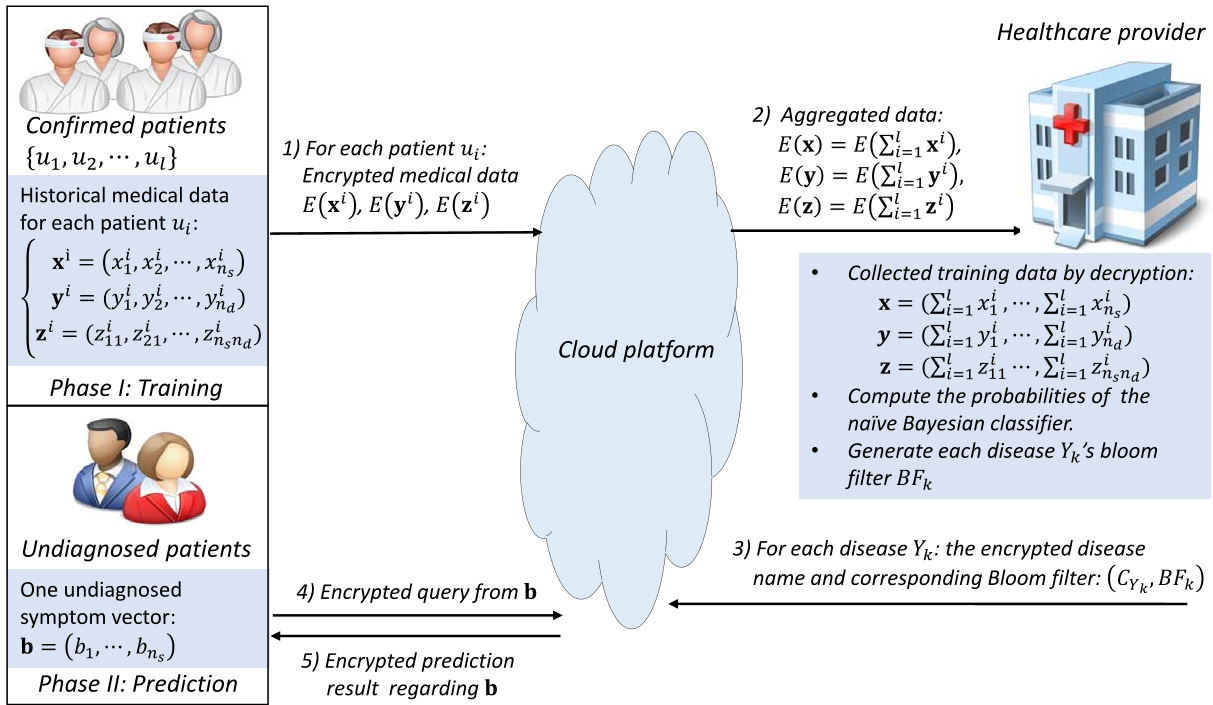
In traditional homomorphic encryption, if you have 10 different symptoms, you might need 10 separate encryptions. EPDP uses a super-increasing sequence (a sequence where each term is greater than the sum of the preceding terms) to "pack" multidimensional symptom vectors into a single plaintext value.
- Physical Intuition: Think of it like a currency system (1, 10, 100, 1000). You can represent any combination of units by a single number without them "bleeding" into each other during addition.
- Benefit: This reduces the number of encryption operations and the size of the ciphertext sent over the network.
2. Bloom Filter-Based Diagnosis
The most brilliant shift in this paper is moving away from comparing encrypted probabilities during the prediction phase. Instead:
- The Healthcare Provider (HP) trains a Naive Bayesian Classifier.
- The HP identifies all symptom combinations that indicate a high risk.
- These combinations are hashed and stored in a Bloom Filter (BF).
- To diagnose, the Cloud Provider (CP) simply checks if the patient's symptoms exist in the Bloom Filter. This is a simple bit-array check—lightning fast and constant time.
Performance Benchmarks: A New Standard
The authors compared EPDP against the PPCD (Privacy-Preserving Clinical Decision Support) scheme using the UCI Acute Inflammations dataset.
| Metric | PPCD (Prior Work) | EPDP (This Work) | Improvement |
|---|---|---|---|
| Training Time | 33.39 seconds | 0.84 seconds | ~40x Faster |
| Prediction Time | 1.06 seconds | 0.17 seconds | ~6x Faster |
| Comm. Overhead | 1220 KB | 6.43 KB | ~190x Lighter |
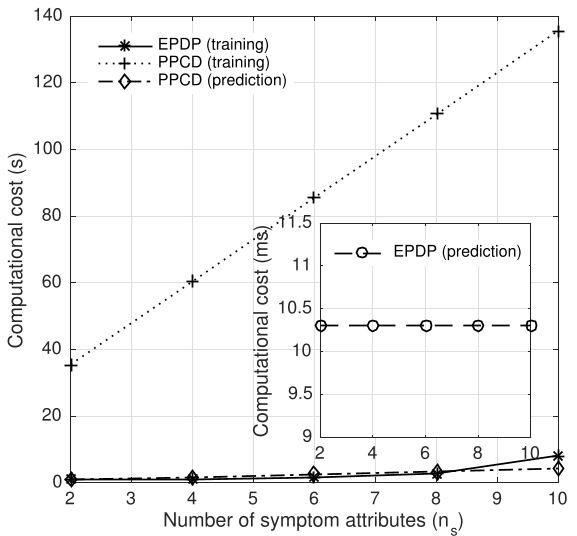 (The charts above clearly illustrate how EPDP scales linearly and efficiently as the number of symptoms and diseases increases.)
Critical Insight: Why Global Efficiency Matters
EPDP isn't just a theoretical exercise; it addresses the "Medical Emergency" scenario. If a user faints, their sensor data must be analyzed instantly. By delegating the heavy lifting (Bloom Filter membership queries) to the Cloud while keeping the keys at the Healthcare Provider, EPDP ensures that the patient gets a result in milliseconds without the Cloud ever knowing what symptoms the patient has or which disease was diagnosed.
Limitations & Future Work
While EPDP is highly efficient, it currently assumes an honest-but-curious model. It does not fully address Active Collusion (where the Cloud and a Patient work together to deanonymize the HP's model) or Message Integrity (ensure data wasn't tampered with). The authors identify these as critical next steps for commercial-grade security.
Conclusion
EPDP represents a shift toward "practical" privacy. By using Bloom Filters and super-increasing sequences, it proves that we don't need the most expensive math to get the best security. It paves the way for a future where real-time, AI-driven medical advice is a standard feature of every wearable device.