
Beyond Plaintext: Balancing Social Discovery and Privacy via Semantic Tag Matching
An Efficient Privacy-Preserving Friend Recommendation Scheme for Social Network
This paper proposes an efficient privacy-preserving friend recommendation scheme for social networks based on a tag matching model. By utilizing Word2Vec for distributed word representations and a commutative encryption-based protocol, the system achieves SOTA performance in balancing recommendation accuracy and user data privacy.
TL;DR
In the modern social network landscape, the "Privacy-Utility Tradeoff" remains a central challenge. This paper presents a novel framework that uses commutative encryption and Word2Vec-based semantic tag matching to recommend friends. It avoids the "privacy vs. accuracy" trap, achieving over 97% precision while ensuring that sensitive user interests are never exposed in plaintext to unauthorized parties.
The Core Conflict: Discovery vs. Secrecy
Existing recommendation systems typically fall into two categories:
- Topology-based: Looking at mutual friends (often misses people with similar interests but no shared connections).
- Interest-based: Analyzing user tags (usually requires uploading private data to a central server in plaintext).
The author's highlight a poignant example: An individual seeking friends with specific sensitive orientations (e.g., sexual orientation or political views) needs an accurate match without broadcasting that data. Modern anonymous solutions often "blind" the algorithm so much that the recommendations become random and unreliable.
Methodology: The Privacy-Preserving Protocol
The system relies on a Central Authority (CA) that acts as a trusted third party for initial filtering but never sees the final plaintext content during the verification phase.
1. Commutative Encryption
The mathematical backbone is the commutative property: . This allows the target user () and a candidate () to "double-encrypt" their tag sets. Because the order of encryption doesn't matter, they can eventually arrive at a common encrypted value to verify intersections without either party revealing their non-matching tags.
2. Semantic Tag Matching with Word2Vec
Instead of simple string matching (which fails if one user tags "Music" and another tags "Rock"), the authors use Word2Vec to map tags into an 80-dimensional vector space. Similarity is calculated using the cosine distance between these vectors.
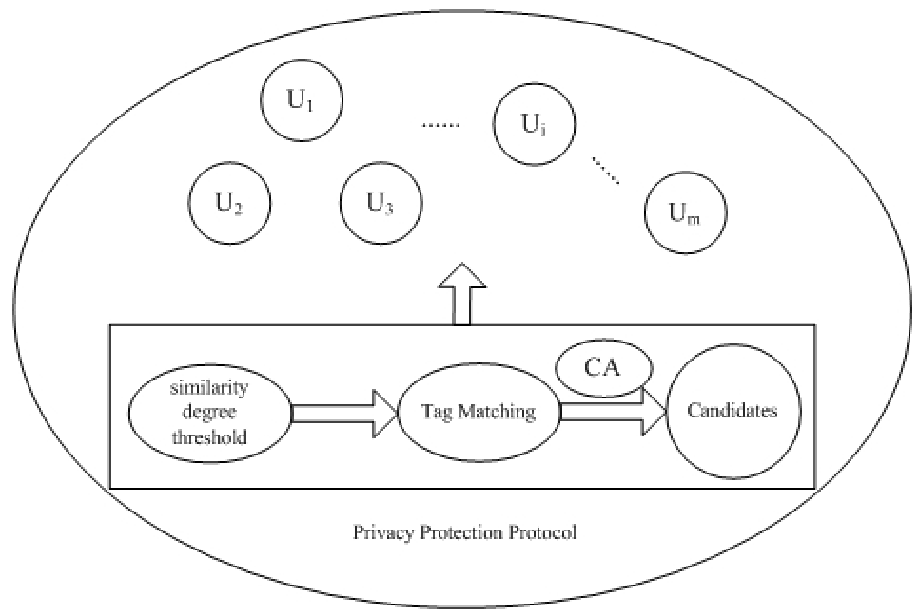 Figure 1: The execution flow of the privacy-preserving protocol between users and the CA.
3. The Similarity Threshold ()
A standout feature of this research is the Heuristic Threshold Selection. The authors don't just pick a random number; they analyze the distribution of (Successful Matches) across different tag cardinality groups to find the "Sweet Spot" (Alpha) where precision is maximized without tanking the recall rate.
Experimental Results
The authors tested their model against a dataset of 0.6 million Sina Weibo users.
- Precision and Recall: The proposed scheme achieved a Precision of 0.972 and a Recall of 0.996 under optimal parameters ().
- Comparison: When compared to the Topic Model (LDA) and Friend Relationship methods, the Tag Matching scheme significantly reduced "False Positives" (where irrelevant friends are recommended) and "False Negatives" (where similar interests are ignored).
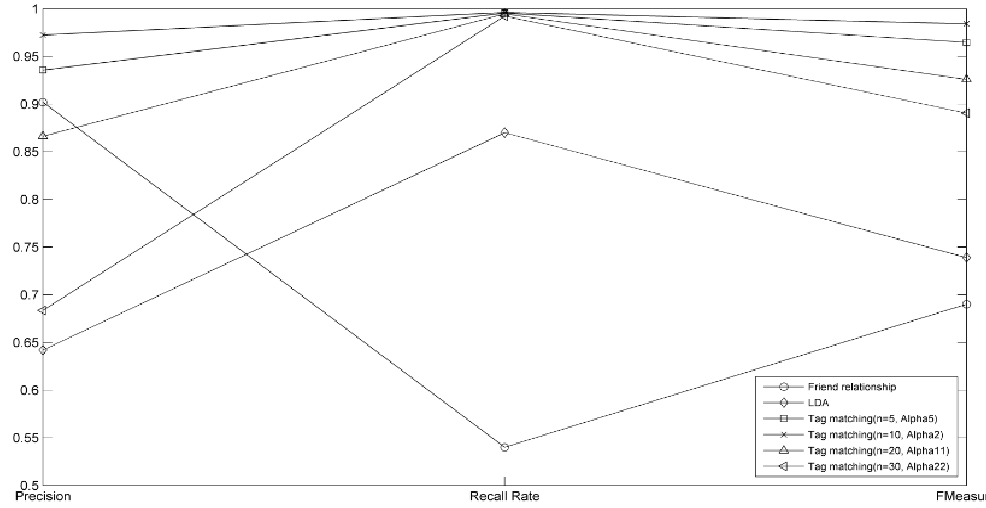 Figure 2: Performance comparison showing the superior F-measure of the proposed scheme over LDA and Relationship-based baselines.
Critical Insights & Takeaways
- Tag Cardinality Matters: The research found that the scheme performs best when users have a "moderate" number of tags. Too few tags lead to insufficient data; too many tags introduce noise that confuses the semantic matching.
- Privacy is Not Free: While effective, the authors admit that the computational cost of calculating similarity thresholds and performing multi-step encryption is higher than traditional methods.
- Future Direction: The next logical step for this research is scaling. Applying this to a real-time environment with millions of active requests would requiring optimizing the vector search (perhaps using Vector Databases or Approximate Nearest Neighbor search).
Conclusion
This paper successfully demonstrates that privacy-preserving friend recommendation is not a zero-sum game. By combining the semantic depth of Word2Vec with the cryptographic security of commutative protocols, social platforms can offer highly personalized discovery while respecting the "Right to be Forgotten" and the sanctity of private data.