
Scaling Privacy: How Social Graphs Can Make Recommender Systems Efficient and Anonymous
Efficient privacy-preserving recommendations based on social graphs
The paper proposes an efficient, privacy-preserving recommendation framework based on Distributed Association Rule Mining (PPARM). It introduces an Anonymous Random Walk (ARW) sampling strategy on social graphs to reduce data size while maintaining high recommendation precision and protecting user linkability.
TL;DR
Privacy-Preserving Association Rule Mining (PPARM) is often too slow for large-scale social networks due to heavy encryption. This paper introduces a breakthrough: using Anonymous Random Walks (ARW) on social graphs to select a representative sample of users. By processing only 50% of the data, the system achieves a 4x reduction in communication costs while maintaining high recommendation accuracy and ensuring that neither the provider nor other users can link data to specific individuals.
Problem & Motivation: The Heavy Cost of Privacy
Traditional recommender systems are a privacy nightmare. Centralized providers (Spotify, Facebook) have total access to your sensitive interests. While distributed PPARM methods exist to keep data local, they are notoriously inefficient.
Current SOTA methods rely on Secure Multi-Party Computation (SMC) and complex cryptographic sums/unions across millions of users. The communication overhead is massive—if 1 million users try to participate in a secure union of itemsets, the protocol collapses under the weight of billions of messages. The authors' insight: We don't need everyone's data to find the rules that govern the group.
Methodology: Exploiting Homophily through ARW
The key technical insight is Homophily—the "birds of a feather flock together" principle. If your friends share your interests, we only need to sample a few "influencers" (highly connected nodes) to get a clear picture of the global frequent itemsets (FIs).
The Anonymous Random Walk (ARW)
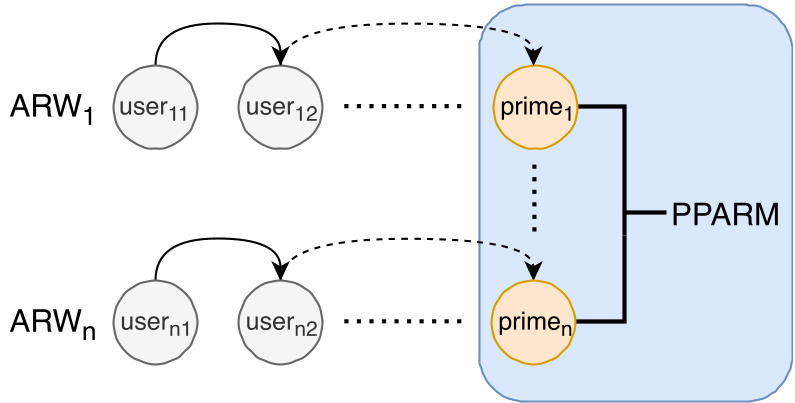
Instead of uniform sampling (which is hard in sparse ID spaces), the authors use a modified Random Walk:
- Walk Initiation: Only a small percentage of users start a walk.
- Local Decision: As the walk hits a user, that user decides locally and privately (based on a "contributing probability") whether to add their data to the sample.
- Prime Users: The walk ends at a "Prime User" who holds a small batch of encrypted data.
This ensures Unlinkability: The Prime User knows the data exists but doesn't know which user in the walk provided it.
Experiments & Results: Accuracy vs. Efficiency
The authors tested their approach on three real-world datasets: Flickr, Orkut, and LiveJournal.
Performance Gains
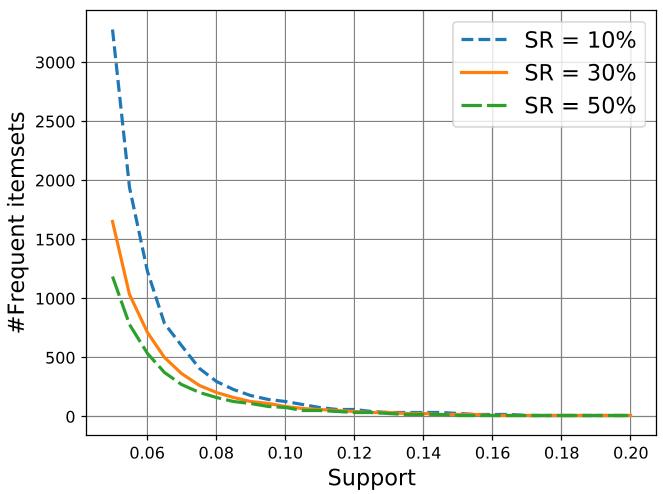
- Efficiency: With a 50% sampling rate, the number of messages required for PPARM dropped by 75% (a 4-fold improvement).
- Accuracy: Despite using far less data, the Average Precision (AP) remained robust. Interestingly, the ARW approach performed better as the population size increased, suggesting it thrives in true "Large Scale" environments.
- Topology Matters: The method is most effective in "specialized" networks (like Flickr or LiveJournal) where communities are more distinct, compared to general-purpose networks like Orkut.
Verification Phase
To ensure no "false" rules are recommended, the system includes a zero-knowledge-style verification step where the final candidate rules are checked against the global population using a lightweight secure sum ring, ensuring the precision eventually reaches 1.0.
Critical Analysis & Conclusion
This paper shifts the focus from "better encryption" to "smarter data selection."
Core Contributions:
- Proves that social graph topology is a viable proxy for interest-based sampling.
- Achieves significant efficiency gains (4x) without compromising privacy.
- Introduces the ARW protocol which provides better privacy than standard Random Walks by masking local contributions.
Limitations & Future Work: While homogeneous social graphs work well, the authors admit that similarity graphs (based on activity rather than just friendship) might be even more powerful. Additionally, the approach assumes a semi-honest adversary model; future iterations might need to address malicious actors who could inject "fake" interests into a walk to bias the recommender system.
Takeaway
For developers of decentralized apps (dApps) or privacy-first social networks, this paper provides a roadmap: Don't encrypt everything—sample the graph first.