
Logic of Persuasion: Characterizing Efficient Referrals in Social Networks
Characterizing Efficient Referrals in Social Networks
This paper introduces a computational framework to characterize and predict "Efficient Referrals" (ER) in social networks, specifically on Reddit. By utilizing textual similarity, user reputation, and past referral success, the authors achieve an AUC of 0.87 in identifying referrals that successfully drive users to new communities.
TL;DR
How do you convince someone to step out of their comfort zone? This paper analyzes "Efficient Referrals" (ERs) on Reddit—instances where a user successfully invites another to join a new community. By analyzing textual similarity and user history, the researchers developed a model capable of predicting referral success with an AUC of 0.87, proving that breaking the "filter bubble" is a predictable social science.
Background: The Filter Bubble Problem
Selective exposure is a documented psychological tendency where users seek information that reinforces their existing viewpoints. In social networks, this manifests as the Filter Bubble. While algorithms often exacerbate this by recommending "more of the same," human users often act as bridges, referring peers to new sub-communities. However, not all referrals are equal. Most are ignored; only a few are "Efficient."
The Insight: Why Do Some Referrals Work?
The authors posit that the efficiency of a referral isn't just about where you are sent, but how you are invited and who is doing the inviting. They identify three pillars of an Efficient Referral:
- Trust/Reputation: Has the referrer successfully moved people before?
- Linguistic Congruence: Does the referral message sound like the person it's addressed to?
- Contextual Relevance: Is the new community actually related to the current discussion?
Methodology: Identifying the "Click"
The researchers focused on weight-loss subreddits, a niche where overlapping interests make referrals common.
1. The Referral Gatekeeper
First, they built a classifier to distinguish a standard comment from a "referral" (one containing a link to another subreddit). Using a Multinomial Naive Bayes model on TF-IDF features of uni/bi/tri-grams, they achieved a stellar AUC of 0.93.
2. The Efficiency Predictor
Once referrals were identified, the task was to predict if the recipient actually posted in the recommended subreddit. They used a sophisticated feature set:
- Textual Attributes: Word2Vec embeddings combined with TF-IDF.
- User History: Number of past posts and the author's historical "Efficiency Rate" (P_eff).
- Similarity Scores: How similar is the comment to the original thread's title and content?
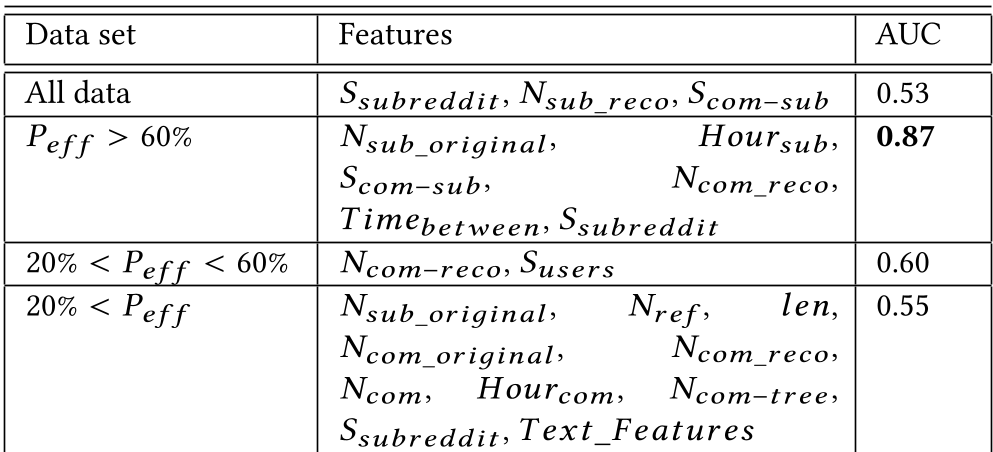 Table 1: Performance of the ER classifier across different user cohorts.
Key Results: Experience is Everything
The study’s most striking finding is the role of the referrer’s history.
- For highly experienced referrers (those with a past success rate > 60%), the model predicted efficiency with an AUC of 0.87.
- For the general population, prediction was much harder (AUC 0.53), suggesting that efficiency is an "earned skill" or a result of established authority within the network.
- Linguistic Similarity (S_com-sub) consistently ranked as a top predictor, confirming that when referrers mirror the language of the asker, they are more persuasive.
Critical Analysis & Future Outlook
This work provides a vital first step toward algorithmic de-bubbling. Instead of simply showing a "Related Community" sidebar, platforms could identify "High-Efficiency" users and power-users to act as community ambassadors.
Limitations: The study is limited to the weight-loss niche and a 2-page poster format, meaning long-term retention in the new subreddits wasn't measured. The Takeaway: To break a filter bubble, don't just provide a link—match the user's language and leverage the credibility of experienced community members.
Conclusion
Social networks don't have to be silos. By understanding the mechanics of efficient referrals, we can design systems that facilitate meaningful cross-community pollination, eventually popping the bubbles that limit our digital experience.