
Bumblebee: Redefining the Limits of Social Network De-anonymization
An Efficient and Robust Social Network De-anonymization Attack
The paper introduces Bumblebee, a novel structural social network de-anonymization attack. It features a new node similarity metric designed to overcome degree-based biases and achieves superior re-identification rates on large-scale datasets compared to previous benchmarks like the Narayanan-Shmatikov (Nar) attack.
TL;DR
Bumblebee is a high-performance structural de-anonymization attack that uses a novel, unbiased similarity metric to match users across different social networks. By fixing the inherent degree-biases of previous methods, it can re-identify up to 50% more users with near-zero error rates and requires as few as a single seed node to compromise an entire "anonymized" dataset.
The Problem: The "Degree Bias" Trap
When a company releases an "anonymized" social network graph, they remove names but keep the connection structure. Attackers try to map this to a known public graph (like Twitter).
The industry standard for years was the Narayanan-Shmatikov (Nar) attack. However, Nar's similarity metric—essentially a variation of cosine similarity—accidentally penalizes high-degree nodes. Conversely, newer methods like Grasshopper were biased toward high-degree "hubs." This created a "blind spot" for attackers: if a user's degree changed slightly due to noise or data collection gaps, these algorithms would fail to bridge the gap between the two graphs.
Methodology: The Bumblebee Sting
The core innovation is BlbSim, a symmetric similarity measure defined as:
Why this works:
- Symmetry: Unlike prior work, it treats the source and target nodes equally.
- Tunable Penalty (): The parameter allows the attacker to control how strictly the algorithm penalizes differences in node degrees.
- Local to Global: It uses a propagation phase that iteratively expands from seeds, using a "reverse checking" step to ensure that if node A maps to B, then B must also choose A as its best match.
 Figure 1: High-level overview of the structural de-anonymization process.
Experiments: Superior Robustness
The authors tested Bumblebee on real-world data from Slashdot, Epinions, and LiveJournal.
Key Findings:
- Seed Efficiency: While previous SOTA required ~15 seeds, Bumblebee often succeeded with 1 or 2 seeds.
- Noise Tolerance: In scenarios where edge overlap was below 10% (extremely noisy), Bumblebee still achieved large-scale re-identification while Nar and others stayed below 1%.
- Precision and Recall: Across various datasets, Bumblebee increased recall by roughly 50% without increasing the error rate. In many tests, the error rate stayed below 0.2%.
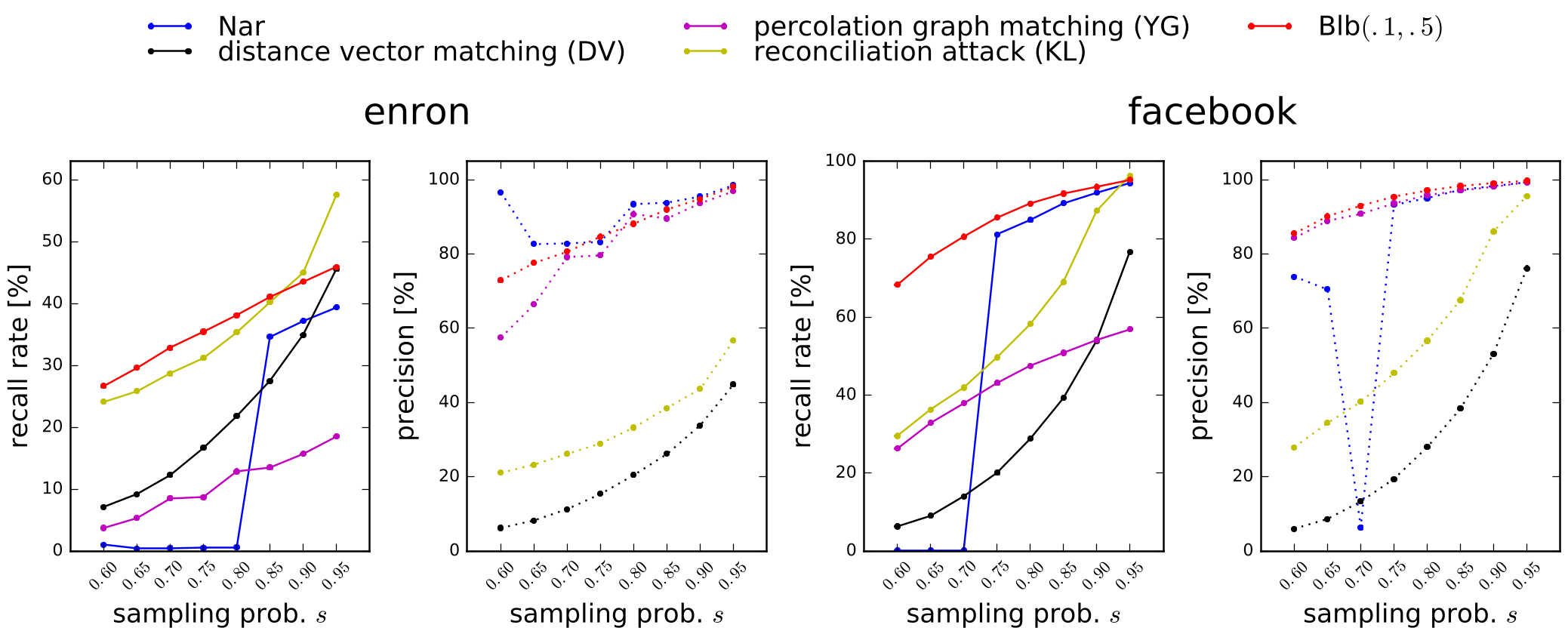 Figure 2: Performance comparison of Bumblebee vs. percolation graph matching (YG) and distance vector matching (DV).
Deep Insight: Is Anonymity Dead?
The paper effectively proves that the "mathematical intuition" behind similarity is more important than raw computational power. By simply refining the way we calculate node similarity (moving from cosine-variations to a degree-ratio balance), the "robustness" of anonymized graphs evaporates.
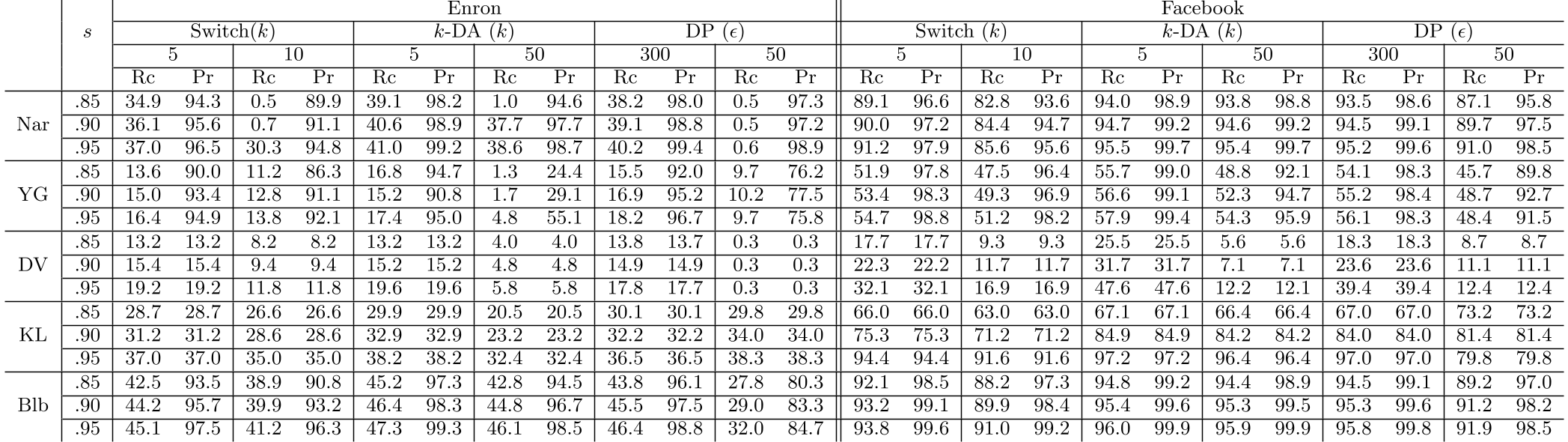
One of the most striking results is shown in the Table below, where Bumblebee maintains high precision even against advanced protection schemes like Differential Privacy (DP) and k-degree anonymization.
Conclusion & Takeaways
Bumblebee represents a significant leap in the "arms race" of data privacy.
- For Researchers: It highlights that similarity metrics need to be degree-invariant to be truly robust.
- For Data Providers: Standard graph anonymization (removing labels) is virtually useless against a determined attacker with even a tiny amount of background knowledge.
- Limitation: The attack still relies on structural similarity. If the networks are fundamentally different in their connection logic, structural attacks will still face hurdles.
The authors have released their framework, SALab, as an open-source tool to help the community further investigate these vulnerabilities.