
Efficient Search Ranking in Social Networks: Navigating the 40-Million-Node Friendship Graph
Efficient search ranking in social networks
The paper introduces an efficient search ranking system for social networks like Orkut (40M+ users), utilizing a "Seeds-based Ranking" method. It leverages graph distances as a primary relevance signal, significantly outperforming traditional text-based or naive graph search methods in both speed and precision.
TL;DR
In a massive social network like Orkut, text search is nearly useless because everyone is searching for common names. This paper solves the problem by using Seeds-based Ranking, a method that approximates the social distance between users using landmark nodes. It achieves high precision (90%+) with a 400x speedup over traditional graph traversal, making real-time social search feasible at scale.
Problem & Motivation: The Identity Crisis in Social Search
When a user searches for "Maria" on a platform with 40 million users, the result set isn't just large—it's anonymous. Text-only matching yields thousands of results with no intuitive order.
The authors' core insight is that social proximity equals relevance. If John is searching for "Maria," he is likely looking for the Maria who is his direct friend, or a friend-of-a-friend. However, computing the shortest path in a graph with 1.2 billion edges at query time is an algorithmic nightmare. Standard methods like Breadth-First Search (BFS) are too slow for an interactive web service, and pre-computing all pairs of distances would require petabytes of storage.
Methodology: The Power of Seeds
To bridge the gap between "perfectly accurate but slow" and "fast but irrelevant," the authors introduced a system of navigational beacons called Seeds.
1. The Seeds-based Approach
Instead of calculating distances between every pair of users, the system pre-computes distances from every user to a set of pre-selected random "seed" nodes.
- Offline Phase: Use a Map-Reduce process to propagate distances from seeds across the network.
- Sparse Vectors: Since user distances greater than 4 are rarely relevant in social search, they cap seed distances at 2. This creates highly sparse vectors that dramatically reduce memory consumption.
2. The Ranking Formula
The ranking function uses the sum of distances to common seeds to estimate the distance between the searcher () and the result ():
This formula gives exponentially higher weights () to users who share very close seed neighbors.
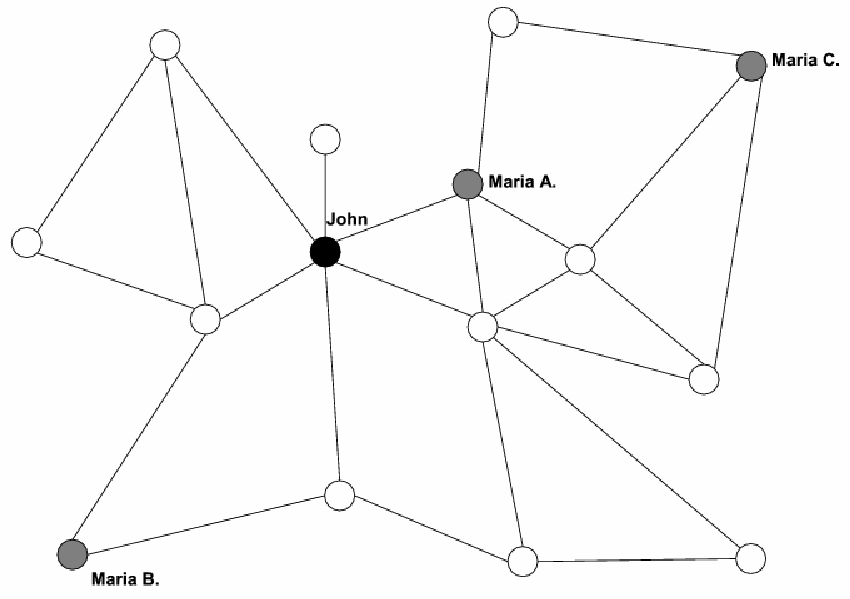 Figure 1: Illustration of a friendship graph where 'Maria A' is closer to 'John' than 'Maria C'. Seeds-based vectors capture this structural proximity.
Experiments & Results: Speed vs. Precision
The authors tested their system on a cluster of 128 machines using real Orkut data. They compared their method against On-the-fly Ranking (BFS) and Co-friends Ranking (intersection of friend-of-friend lists).
Key Findings:
- Latency: Seeds-based Ranking took only 4.89ms per query (with 2M seeds), compared to 2,018ms for BFS.
- Precision: Using "Compare-Rankings Precision" (crP), the method achieved over 90% accuracy compared to the "perfect" BFS results.
- Speedup: The system demonstrated a massive 413x speedup over the baseline on-the-fly search.
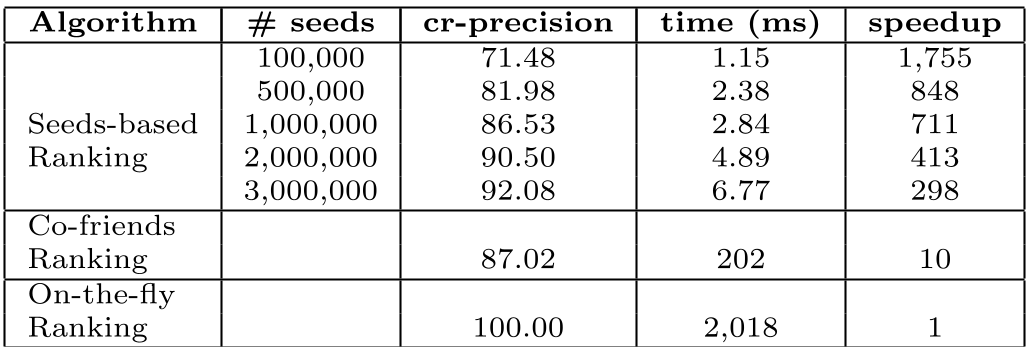 Table 1: The trade-off between the number of seeds, precision, and query execution time.
Critical Analysis & Conclusion
Takeaway
The paper proves that a small percentage of "seed" nodes (0.25% to 5% of the total population) is sufficient to categorize the structural connectivity of a massive sparse graph for search purposes.
Limitations
- Seed Selection: The nodes were selected randomly. Targeted selection (e.g., picking high-degree hubs) might improve precision even further with fewer seeds.
- Graph Dynamics: The paper doesn't deeply explore how to handle real-time edge updates (new friendships) without re-running the full Map-Reduce cycle.
Future Outlook
This work laid the foundation for modern personalized search. By moving from simple text-matching to structural graph-signal matching, social platforms can transform a "random" experience into one that feels deeply personal and relevant.