
ESkNNC: Redefining Efficiency in Secure kNN Classification via Vector Homomorphic Encryption
Efficient and Secure kNN Classification over Encrypted Data Using Vector Homomorphic Encryption
The paper proposes ESkNNC, an efficient and secure k-Nearest Neighbor (kNN) classification protocol over encrypted cloud data using Vector Homomorphic Encryption (VHE). By leveraging record-wise encryption and linear transformations, it achieves high classification accuracy (98%) comparable to plaintext methods while significantly reducing computational and communication overhead.
TL;DR
ESkNNC is a high-performance protocol for outsourcing kNN classification to the cloud without compromising data privacy or algorithm secrecy. By utilizing Vector Homomorphic Encryption (VHE) instead of traditional attribute-wise encryption, it achieves 98% accuracy while slashing communication costs by 90% and accelerating computation by nearly 100x compared to previous state-of-the-art secure classifiers.
Background & Motivation: The Multi-Attribute Bottleneck
In the era of big data, outsourcing analytics to public clouds is a necessity for many enterprises. However, privacy remains the "Achilles' heel" of this model. While Homomorphic Encryption (HE) allows processing encrypted data, traditional methods like the Paillier cryptosystem require each attribute of a data record (e.g., age, income, health status) to be encrypted individually.
Imagine a database with thousands of records, each having 50 attributes. Attribute-wise encryption creates a massive expansion in ciphertext size and computational operations. Furthermore, most existing protocols reveal the "access pattern"—the cloud can tell which specific records were queried even if it can't see the content. The authors of ESkNNC identified that to make secure kNN viable, we must treat data records as atomic vectors rather than collections of isolated scalars.
Methodology: The Power of Linear Transformation
The core innovation of ESkNNC lies in its use of Vector Homomorphic Encryption (VHE). Unlike Full Homomorphic Encryption (FHE), which is often too slow for practical use, VHE is optimized for linear transformations—the exact operations needed for similarity measures like inner products and Euclidean distances.
1. Unified Record Encryption
Instead of encryptions for attributes, ESkNNC encrypts a record as a single ciphertext vector. This "record-wise" approach significantly reduces the data expansion factor.
2. Inner Product via Key Switching
To calculate the similarity between a query and a training record , the user provides the cloud with a Key-Switching Matrix (M). This matrix represents the classification function (where ). This allows the cloud to transform the encrypted record into an encrypted similarity score without ever knowing , , or the resulting score.
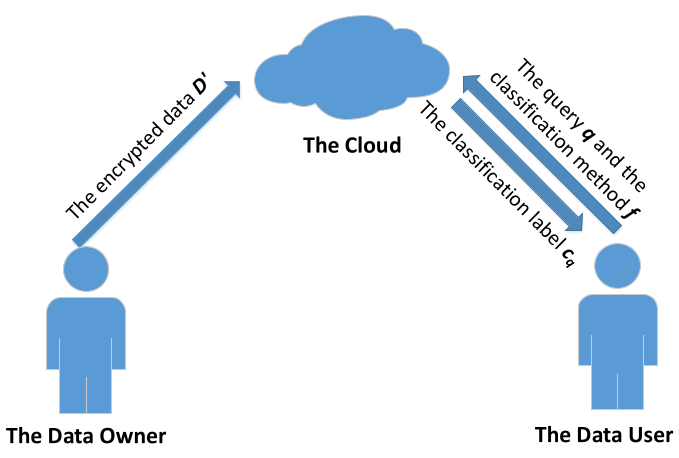 Figure 1: The ESkNNC System Model involving Data Owner, Cloud, and Data User.
3. Batch Computation
The authors propose a batching method where multiple query records are packed into a single transformation matrix . This allows the user to send one matrix to handle queries, keeping communication overhead constant regardless of the number of queries.
Performance & Results: Accuracy Meets Speed
The researchers tested ESkNNC on real-world datasets from the UCI repository. The experiments focused on two primary metrics: Accuracy Preservation and System Latency.
- Accuracy: One of the primary risks of HE is noise and rounding errors from converting floating-point numbers to integers. ESkNNC shows that with a precision of just 2 decimal digits, the classifier achieves a 98% accuracy rate, perfectly matching the performance of a plaintext kNN classifier.
- Computation Speed: Compared to the landmark work by Samanthula et al. [11], ESkNNC is significantly faster. For a batch of 100 queries, ESkNNC completes the score calculation in 109ms, whereas previous methods required over 10,000ms.
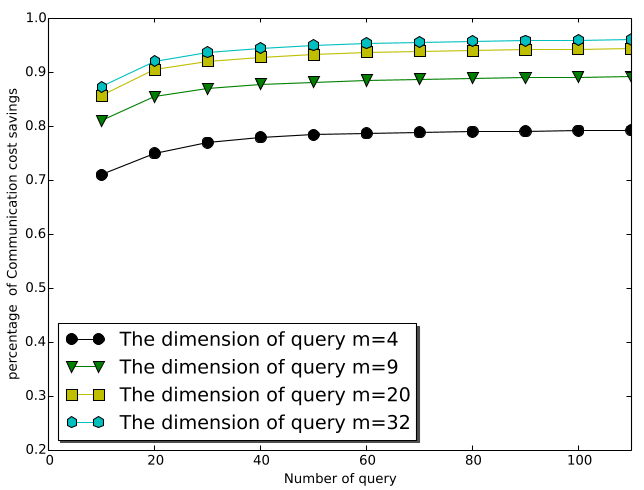 Figure 2: Communication overhead for transmitting the key-switching matrix remains constant in ESkNNC despite increasing query volume.
Critical Insight: Function Secrecy
Beyond speed and privacy, ESkNNC addresses Function Secrecy. In many industrial applications, the classification criteria (the weights or the query vector) are proprietary trade secrets. Because the cloud only receives a key-switching matrix , it is mathematically impossible (based on the hardness of the Ring Learning With Errors (RLWE) problem) for the cloud to reverse-engineer the query vector or the new secret key . This makes ESkNNC suitable for "Algorithm-as-a-Service" models.
Conclusion & Future Outlook
ESkNNC proves that vector-based encryption is the superior path for secure data mining. By treating data as multidimensional entities and utilizing optimized linear transformations, the protocol bridges the gap between theoretical security and industrial practicality.
The authors suggest that the future of this work lies in extending these vector-wise operations to even more complex architectures, such as Support Vector Machines (SVMs) and Artificial Neural Networks (ANNs), potentially allowing for fully private deep learning inference in the cloud.