
Efficient Individual Revocation: Strengthening Security in Mobile Social Networks
An Efficient and Secure User Revocation Scheme in Mobile Social Networks
The paper introduces an efficient and secure user revocation scheme tailored for Mobile Social Networks (MSNs) using Ciphertext-Policy Attribute-Based Encryption (CP-ABE). It enables a Trusted Authority (TA) to revoke individual malicious users' decryption capabilities without affecting non-revoked users, outperforming the YRL [1] baseline in communication overhead and update speed.
TL;DR
Mobile Social Networks (MSNs) thrive on attribute-based sharing, but "inside attacks" by legitimate users remain a major threat. This paper proposes a lightweight revocation scheme that allows a Trusted Authority to "switch off" a single user's decryption power without re-keying the entire network. By leveraging a binary tree-based update mechanism, it slashes communication costs by over 90% in common scenarios compared to previous SOTA.
The Challenge: Why Revocation is Hard in MSN
In an MSN, users connect based on shared interests (attributes) rather than fixed identities. While Attribute-Based Encryption (ABE) is the perfect fit for this paradigm, it creates a massive headache for security:
- Identity vs. Attribute: How do you revoke one specific malicious "Student" without revoking every other "Student" in the network?
- Intermittent Connectivity: Mobile users aren't always online. They can't depend on a constant connection to a central server for key updates.
- The Collusion Threat: Revoked users shouldn't be able to pool their "old" keys or collaborate with non-revoked users to bypass security.
Methodology: The Binary Tree + CP-ABE Rationale
The core innovation lies in the marriage of Waters’ CP-ABE [12] and a Binary Tree structure used for entity management.
1. The Tree Structure
Instead of just issuing keys based on attributes, the Trusted Authority (TA) assigns every user a unique leaf node in a binary tree.
- Path Nodes: Each user maintains secret parameters related to the path from their leaf to the root.
- Update Info: At every time slot , the TA broadcasts update information for certain nodes in the tree.
2. The Decryption Logic
To decrypt a message, a user must satisfy three conditions:
- Possession of the correct attributes (standard ABE).
- Being a "non-revoked" member (verified via the tree path).
- Having the current time slot's update information.
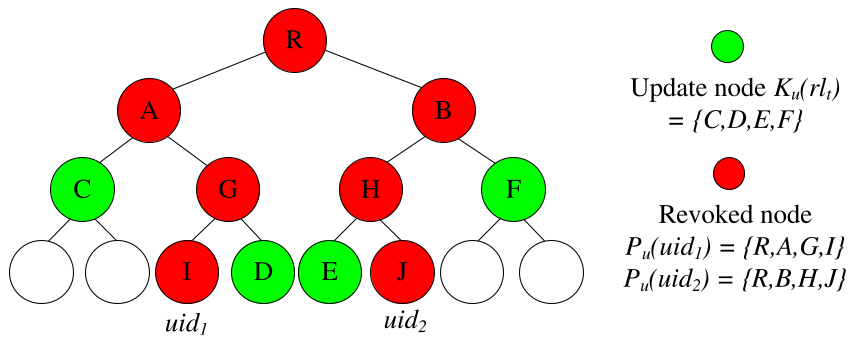 Fig 1: The Binary Tree . If users at and are revoked, the TA broadcasts updates for the green nodes, which cover all remaining valid users.
Security Analysis: Resisting Collusion
The authors prove that their scheme is resilient against:
- Attribute Collusion: Users cannot combine different sets of attributes to decrypt a message they aren't authorized for, because each user's key is tied to a unique, random exponent .
- Revoke Collusion: A revoked user cannot use their old keying material in combination with a new broadcast update because the mathematical "pairing" won't align—the time-slot parameter ensures that once you are out of the "green node" set, your keys become mathematically inert for that slot.
Performance: Efficiency Gains
The efficiency of this approach is most visible when the number of revoked users is small.
| Metric | WAT [12] (Basic CP-ABE) | Proposed Scheme |
|---|---|---|
| Secret Key Size | $( | A_i |
| Revocation | Disabled | Enabled |
While the secret key is slightly larger (logarithmic growth with the number of users ), the revocation overhead is significantly lower than the previous YRL scheme.
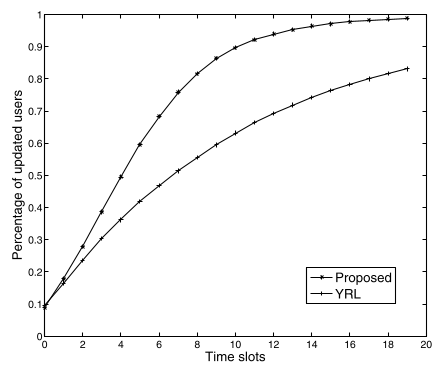 Fig 2: As shown, for a small number of revoked users, the proposed scheme (bottom line) requires significantly less update data compared to YRL.
Depth Insight & Conclusion
Most ABE schemes fall into the trap of being "all or nothing"—revoking an attribute revokes everyone holding it. This paper successfully decouples logical access (attributes) from participation rights (the tree-based revocation).
Takeaway: For real-world deployment of secure mobile social platforms, the ability to "snip" individual malicious nodes without taxing the network bandwidth is the "missing link." The next step for this research is incentivizing users to share these update packets via peer-to-peer (D2D) communication, further reducing the load on infrastructure.